
Document and Automate Repetitive Procedures the Right Way

Document the procedure first, then automate only the deterministic steps. Everything else about this topic is commentary on that one rule.
Here’s the fast plan: run a quick audit of the process as it’s actually performed today, write it down with a named owner and clear acceptance criteria for each step, then pilot automation on whatever steps pass a simple readiness test. Do this in order and you avoid the most common failure in operations work: automating a process nobody actually understands yet.
- Audit the process as it’s really done (not as the org chart says it’s done).
- Document each step with an owner, inputs, outputs, and a pass/fail condition.
- Pilot automation on the steps that are deterministic and repeatable, leaving judgment calls to a human.
What you should expect from doing this properly:
- Fewer follow-up emails and status-check messages between teams
- A measurable drop in rework caused by missed or skipped steps
- A documented process that survives someone leaving or changing roles
Key Takeaways
Documenting a procedure before automating it prevents the two most expensive failures in operations work: automating the wrong step and automating a step nobody fully understood.
| Point | Details |
|---|---|
| Document before you automate | Capture the process as it’s actually performed, with owner and acceptance criteria per step. |
| Use the three-question filter | Automate steps with a deterministic trigger, known inputs/outputs, and no judgment required. |
| Match the tool to the task | Use rules-based platforms for clean APIs, RPA for legacy UIs, OCR for extraction, AI agents for judgment-adjacent work. |
| Pilot with real metrics | Track time per transaction, error rate, cycle time, and percent automated before scaling up. |
| EasyFlow executes the handoffs | It runs documented processes directly, using magic links so external collaborators can act without an account. |
Table of Contents
- How to Document and Automate Repetitive Procedures
- How Do You Map a Process Before Automating It?
- What Should Go Into a Standard Operating Procedure?
- Which Steps Are Actually Ready to Automate?
- Rules-Based Workflows, RPA, OCR, or AI Agents: Which Fits?
- How Do You Roll Out a New Automation Safely?
- Who Owns a Procedure After It’s Automated?
- What Can Go Wrong When You Automate a Process?
- Ready-to-Use Templates for Common Procedures
- How EasyFlow Fits Into This Process
- What Operations Teams Get Wrong About Automation
- Get Started With EasyFlow
- Sources
- FAQ
How to Document and Automate Repetitive Procedures
The tasks worth automating share three traits: they happen often, they follow the same logic every time, and getting them wrong costs real money or time. Here are the categories that show up again and again as strong candidates.
- OCR and data extraction. Pulling structured data out of scanned invoices, contracts, or forms. This is a classic candidate because the input format is predictable even when the content varies.
- Invoice processing. Matching purchase orders to invoices to receipts, then routing for approval. Accounts payable teams have some of the best-documented benchmarks for measuring this kind of automation impact, including cycle time and error rate.
- Approvals and routing. Sending a document to the right person based on amount, department, or type, and escalating if nobody responds in time.
- File naming and tagging. Enforcing consistent naming conventions so documents are searchable instead of buried in a shared drive under six slightly different filenames.
- Version control. Making sure the person editing a contract is working from the latest draft, not a copy from three weeks ago.
- Syncing between systems. Keeping a CRM, an accounting platform, and a project tool in agreement instead of relying on someone to manually re-enter the same data three times.
Each of these tends to show the same pattern: a five-minute task, repeated fifty times a week, quietly eating a full workday somewhere in the org.
Pro Tip: Don’t start with the task that annoys people the most. Start with the task that happens most often and has a measurable error cost. Annoyance is a feeling; frequency and error cost are numbers you can put in a business case.
How Do You Map a Process Before Automating It?
You can’t document what you haven’t watched. Writing a procedure from memory is the single most common way SOPs end up wrong, because people forget the exceptions and shortcuts they’ve absorbed over time. Recording actual work, whether through direct observation or a tool like Loom, surfaces the judgment calls that get left out when someone just types up what they think they do.
A workable discovery method looks like this:
- Shadow the person doing the work, or record their screen for a real instance of the task, not a demo version.
- Turn the recording into a rough transcript, then convert that transcript into a numbered draft of steps.
- Interview the doer with a standard set of questions: What do you check before starting? What makes you stop and ask someone else? What’s the most common mistake you catch?
- Map the process visually using a flowchart or a swimlane diagram that shows who touches the work at each stage. Visual formats matter here because most people process a flowchart faster than a paragraph of instructions.
The output of this stage should include a step-by-step draft, a list of decision points with explicit acceptance criteria attached to each one, and a simple data contract for any step you plan to automate later (what goes in, what comes out, in what format).
- Swimlane diagrams for cross-team handoffs
- Simple flowcharts for single-owner processes
- A one-page data contract template per automation candidate
Pro Tip: Test your draft SOP on someone who didn’t write it and wasn’t shadowed. If they get stuck, that’s not their failure. That’s a gap in the document, and it’s exactly the kind of gap that breaks an automation once it’s live.
Consider running a simple workflow bottleneck checklist during this phase. It forces you to trace every handoff instead of just the steps one person handles.
What Should Go Into a Standard Operating Procedure?
An SOP that’s ready for automation needs more than a numbered list. It needs enough structure that someone unfamiliar with the task, or a piece of software, can follow it without guessing.
Build every procedure around nine elements:
- Purpose. Why the procedure exists and what it prevents from going wrong.
- Audience. Who this is written for.
- Overview. A two-sentence summary of the whole process.
- Step-by-step actions. One action per step, no bundling three tasks into one bullet.
- Checklists. A quick pass/fail list for anyone verifying the work got done correctly.
- Exceptions. What happens when the standard path doesn’t apply.
- Escalation path. Who gets notified, and when, if a step stalls or fails.
- Metadata. Owner, version number, and review date.
- Reference artifacts. Screenshots, templates, or linked files the step depends on.
Every step should start with a verb, list its inputs and outputs, name who owns it, and define exactly what “done” looks like. “Review the invoice” is not a step. “Confirm the invoice total matches the purchase order within $0.01, flag anything larger for the AP lead” is a step.
Tag each step with an automation callout wherever it applies: note the result of the three-question filter and which category of tool fits (workflow platform, OCR service, human review). A compliant document control approach also covers identification, revision history, and retention, which matters if the process ever faces an audit. Keep the review cadence attached to the metadata field: quarterly for high-change processes, annually for stable ones, and immediately whenever the underlying system changes.
Which Steps Are Actually Ready to Automate?
Not every repetitive task should be automated, and the fastest way to waste a quarter is to try. Run each documented step through three questions before you touch a workflow tool.
- Is there a deterministic trigger? Does something specific and detectable start this step (an email arrives, a form gets submitted, a date passes)?
- Are the inputs and outputs known? Can you name the exact format coming in and the exact format expected out?
- Is judgment required? Does a person need to weigh context, negotiate, or make an exception call?
A step that passes the first two and fails the third is a candidate for a rules-based workflow. A step that fails any of the three needs a human in the loop, at least for now. This three-question filter turns a documented step into a clear automation verdict instead of a guess.
Once you know which steps pass, prioritize using frequency, volume, and error cost together.
| Filter Result | Frequency/Volume | Recommended Next Step |
|---|---|---|
| Passes all three | High | Pilot immediately with a workflow tool |
| Passes deterministic + I/O, fails judgment | High | Automate the routing, keep a human approval gate |
| Fails deterministic trigger | Any | Fix the upstream process first, don’t automate a mess |
| Passes all three | Low | Document it, automate later once volume justifies the build |
Rules-Based Workflows, RPA, OCR, or AI Agents: Which Fits?
Picking the wrong tool category is one of the fastest ways to burn a pilot. Each pattern solves a different problem, and matching them correctly matters more than picking the “best” tool on the market.
Rules-based workflow platforms (Zapier, Make, n8n) handle triggers and conditional logic well when the process has clean APIs to connect to. They’re the right first stop for approvals, notifications, and syncing data between systems, since deterministic logic is exactly what they’re built for.
RPA (robotic process automation) earns its keep when you’re stuck automating a legacy system with no API, one where the only option is clicking through a user interface the way a person would. It’s brittle by nature, since any UI change can break it, but sometimes it’s the only bridge available.
OCR services (Google Vision API, ABBYY) extract structured data from scanned documents, invoices, and forms. They’re a component, not a full solution. Pair OCR with a workflow tool or an approval step for anything with financial or legal consequences.
AI-managed agents (including tools like Claude for agentic tasks) fit the gray zone: steps that need some judgment but follow a general pattern, like drafting a response for human approval or flagging an anomaly for review rather than resolving it outright.
| Use Case | Best-Fit Pattern |
|---|---|
| Sync data between two SaaS tools | Rules-based workflow platform |
| Legacy system with no API | RPA |
| Extract fields from scanned invoices | OCR service |
| Draft a response requiring context | AI-managed agent |
Before connecting anything, confirm credential scoping, who can access what data, where that data is stored, and whether the tool logs an audit trail. Skipping this step is how a scrappy pilot turns into a compliance headache.
How Do You Roll Out a New Automation Safely?
A pilot succeeds or fails on how it’s scoped, not on how clever the automation is. Start narrow.
- Scope the pilot. Pick one documented process, one team, and a two to four week window.
- Set success metrics before you build anything: time per transaction, error rate, cycle time, and percentage of the workflow actually automated versus still manual.
- Build the automation against the documented steps, not against assumptions about what the steps probably are.
- Run QA and user acceptance testing, including deliberately broken inputs: a malformed file, a missing field, a duplicate submission.
- Roll out in phases, starting with the team that helped build the pilot before expanding company-wide.
| Pilot Metric | What to Track |
|---|---|
| Time per transaction | Minutes before vs. after automation |
| Error rate | Percentage of runs needing manual correction |
| Cycle time | Total time from trigger to completion |
| Percent automated | Share of the workflow no longer touched by hand |
Test edge cases in a staging environment before anything touches production data. Write a rollback plan in plain language: if the automation misfires, who gets notified, what manual process takes over immediately, and how fast can you revert. A clear efficiency dashboard makes this phase far less guessy, since you’re watching the same numbers before and after the change.
Change management matters here as much as the build. Tell the affected team what’s changing and why before launch, not after. Walk new users through the automation with a short training checklist, and keep someone available for quick support during the first week. Most rollout complaints aren’t about the automation itself. They’re about people feeling blindsided by it.
Who Owns a Procedure After It’s Automated?
An automation with no owner degrades quietly. Someone changes a field name in the source system, the automation keeps running, and three weeks later someone notices the numbers are wrong.
Assign two owners for every automated process: a document owner responsible for keeping the SOP accurate, and an automation owner responsible for the tool itself. They can be the same person on a small team, but the responsibilities need to be named separately.
| Role | Responsibility |
|---|---|
| Document owner | Keeps the SOP current, runs scheduled reviews |
| Automation owner | Monitors the tool, handles failures and updates |
| Escalation contact | Handles exceptions the automation can’t resolve |
Set a review cadence and stick to it. A living document with an assigned owner stays accurate; one nobody’s responsible for goes stale within a quarter. Trigger an ad-hoc review any time the underlying system changes, not just on the calendar schedule. Watch error logs and failure alerts closely enough that a spike gets caught the same day, not the same month.
What Can Go Wrong When You Automate a Process?
Automation fails in predictable ways, and most of them trace back to skipping the documentation step.
- Brittle UI-based automations break the moment a vendor changes a button placement or a login flow.
- Ambiguous OCR results get accepted at face value instead of flagged for review, leading to bad data entering downstream systems.
- Missing escalation paths mean a stalled step just… sits there, with nobody notified.
- Stale SOPs describe a process that no longer matches reality, so the automation built from it is already wrong on day one.
Build in exception handling from the start, write error messages a human can actually understand, and have a rollback step ready before you need it.
Some tasks should never run without a person checking the output: anything touching legal or regulatory compliance, any OCR result below a confidence threshold, and any situation involving negotiation or a judgment call with a customer.
Pro Tip: Write your escalation template before launch, not during the first incident. “If X fails, notify Y within Z minutes, and here’s the manual fallback” takes five minutes to draft and saves hours of confusion later.

Ready-to-Use Templates for Common Procedures
A few patterns come up often enough to sketch out directly.
Invoice processing: invoice arrives by email → OCR extracts vendor, amount, and line items → system matches against the purchase order → matches route for auto-approval, mismatches escalate to the AP lead.
Approvals routing: request submitted → amount checked against threshold → under threshold routes to auto-approval, over threshold routes to the department head → no response in 48 hours escalates to the next manager.
Document template generation: intake form submitted → data populates a pre-built template → draft routes for one review pass → approved version saves to the shared system with the right file name automatically applied.
- Adapt each snippet’s trigger to whatever tool actually receives the input in your stack.
- Prefer an API connection over UI automation whenever the source system offers one. It’s more stable long term.
- Test each snippet with at least one deliberately bad input before calling the pilot done.
A reusable workflow template makes it far easier to hand a working pilot to a second team without rebuilding it from scratch.
How EasyFlow Fits Into This Process
Once a procedure is documented and scored against the three-question filter, the execution layer needs to match what you actually mapped, not force you to redesign the process around the tool.
- Automation execution, not just tracking. EasyFlow runs the handoffs between steps instead of just logging that they happened, which matters once you’ve documented who owns what.
- Magic links for external collaborators. Anyone outside your team, a client, a vendor, a new hire, can complete their step without creating an account, which removes a real source of pilot delay.
- Pre-built templates and visual diagrams. Gantt and timeline views mirror the swimlane maps from your discovery phase instead of requiring a second translation step.
- Automatic notifications and blocker detection. This covers the escalation path you wrote into the SOP without anyone manually checking on stalled steps.
A two-week pilot recipe: pick one documented, automation-ready process, set your three or four success metrics up front, build it in EasyFlow using your existing SOP as the spec, and run it with the same edge-case tests you’d use for any other tool. Start with the EasyFlow trial once your SOP is written and scored.
What Operations Teams Get Wrong About Automation
The conventional advice treats documentation as a compliance chore you finish before the “real work” of automating begins. That’s backward. The documentation is the real work. The automation is just execution of a spec you already wrote.
What’s overrated is tool selection. Operations managers spend weeks comparing platforms when the actual failure point is almost always upstream: a process that was never accurately mapped, so whatever tool gets picked automates the wrong version of reality. A mediocre tool applied to a well-documented process beats a sophisticated one applied to a guess.
What the reader should prioritize first is uncomfortable but simple: watch the work happen before writing a single step down. Every SOP written from memory has gaps, and those gaps become the automation’s failure points six weeks after launch. The three-question filter is useful, but it only produces good verdicts when the documentation feeding it is honest about what actually happens, exceptions included.
Get Started With EasyFlow
EasyFlow is built for the exact moment this article ends: you’ve documented the process, scored it against the automation filter, and now you need something that actually runs the handoffs instead of just tracking whether they happened. Traditional project trackers like Asana or Trello log tasks; EasyFlow executes them, moving work between people automatically and flagging blockers before they turn into a backlog of follow-up messages.
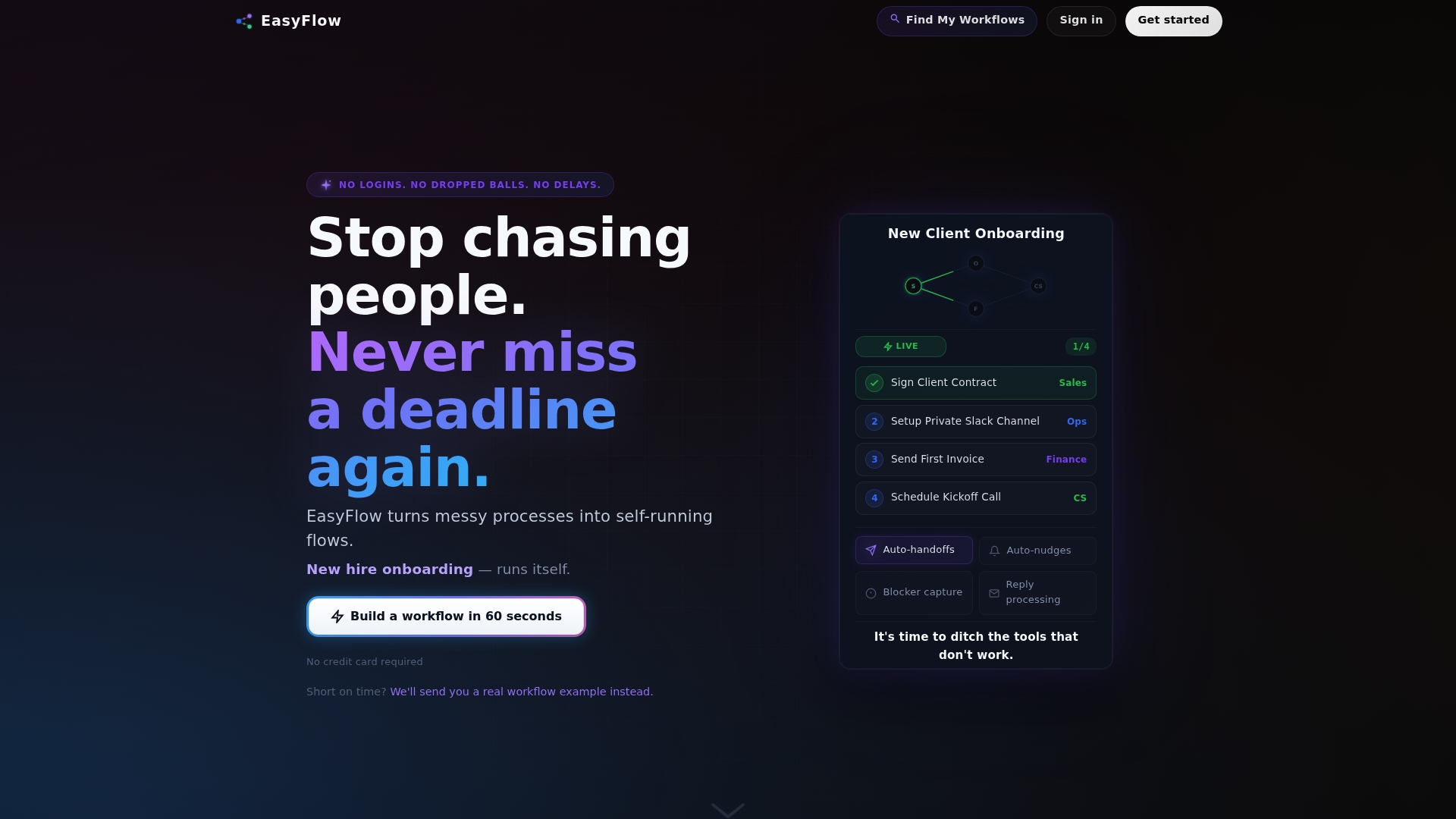
The detail that matters most for operations teams working with external collaborators: nobody outside your organization needs to create an account. A client, vendor, or new hire gets a magic link, completes their step, and the process moves forward on its own. Combined with pre-built templates and visual workflow diagrams that mirror the swimlane maps from your discovery phase, EasyFlow turns your documented SOP into a running process without a second build phase.
If you’ve already mapped a candidate process using the steps above, start a free trial and pilot it with your own SOP as the spec.
Sources
- The ultimate guide to process documentation | Atlassian
- Process documentation
- charlesdove977/procedure-ops
- Apqc
- Pmc
FAQ
How Do I Automate Repetitive Tasks?
Document the task step by step first, run it through the three-question filter (deterministic trigger, known inputs and outputs, no judgment required), then pilot automation only on the steps that pass.
What Does It Mean to Automate a Repetitive Task?
It means replacing a manual, rule-following action, like data entry, approval routing, or file naming, with software that executes the same steps without a person doing them each time, while keeping a human in the loop for anything requiring judgment.
How Do You Automate Process Documentation?
You can’t fully automate the discovery phase, since it requires watching real work and interviewing the people who do it, but tools like screen recorders and AI transcription can turn a recorded session into a rough step-by-step draft much faster than writing one from scratch. Platforms like EasyFlow can then generate a workflow from that draft rather than requiring a manual rebuild.

What Are Examples of Repetitive Tasks Worth Automating?
Invoice matching, document approval routing, file naming and tagging, data syncing between systems, and OCR-based data extraction from scanned forms are among the most common, high-impact candidates.