
Common Client Onboarding Mistakes to Fix in 2026

Client onboarding mistakes are process failures, communication gaps, and technology shortfalls that cause clients to lose confidence and disengage before they see real value. These errors in client onboarding are far more common than most teams realize, and the cost shows up fast in churn rates, stalled projects, and damaged trust. Structured onboarding produces 82% higher retention and 70% faster time-to-productivity. That gap between structured and unstructured onboarding is where most client relationships are won or lost.
1. What are the most damaging client onboarding mistakes?
The most damaging onboarding process pitfalls share one trait: they all erode client confidence before the relationship has a chance to build. Knowing which mistakes cause the most harm lets you fix them before they cost you clients.
Ignoring buyer’s remorse after contract signing
Buyer’s remorse is real and it hits fast. Delayed verification after signing causes client drop-off before the work even begins. The fix is simple: send a welcome message, a clear timeline, and a named point of contact within 24 hours of contract signing. That one action resets the client’s emotional state from anxious to confident.
Leaving expectations vague
Vague expectations erode client trust faster than almost any other mistake. Clients need to know exactly what you will deliver, when you will deliver it, and what you need from them. A one-page scope summary shared at kickoff eliminates most of the confusion that generates unnecessary follow-up emails.

No standardized onboarding process
Inconsistent onboarding damages professional reputation and creates wildly different client experiences depending on who handles the account. When each team member runs onboarding their own way, quality becomes unpredictable. A documented onboarding checklist fixes this immediately by giving every team member the same starting point.
Slow account setup and access sharing
Clients who wait days for platform access or login credentials start questioning your competence. Speed of access is one of the clearest signals of operational readiness. Collecting all required credentials and permissions before the kickoff call, not during it, removes one of the most common friction points in the entire process.
Manual document chasing and fragmented systems
Manual document chasing creates friction and compliance gaps that frustrate clients and expose your firm to regulatory risk. Sending documents via email, tracking responses in spreadsheets, and following up manually is a process that breaks under volume. Firms that rely on scattered systems lose clients to competitors running faster, automated workflows.
Disconnected communication
When clients receive updates from three different people using three different channels, anxiety replaces confidence. A single communication protocol, one channel, one contact, one update cadence, prevents the confusion that makes clients feel like they are not a priority.
Rushing the human relationship
Speed matters, but skipping the relationship-building steps is a mistake that shows up later as low engagement and high churn. A 15-minute welcome call where you ask about the client’s goals is not a luxury. It is the foundation of every successful long-term account.
Failing to align metrics with client goals
Onboarding that focuses only on your internal process steps misses the client’s actual definition of success. Ask clients what a successful first 90 days looks like to them. Then build your onboarding milestones around their answer, not your standard template.
Pro Tip: Send a one-page “What to expect in your first 30 days” document immediately after contract signing. It answers the questions clients are too polite to ask and reduces inbound check-in emails by a significant margin.
2. How structured onboarding prevents these errors
A standardized onboarding workflow is the single most effective defense against recurring client onboarding errors. Structure removes the dependency on individual memory and replaces it with a repeatable, auditable process.
Automation handles the tasks that humans forget or deprioritize under pressure. Automated reminders for document submission, access requests, and milestone sign-offs keep the process moving without requiring a team member to manually chase each step. This is where onboarding automation moves from a nice-to-have to a core operational requirement.
Role clarity is equally critical. Every onboarding workflow should assign a named owner to each task. When no one owns a step, no one completes it. Defining who is responsible for what, and by when, eliminates the ambiguity that causes delays.
Compliance risk drops significantly when onboarding follows a documented process with an audit trail. Scattered systems create compliance gaps that surface during audits and result in penalties. A centralized workflow with timestamped task completion gives you the documentation you need before a regulator asks for it.
| Onboarding element | Without structure | With structure |
|---|---|---|
| Document collection | Manual email chains, missed items | Automated requests with tracked completion |
| Role ownership | Unclear, task-dependent on memory | Named owner per step, visible to all |
| Compliance documentation | Scattered, hard to retrieve | Centralized audit trail, timestamped |
| Client communication | Ad hoc, inconsistent | Scheduled, templated, consistent |
Pro Tip: Run a 30-minute internal audit of your last five onboarding projects. Note every step that required a manual follow-up. Those are your automation candidates.
3. What technology helps avoid client onboarding errors
The right technology removes the manual work that creates most onboarding process pitfalls. The wrong technology adds complexity without solving the root problem.
Automation platforms that handle document collection, deadline reminders, and access requests cut the time your team spends on administrative follow-up. The best platforms also give clients a clear view of what is complete and what is still needed, which reduces inbound status questions.
Role-based tracking tools let project managers see exactly where each client sits in the onboarding process at any moment. This visibility prevents the common mistake of assuming a step is complete when it is not. When a task stalls, the system flags it rather than waiting for a client to complain.
Branding the onboarding experience with custom communications and client-facing portals improves confidence and engagement. Generic emails with no visual identity signal that the client is just another ticket in a queue. Branded, personalized communications signal that you built this process specifically for them.
Key technology capabilities to prioritize:
- Automated task reminders that trigger without manual input from your team
- Progress dashboards visible to both your team and the client
- Integrated compliance checks built into the workflow, not bolted on afterward
- Magic link access that lets clients complete tasks without creating accounts or remembering passwords
- Audit trail logging that timestamps every completed step for compliance purposes
EasyFlow executes these workflows directly, meaning clients receive task requests via magic links and complete them without needing to log in to any platform. That single feature removes one of the most common friction points in client-facing onboarding.
4. Best practices for a smooth client onboarding experience
The teams with the lowest churn rates share a set of habits that most teams skip because they feel like extras. They are not extras. They are the difference between a client who renews and one who quietly leaves.
Start pre-boarding the moment the contract is signed. Do not wait for the kickoff call to begin collecting information. Send your intake form, access request, and welcome communication within hours of signature. Clients who receive immediate action feel confident they made the right choice.
Collect access before kickoff, not during it. Collecting access early speeds up onboarding and removes the frustration of spending kickoff time on administrative tasks instead of strategy. Your kickoff call should be about goals, not logins.
Communicate on a fixed schedule. Tell clients exactly when they will hear from you and through which channel. Weekly status emails sent every Monday at 9:00 AM are more reassuring than sporadic updates sent whenever something happens.
Avoid information overload in the first week. Sending a 40-page onboarding guide on day one overwhelms clients and guarantees most of it goes unread. Break information into weekly releases tied to specific milestones. Clients absorb information better when it arrives in context.
Collect feedback at key milestones. Early feedback collection catches onboarding issues before they escalate into churn. A three-question check-in at the end of week two takes five minutes and surfaces problems you would not otherwise hear about until the client is already disengaged.
Use branded, personalized communications. Replace generic email templates with communications that reference the client’s name, their specific goals, and their timeline. Personalization at this level takes minutes to set up and significantly improves client engagement.
5. Which metrics reveal onboarding strengths and weaknesses
Measuring your onboarding process is the only way to know whether your improvements are working. Most teams track the wrong things or track nothing at all.
Time-to-access measures the number of days between an onboarding request and the moment the client gains full platform access. This metric reveals how much friction exists in your access and verification steps. A long time-to-access is almost always a sign of manual bottlenecks.
Completion rate without follow-up tracks the percentage of clients who complete all onboarding steps without requiring a manual reminder from your team. A low completion rate signals that your instructions are unclear, your timeline is unrealistic, or your process has too many steps.
| Metric | What it measures | Red flag threshold |
|---|---|---|
| Time-to-access | Days from request to full platform access | More than 3 business days |
| Completion rate | % completing onboarding without manual follow-up | Below 80% |
| 30-day satisfaction score | Client confidence at the end of month one | Below 7 out of 10 |
| Drop-off rate | % of clients who disengage before onboarding ends | Above 10% |
Tracking onboarding as a longitudinal process, not a single event, changes how you improve it. A client who completes all onboarding steps but disengages at day 45 is telling you that your process ends too early. Extend your measurement window to 90 days and you will catch problems that a 30-day view misses entirely. Tools that track onboarding progress automatically make this kind of longitudinal measurement practical for teams of any size.
Key takeaways
The most preventable client onboarding mistakes share a single root cause: the absence of a documented, automated, and consistently executed process.
| Point | Details |
|---|---|
| Address buyer’s remorse immediately | Send a welcome message and timeline within 24 hours of contract signing to prevent early churn. |
| Standardize every onboarding step | A documented checklist removes quality variation and protects your professional reputation. |
| Collect access before kickoff | Gathering credentials early keeps kickoff calls focused on goals, not administrative tasks. |
| Automate follow-up and reminders | Automation eliminates manual chasing and reduces compliance gaps in regulated industries. |
| Measure onboarding longitudinally | Track time-to-access, completion rate, and 30-day satisfaction scores to find and fix friction points. |
Where speed and empathy have to coexist
I have worked with enough client-facing teams to know that onboarding mistakes rarely come from laziness. They come from teams that are moving fast, juggling multiple accounts, and relying on memory instead of systems.
The most common pattern I see is this: a team nails the sales process, signs the client, and then hands off to an onboarding process that was never properly designed. The salesperson knew everything about the client’s goals. The onboarding team knows nothing. That gap is where trust breaks.
The instinct is to fix this with more communication. But more communication without structure just creates more noise. What actually works is building a process where the right information reaches the right person at the right time, automatically. When a client receives a branded task request with a clear deadline and a one-click completion link, they do not feel like they are being processed. They feel like they are being taken care of.
The teams I respect most treat onboarding as a product, not a checklist. They iterate on it, measure it, and improve it the same way a product team improves software. That mindset shift is what separates firms with strong retention from firms that are constantly replacing churned clients with new ones. If you want a practical starting point, the frictionless onboarding workflow framework is worth your time.
— Harsh
How EasyFlow helps teams fix onboarding errors at the source
Client-facing teams that rely on manual follow-up, scattered documents, and ad hoc communication will keep making the same onboarding errors regardless of how much effort they put in. The problem is structural, and the fix has to be structural too.
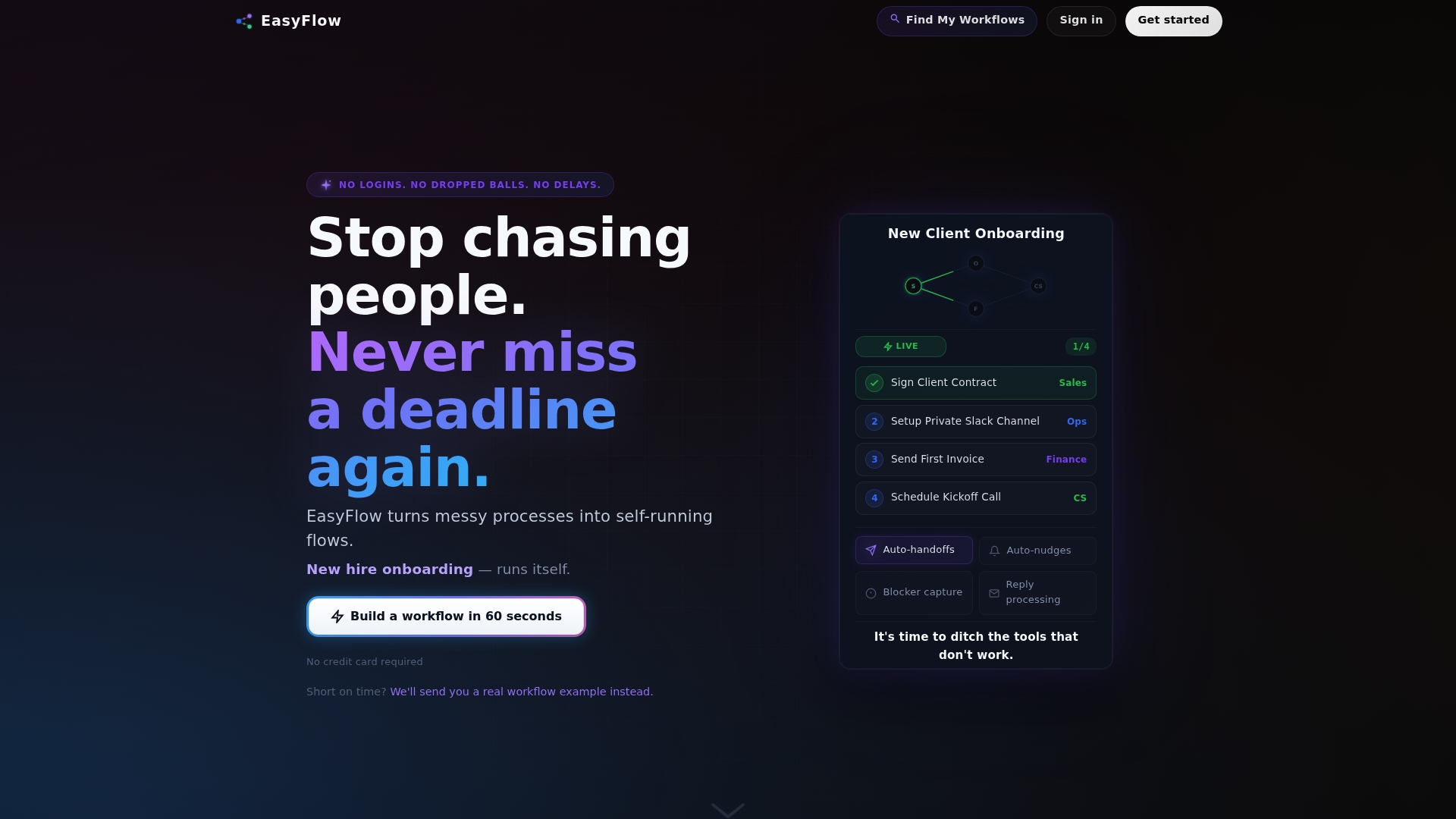
EasyFlow automates the workflows that create the most friction in client onboarding. Clients receive task requests via magic links and complete them without creating accounts or navigating unfamiliar platforms. Your team gets real-time visibility into every step, every completion, and every delay. No manual chasing. No compliance gaps. No missed handoffs. Teams that want to reduce onboarding time without adding headcount use EasyFlow to execute the process, not just track it. Start with EasyFlow and see how automated workflows change the client experience from day one.
FAQ
What are the most common client onboarding mistakes?
The most common mistakes include ignoring buyer’s remorse after signing, leaving expectations vague, using no standardized process, collecting access during kickoff instead of before, and relying on manual document chasing. Each of these errors erodes client trust before the relationship has a chance to develop.
How does a standardized onboarding process improve client retention?
Structured onboarding produces 82% higher retention compared to unstructured approaches. A documented, repeatable process removes quality variation and gives every client the same reliable experience regardless of who manages their account.
When should access collection happen in client onboarding?
Access collection should happen before the kickoff call, not during it. Collecting access early keeps kickoff focused on strategy and goals rather than administrative tasks, which speeds up the entire onboarding timeline.
What metrics should teams track to improve onboarding?
Track time-to-access, completion rate without manual follow-up, and 30-day client satisfaction scores. These three metrics identify where friction exists and whether your process improvements are producing measurable results.
How does automation reduce onboarding errors?
Automation removes the dependency on human memory for task reminders, document requests, and access follow-ups. Manual processes create compliance gaps and slow down verification, while automated workflows execute each step on schedule without requiring manual intervention.