
Client Onboarding Checklist Essentials for Teams

A client onboarding checklist is a structured, step-by-step guide that moves a new client from contract signing to first deliverable, typically within 7–14 days. Teams that skip this structure pay for it in confusion, missed handoffs, and early churn. The good news: the core checklist essentials are well-defined, repeatable, and proven to build client confidence fast. Tools like HoneyBook, DocuSign, and PrimeBase have shaped modern onboarding standards, and this guide pulls the best of those frameworks into one practical resource for teams managing real client relationships.
1. What are the client onboarding checklist essentials?
A client onboarding checklist covers every step from the moment a contract is signed to the moment the client sees their first result. PrimeBase details a 12-step checklist that runs from welcome email through kickoff, compliance collection, account setup, first deliverable, and a Day-30 review. That structure is the gold standard for teams managing ongoing client work.
The checklist serves two purposes at once. It keeps your team organized internally, and it signals professionalism to the client. A client who receives a clear welcome email, a scheduled kickoff, and a shared project board on Day 1 immediately trusts that your team has done this before.

Pro Tip: Build your checklist in a tool that sends automatic reminders. Manual follow-ups on document collection and meeting confirmations are the biggest time drain in the first week.
2. Send a welcome email within 24 hours
The welcome email is the first signal your client receives after signing. Send it within 24 hours of contract execution, and include the name and contact details of their primary point of contact, the next scheduled step, and any intake forms they need to complete.
Generic welcome emails lose clients before the relationship starts. The email should reference the client’s specific goals and confirm the timeline you agreed on. DocuSign users can trigger this automatically the moment a contract is countersigned, which removes the risk of a delayed send.
This step also sets the tone for how your team communicates. Clients who receive a clear, specific welcome email are far less likely to send anxious follow-up messages in the first 48 hours.
3. Schedule the kickoff meeting in days 3–7
Kickoff meetings scheduled within days 3–7 post-contract signing give the client time to complete intake forms while keeping momentum high. The meeting should run no longer than 60 minutes. Send the agenda at least 24 hours before the call.
Timeboxing each agenda section is a tactic most teams skip. Alex Berman recommends sharing questions ahead of time to increase client engagement and prevent the meeting from running long. When clients know what to expect, they show up prepared.
Send a recap email within 24 hours of the kickoff. That recap is not a courtesy note. It is a binding record of decisions made, owners assigned, and deadlines confirmed.
Pro Tip: Label the recap email clearly as “Kickoff Recap and Action Items.” Clients who see a formal subject line treat the contents as official, which reduces scope creep later.
4. Collect intake forms and client information
Intake forms are the fastest way to gather goals, key contacts, brand assets, deadlines, and technical access in one pass. Send the form with the welcome email so clients can complete it before the kickoff meeting. That way, your team arrives at kickoff already briefed.
The form should cover: primary goals and success metrics, key stakeholders and their roles, existing tools and access credentials, preferred communication channels, and hard deadlines. Keep it under 15 fields. Long forms get abandoned.
HoneyBook and similar client management platforms include intake form templates that feed directly into project records. That eliminates manual data entry and reduces the risk of losing information in email threads.
5. Collect legal and compliance documents
Contracts, NDAs, W-9s, and any required compliance forms must be collected before work begins. This step protects both parties and prevents billing disputes later. DocuSign handles electronic signatures for all of these, and the signed copies should be stored in a shared folder the client can access.
Do not wait until the kickoff meeting to request these documents. Include the document request in the welcome email alongside the intake form. Clients who receive everything at once complete it faster than clients who receive requests in separate emails over several days.
Assign one team member to own document collection. When no one owns it, documents get chased for weeks.
6. Complete the internal team handoff on Day 0
Day-0 sales-to-delivery handoffs are the single most overlooked step in client onboarding. The sales team holds critical context: the client’s real goals, their communication style, any red flags from the sales process, and the commitments made during negotiation. That context must transfer to the delivery team before the welcome email goes out.
“A complete and detailed sales-to-delivery handoff directly impacts the effectiveness of kickoff meetings and reduces the risk of chasing missing information.” — SuccessKnocks
The handoff should include a written summary of client goals, stakeholder names and titles, any promises made during the sales process, and known risks. Verbal handoffs lose details. Written handoffs create accountability.
Assign a dedicated client success manager at this stage. Clients who have a named contact from Day 0 report higher satisfaction than those who are passed between team members in the first week.
7. Set up the shared project workspace
Create the client’s project board, shared folder, and communication channel before the kickoff meeting. When the client joins the kickoff and sees an organized workspace already waiting for them, it builds immediate confidence. Platforms like Asana or Trello work for task tracking, but they require clients to create accounts, which adds friction.
Workflow automation tools that allow external collaborators to complete tasks via magic links remove that barrier entirely. The client clicks a link, completes their action, and the task updates automatically. No account creation required.
Document roles and responsibilities in the workspace using a simple RACI model: who is Responsible, Accountable, Consulted, and Informed for each deliverable. Teams that skip this step spend the first month answering “who handles this?” questions.
8. Confirm billing and payment terms
Billing confusion is a relationship killer. Confirm payment terms, invoice schedule, and accepted payment methods in writing before work begins. Include this confirmation in the welcome email or as a separate document sent alongside the contract.
Specify the invoice date, due date, late payment terms, and the contact who receives invoices on the client side. Clients who approve these terms in writing before kickoff rarely dispute invoices later.
This step also protects your team. When a client delays payment and claims they were unaware of the terms, a signed billing confirmation ends that conversation immediately.
9. Deliver the first quick win by day 14
Delivering first value within 14 days is the single most effective way to reduce early churn. The first quick win does not need to be a major deliverable. It can be a completed audit, a draft strategy document, a configured tool, or a first report. The goal is to show the client that work is happening and that your team delivers on its commitments.
Teams that wait until day 30 or later for the first deliverable lose clients who assumed work would start immediately. The gap between contract signing and visible progress is where doubt grows.
Schedule the first quick win as a hard deadline in your project board on Day 1. Treat it with the same urgency as a final deliverable.
10. Conduct a 30-day relationship checkpoint
The Day-30 check-in closes the formal onboarding phase and opens the ongoing relationship. Use this meeting to review progress against the goals set at kickoff, address any unresolved issues, and confirm that the client feels supported.
Week 1 of onboarding focuses on alignment so the client fully understands team roles, communication norms, and timeline expectations. By Day 30, those norms should be established. The checkpoint confirms they are working.
Ask the client directly: “Is there anything we could be doing differently?” Clients who feel heard at Day 30 stay longer than clients who only hear from you when there is a problem.
Pro Tip: Set up a recurring monthly check-in at the Day-30 meeting. Clients who agree to a standing call are far less likely to go silent or churn quietly.
11. Compare onboarding checklist frameworks
Not all onboarding checklists are built the same. Popular checklists range from 6 to over 40 items, segmented into pre-kickoff, kickoff week, and first 30 days phases. The right size depends on your team’s complexity and the client’s expectations.
| Framework | Step count | Best for |
|---|---|---|
| PrimeBase | 12 steps | Agencies and service teams needing a fast, structured start |
| Gatilab | 47 items | Complex projects requiring SLAs and detailed progress tracking |
| Pitchsite | Phase-based | Agencies managing multiple clients with recurring onboarding cycles |
| HoneyBook | Template-driven | Freelancers and small teams needing intake forms and contracts in one place |
Generic checklists fail because they do not account for team size or project complexity. A 47-item checklist overwhelms a two-person team. A 6-item checklist leaves gaps for an enterprise client implementation. Match the framework to the engagement, then customize from there.
Pro Tip: Start with a 12-step framework and add items only when a real gap causes a real problem. Checklists built from failure are more durable than checklists built from theory.
Key takeaways
A client onboarding checklist that runs from Day-0 handoff through a Day-30 checkpoint, with a first deliverable by Day 14, is the most reliable structure for reducing early churn and building client trust.
| Point | Details |
|---|---|
| Send welcome email within 24 hours | Include the primary contact, next steps, and intake form to set expectations immediately. |
| Run kickoff in days 3–7 | Send the agenda 24 hours prior and email a recap within 24 hours after to lock in decisions. |
| Deliver first value by day 14 | A quick win within two weeks shows the client that work is happening and builds confidence. |
| Complete Day-0 internal handoff | Transfer full client context from sales to delivery in writing before any client communication. |
| Conduct a Day-30 checkpoint | Close the onboarding phase by reviewing goals, resolving issues, and setting recurring check-ins. |
Why most onboarding checklists fail before day 7
I have reviewed dozens of onboarding processes across agencies, SaaS teams, and consulting firms. The failure point is almost never the checklist itself. It is the gap between the checklist existing and the team actually following it.
The most common failure I see is the Day-0 handoff getting skipped or rushed. The sales team closes the deal and moves on. The delivery team gets a two-sentence Slack message and a contract PDF. Then the kickoff meeting happens, and the client spends 20 minutes re-explaining their goals to people who should already know them. That is a trust-destroying experience, and it happens constantly.
Poor onboarding alignment is the highest risk factor for early client churn. That finding matches what I have seen firsthand. Clients do not leave because the work is bad. They leave because they felt like no one was paying attention during the first 30 days.
The kickoff recap email is the most underused tool in the checklist. Treat it as a legal-grade document. Name every decision, assign every action item, and set every due date. When a client later says “that was never agreed,” you have a timestamped email that says otherwise. That is not paranoia. That is professional practice.
The teams that get onboarding right are the ones who treat the checklist as a non-negotiable process, not a suggestion. They reduce onboarding friction by removing every step that requires a client to chase them. That discipline is what separates teams with strong retention from teams that are always replacing churned clients.
— Harsh
How EasyFlow runs your onboarding checklist automatically
Manual onboarding checklists break down the moment one team member forgets to send a follow-up or a client ignores an email. EasyFlow automates the entire process, from welcome email triggers to task assignments and client-facing action items, without requiring clients to create an account.
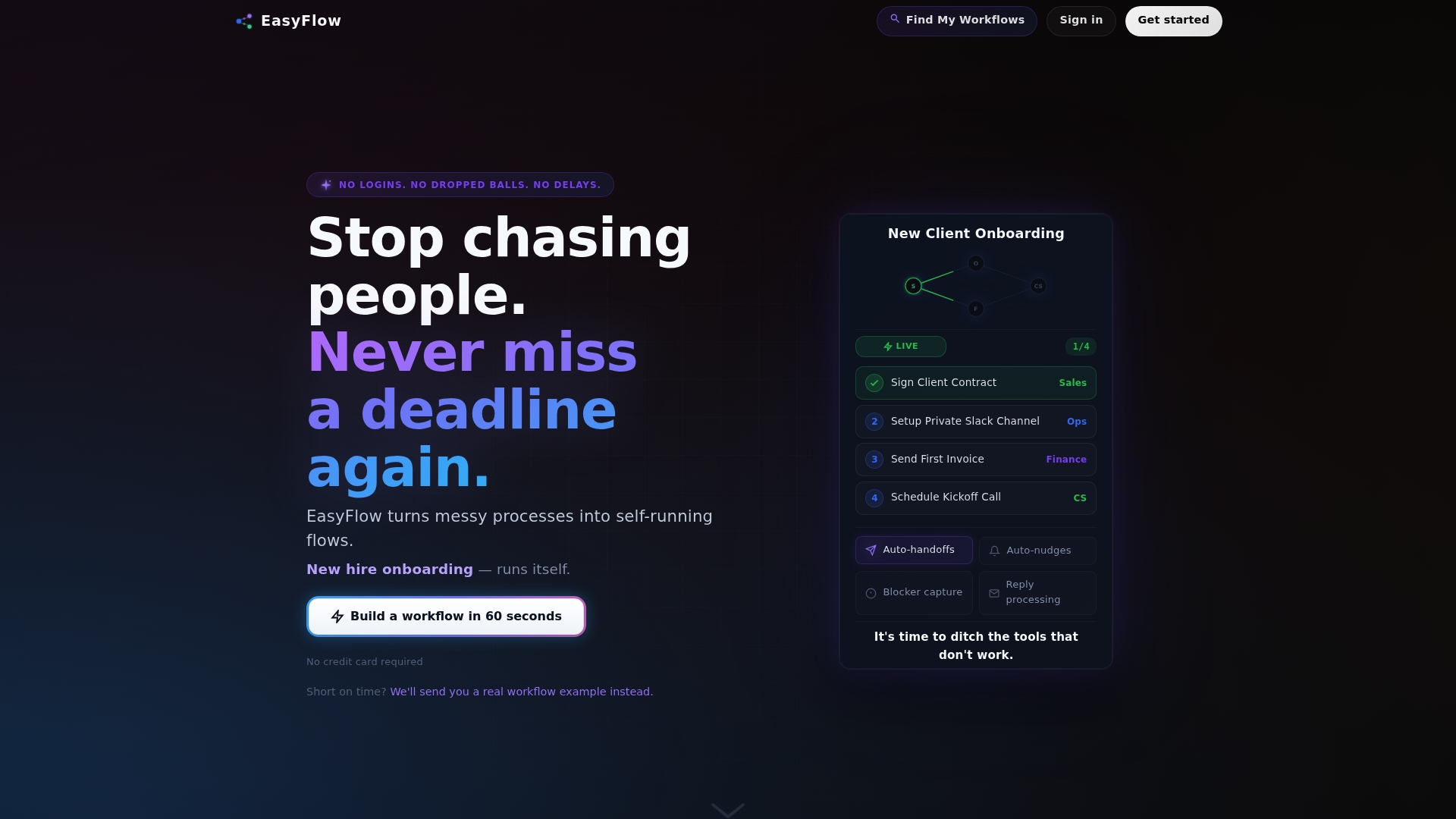
EasyFlow executes your onboarding workflow automatically, sending tasks to the right people at the right time via magic links. Clients complete their steps with a single click. Your team sees real-time progress without chasing anyone. Teams managing multiple client onboardings simultaneously use EasyFlow to cut follow-up time and keep every checklist on track. Try EasyFlow free and run your next client onboarding without a single manual reminder.
FAQ
What is a client onboarding checklist?
A client onboarding checklist is a structured list of steps that guides a team from contract signing through kickoff, compliance collection, and first deliverable. It typically covers 7–14 days and includes welcome communications, internal handoffs, and milestone tracking.
How long should client onboarding take?
Most effective onboarding processes run 7–14 days from contract signing to first deliverable. The Day-30 checkpoint closes the formal onboarding phase and transitions the client into the ongoing relationship.
What are the most critical steps in an onboarding process checklist?
The most critical steps are the Day-0 internal handoff, the welcome email within 24 hours, the kickoff meeting in days 3–7, and the first quick win by Day 14. Skipping any of these four steps significantly increases the risk of early churn.
Why do clients churn during onboarding?
Poor alignment and unclear communication are the primary drivers of early client churn. Clients who do not understand team roles, timelines, or next steps lose confidence quickly, often before the first deliverable is complete.
What tools support effective client onboarding?
HoneyBook handles intake forms and contracts for small teams. DocuSign manages electronic signatures and compliance documents. EasyFlow automates task execution and team handoffs, allowing clients to complete actions via magic links without creating an account.