
Onboarding Automation Adoption Examples for HR Teams

Onboarding automation is defined as the use of software to execute repetitive administrative tasks during new hire processing, replacing manual handoffs with triggered workflows. The right onboarding automation adoption examples prove this is not a future-state concept. Companies like EMP Trust HR, OnboardIQ, and Greenhouse have already demonstrated that automated onboarding processes cut compliance review times, reduce costs by $1,500 per hire, and improve retention by 82%. For HR leaders managing high-volume hiring, these results are the baseline, not the ceiling.
1. Which onboarding tasks deliver the biggest automation impact?
Pre-boarding and day-one readiness tasks produce 80% of time savings when automated first. That means document collection, system access provisioning, and equipment requests should be your starting point, not your final destination.
The tasks with the highest automation ROI fall into four categories:
- Compliance document collection: Gathering I-9s, tax forms, and policy acknowledgments manually creates bottlenecks. Automated workflows enforce deadlines and flag missing items before day one.
- IT provisioning: Triggering laptop setup, software licenses, and email account creation the moment an offer is accepted eliminates the classic “no computer on day one” problem.
- Onboarding communications: Welcome emails, manager introductions, and pre-boarding checklists can all fire automatically based on hire date and role.
- Compliance validation: Platforms like EMP Trust HR use intelligent orchestration to run IT provisioning and compliance checks simultaneously rather than sequentially.
That last point matters more than most HR teams realize. Traditional onboarding runs like a relay race: HR finishes, then IT starts, then the hiring manager gets involved. Intelligent orchestration runs all three concurrently, cutting total cycle time significantly.
Pro Tip: Start by automating pre-boarding tasks only. You will see measurable time savings within the first 30 days without disrupting existing HR workflows.

2. EMP Trust HR: AI-driven compliance and personalized portals
EMP Trust HR is one of the most cited platforms in automated onboarding processes, particularly for mid-size to enterprise organizations in regulated industries. Its core differentiator is AI-driven compliance enforcement. The system automatically tracks form completion deadlines, sends alerts for missing documentation, and handles remote I-9 verification with 2026-updated procedures.
Beyond compliance, EMP Trust HR creates personalized engagement portals for new hires. These portals include introductory videos, team bios, and role-specific task lists. The result is reduced pre-boarding anxiety and measurably higher engagement scores before the employee even walks through the door. For HR teams managing dozens of concurrent hires, this level of personalization at scale would be impossible without automation.
3. OnboardIQ: multi-agent AI for healthcare staffing
OnboardIQ is built specifically for high-volume, high-compliance environments like healthcare staffing. The platform uses multiple specialized AI agents alongside deterministic decision engines to produce explainable, auditable onboarding decisions. Every action is logged with a full audit trail, which is non-negotiable in healthcare.
The practical impact is significant. A U.S. healthcare staffing provider processing 12,000+ placements annually reduced compliance package review time from 15–25 minutes per placement to under 30 seconds. That single improvement saved over 3,900 operational hours annually. Same-day deployment replaced the previous 2–3 day manual process. For any organization in a regulated industry, OnboardIQ’s model of auditable AI decisions sets the standard for what automated onboarding processes should deliver.
4. Greenhouse: workflow orchestration and communication reduction
Greenhouse approaches onboarding automation from the hiring workflow side. Its platform uses “if-then” logic to trigger concurrent tasks across HR, IT, and hiring managers the moment a candidate moves to a specific stage. This is the definition of automation acting as a central nervous system for hiring rather than a simple task tracker.
The communication reduction numbers are striking. Anaplan, using Greenhouse’s onboarding automation, reduced onboarding email volume by 95% while creating consistent new hire experiences across global offices. That is not a marginal improvement. It means HR teams reclaimed hours every week that were previously spent chasing confirmations and sending reminders. Greenhouse also enables consistent measurement of completion rates and compliance status across departments, giving HR leaders real visibility into where bottlenecks remain.
5. EasyFlow: process execution without account friction
EasyFlow takes a different approach to onboarding automation adoption. Where most platforms require every participant to hold a software account, EasyFlow lets external collaborators complete tasks via magic links. This matters enormously in onboarding, where new hires, IT vendors, and hiring managers all need to act quickly without navigating login screens.
EasyFlow executes processes rather than just tracking them. A hiring manager approves equipment. IT receives an automatic provisioning request. The new hire completes their paperwork through a link in their email. No one needs to log into a shared system. For operations-heavy teams running 8 critical onboarding steps across multiple stakeholders, this frictionless execution model cuts follow-up volume and speeds up every handoff.
6. AI-generated role-specific onboarding plans
One of the most underused examples of onboarding automation is AI-generated onboarding plans. Tools like FirstHR can generate role-specific plans from a job description in minutes, complete with 30/60/90-day milestones. What previously took an HR manager several hours now takes under five minutes.
This capability is especially valuable for small businesses without dedicated HR expertise. A 20-person company hiring its first engineer does not have a documented onboarding plan for that role. An AI tool can produce one immediately, giving the new hire structure and giving the manager clear checkpoints. The quality of these plans has improved significantly in 2026, with tools now incorporating company-specific context and industry compliance requirements automatically.
7. Finance sector: automated compliance and audit readiness
Financial services firms face onboarding requirements that go well beyond standard HR paperwork. New hires in banking and investment management must complete licensing verifications, background checks, and regulatory training before touching client accounts. Manual management of these requirements creates compliance risk and delays productivity.
Automated onboarding workflows in finance enforce every deadline, log every completed step, and generate audit-ready reports without HR intervention. Platforms with auditing and traceability features built for regulated industries handle this automatically. The practical outcome is that a new financial advisor can be fully compliant and client-ready in days rather than weeks, with zero risk of a missed certification deadline.
8. What measurable outcomes have organizations actually achieved?
The data on automated onboarding outcomes is specific enough to build a business case from. Here is what the research shows across industries:
| Metric | Result | Source |
|---|---|---|
| Compliance review time | 15–25 min reduced to under 30 sec | Healthcare staffing, OnboardIQ |
| Annual hours saved | 3,900+ hours per year | 12,000-placement provider |
| Retention improvement | 82% improvement | EMP Trust HR / Brandon Hall Group |
| Productivity boost | 70%+ increase | EMP Trust HR / SHRM |
| Email volume reduction | 95% reduction | Anaplan via Greenhouse |
| Cost savings | $1,500 per hire | EMP Trust HR / Glassdoor |
“Automation replaces manual administrative chores, allowing HR to focus on the human-centric parts like cultural mentoring and role ramp-up.” — TechPrescient
The retention and productivity numbers deserve particular attention. An 82% retention improvement is not a marginal gain. It means organizations that automate onboarding are fundamentally changing how new hires experience their first weeks, and those hires are staying longer as a result. The $1,500 per-hire cost reduction compounds quickly at any meaningful hiring volume.
9. How to implement onboarding automation: a practical approach
Successful onboarding automation strategies follow a consistent pattern across industries. Here is the sequence that works:
- Audit your current process. Map every onboarding task, who owns it, and how long it takes. Identify the three to five tasks that consume the most time or generate the most errors.
- Prioritize high-frequency repetitive tasks. Compliance document collection and IT provisioning are the right starting points. These tasks are high-frequency and rule-based, which makes them ideal for automation.
- Select software that fits your compliance requirements. Healthcare and finance need platforms with full audit trails. Tech companies may prioritize speed and integration with their applicant tracking system.
- Configure role-based workflows. An engineer’s onboarding looks different from a sales hire’s. Build separate workflow templates for each major role category.
- Engage HR, IT, and hiring managers in workflow design. Automation that HR builds without IT input will fail at the provisioning step. Cross-functional design prevents gaps.
- Start small and scale. Automate pre-boarding first. Measure results for 60 days. Then expand to full lifecycle automation.
Pro Tip: Use workflow automation alignment principles to map cross-functional dependencies before configuring any automation tool. Skipping this step is the most common reason onboarding automation projects stall.
Compliance integration deserves its own emphasis. Regulatory requirements change. Your automation platform must update compliance workflows automatically, not require manual reconfiguration every time a form changes. Platforms that handle regulatory compliance updates automatically are worth the premium for any organization in a regulated industry.
Key takeaways
Onboarding automation delivers its highest ROI when organizations target compliance, IT provisioning, and pre-boarding tasks first, as proven by results across healthcare, finance, and technology sectors.
| Point | Details |
|---|---|
| Start with pre-boarding tasks | Automating document collection and IT provisioning first delivers 80% of total time savings. |
| Measure with real benchmarks | Healthcare staffing cut review time from 25 minutes to 30 seconds, saving 3,900 hours annually. |
| Retention and cost gains are proven | Automated onboarding improves retention by 82% and saves $1,500 per hire on average. |
| Cross-functional design is required | HR, IT, and hiring managers must all contribute to workflow design to prevent execution gaps. |
| Scale gradually after early wins | Automate pre-boarding, measure for 60 days, then expand to full lifecycle workflows. |
Why most HR teams are still leaving hours on the table
I have reviewed onboarding processes at organizations ranging from 15-person startups to 5,000-person enterprises, and the pattern is consistent. HR teams know manual onboarding is inefficient. They feel it every week in the follow-up emails, the missed IT requests, and the new hires who show up on day one without system access. But they delay automation because the project feels large.
The examples in this article prove that it does not have to be. OnboardIQ did not automate an entire healthcare staffing operation overnight. The wins came from targeting one high-volume, high-pain task: compliance package review. That single change saved 3,900 hours a year. Anaplan did not rebuild its entire HR function. It automated onboarding communications and eliminated 95% of email volume.
The organizations that are ahead right now are not the ones with the biggest HR budgets. They are the ones that picked a specific, painful task, automated it well, and measured the result. AI-driven intelligent orchestration will continue to raise the ceiling on what is possible, especially for hybrid and remote teams where manual coordination breaks down fastest. But the floor, the minimum viable automation that pays for itself immediately, is accessible to any organization willing to start with one workflow.
The competitive advantage in hiring is not just about sourcing better candidates. It is about getting them productive faster, keeping them longer, and doing it without burning out your HR team. Automation is how you do all three at once.
— Harsh
How EasyFlow fits into your onboarding automation strategy
HR teams that are ready to move from tracking tasks to actually executing them will find EasyFlow built for exactly that transition. EasyFlow automates team handoffs and repetitive onboarding tasks without requiring new hires or external collaborators to create accounts. That removes the single biggest friction point in most onboarding workflows.
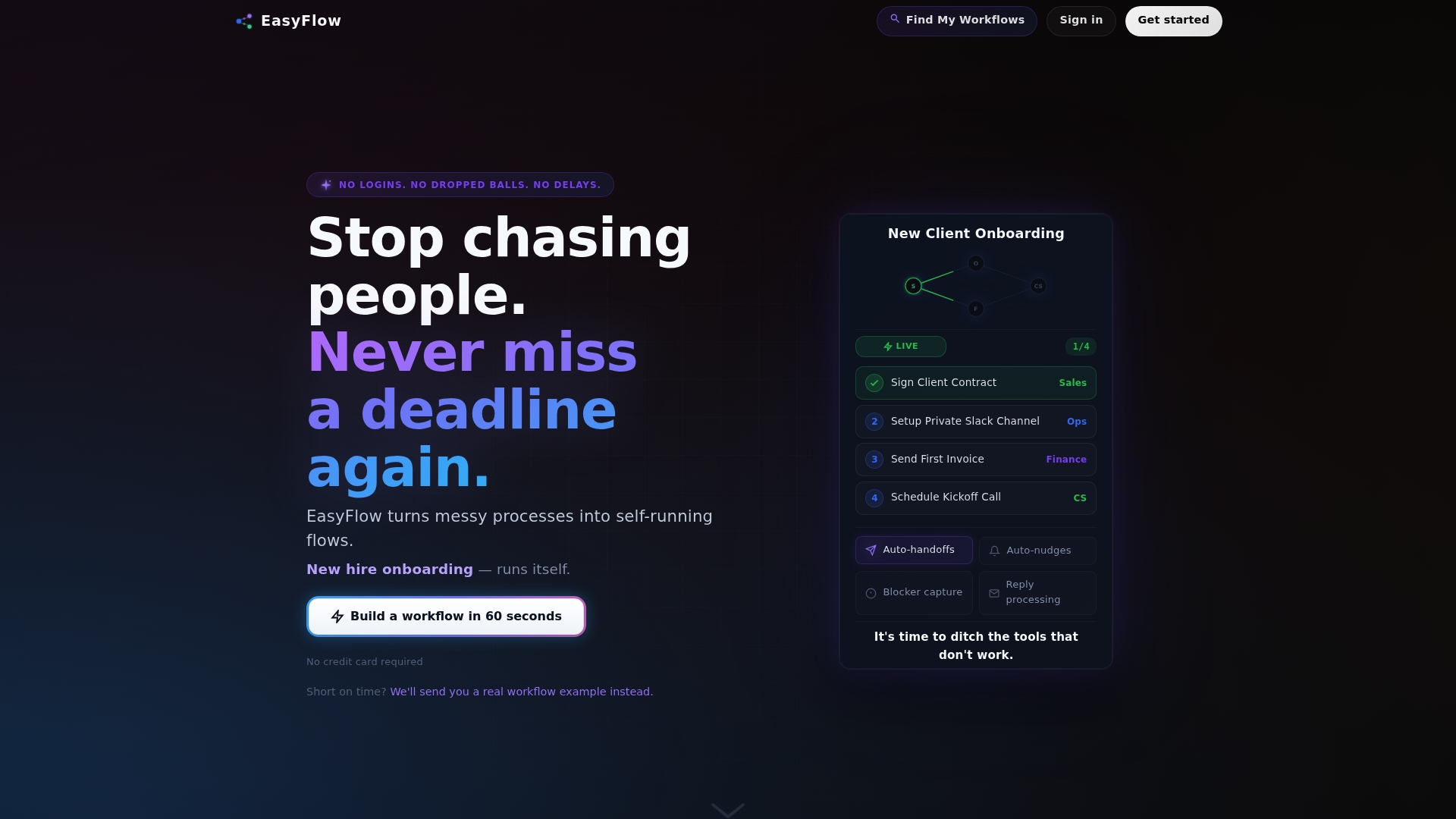
Whether you are automating a five-step pre-boarding sequence or a full multi-department new hire process, EasyFlow handles the execution while your team focuses on the people side of onboarding. You can start automating workflows today or explore the full platform at EasyFlow’s homepage to see how it fits your current process. For teams managing client onboarding progress alongside internal hiring, EasyFlow handles both without adding complexity.
FAQ
What is onboarding automation?
Onboarding automation is the use of software to execute repetitive administrative tasks during new hire processing, including document collection, IT provisioning, and compliance verification, without manual intervention.
Which industries benefit most from automated onboarding?
Healthcare staffing, financial services, and technology companies see the largest gains because their onboarding processes involve high compliance requirements, high hiring volume, or both.
How long does it take to see results from onboarding automation?
Organizations that automate pre-boarding tasks first typically see measurable time savings within 30–60 days. The healthcare staffing case with OnboardIQ achieved same-day deployment results immediately after implementation.
What is the biggest mistake in onboarding automation adoption?
The most common mistake is trying to automate the entire onboarding lifecycle at once. Starting with two or three high-frequency tasks and scaling after measuring results produces faster and more sustainable outcomes.
Does onboarding automation work for small businesses?
AI tools like FirstHR can generate role-specific onboarding plans from a job description in minutes, making automation practical for small businesses without dedicated HR teams or pre-built onboarding programs.