
Why Client Onboarding Experiences Matter in 2026

Client onboarding is the structured process that secures client confidence and loyalty by delivering fast value and clear guidance from day one. Most business leaders treat it as an administrative formality. The data says otherwise. Companies that invest in deliberate onboarding see measurably higher renewal rates, faster product adoption, and stronger long-term revenue. This article breaks down why client onboarding experiences matter, what the research shows about retention impact, and what your team can do differently starting now.
Why client onboarding experiences matter for retention and revenue
Client onboarding is the first real test of your company’s promise. Everything you said in the sales process gets validated or contradicted in those first 30 days. The stakes are high and the window is short.
The numbers are stark. Clients who feel oriented and confident in their first week renew at roughly 71%, compared to just 34% when they feel rushed or confused. That gap represents nearly double the renewal rate. For any subscription or services business, that difference compounds into millions of dollars over a client base.

Time-to-value is the metric that drives this outcome. When a client reaches their first meaningful result quickly, they connect that result to your product or service. Shorter time-to-value leads to stronger adoption, higher retention, and faster expansion conversations. Delay that moment and you create doubt. Doubt is expensive.
There is also an emotional dimension that most onboarding frameworks ignore. Clients do not just need functional access to your product. They need certainty that they made the right decision. Onboarding is the process that delivers that certainty, or fails to. When it fails, no amount of customer success outreach later fully repairs the damage.
The benefits of effective onboarding extend beyond the first renewal. A client who experiences a structured, clear onboarding process builds a mental model of your company as organized and trustworthy. That perception shapes how they respond to upsell conversations, how they refer you to peers, and how forgiving they are when problems arise. Structured onboarding pays dividends years later by building long-term client confidence.
- Renewal rates nearly double when clients feel oriented in week one versus confused or rushed.
- Time-to-value is the single strongest predictor of early adoption and retention.
- Emotional certainty built during onboarding shapes client behavior at every future touchpoint.
- Long-term trust established in onboarding reduces churn risk at every renewal cycle.
What are the best practices for effective client onboarding in 2026?
Modern client expectations have shifted significantly. According to the Adobe AI and Digital Trends 2026 report, 80% of clients expect personalization, 72% expect seamless cross-channel interaction, and 60% want AI-powered tools that still feel human. Generic, one-size-fits-all onboarding no longer meets the bar.
Here are the practices that separate high-retention onboarding programs from average ones:
-
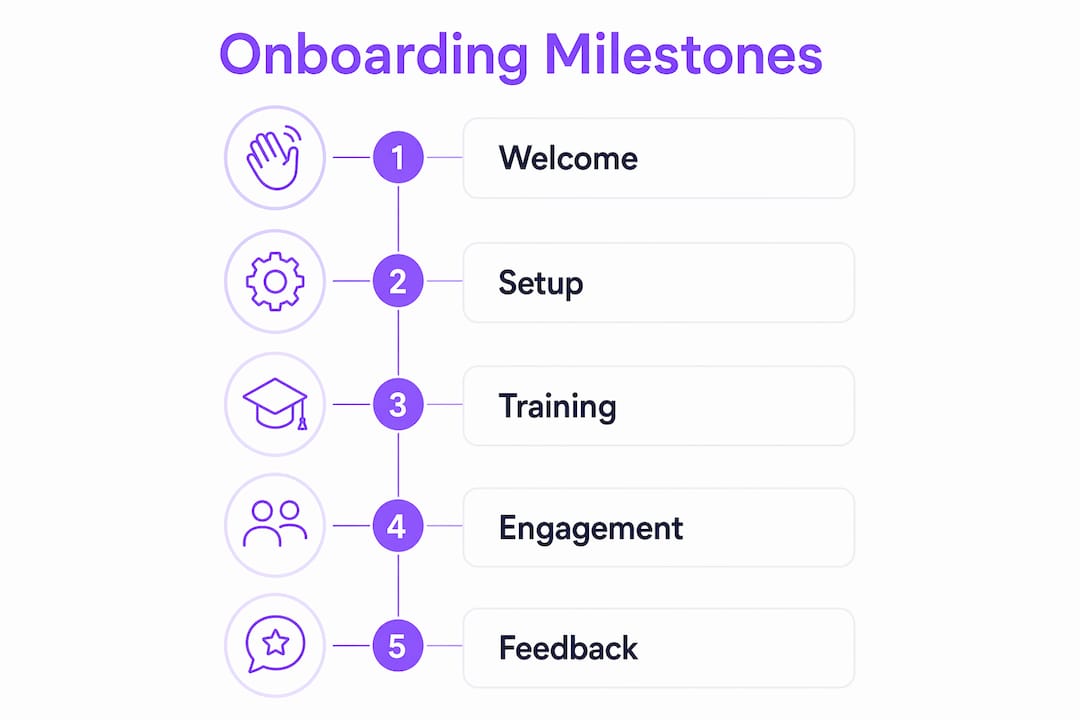
Build a structured touchpoint cadence. A 5-touchpoint onboarding cadence in the first 30 days, at Day 1, 3, 7, 14, and 30, balances communication to build trust without overwhelming the client. Each touchpoint should have a specific purpose: welcome, setup confirmation, first milestone check-in, mid-point review, and 30-day outcome review.
-
Personalize to client goals, not product features. Start every onboarding engagement by documenting what success looks like for that specific client. Then map your onboarding steps to their goals, not your internal product roadmap. This shift alone dramatically improves perceived value in the first two weeks.
-
Create a single digital hub for all onboarding materials. A single, organized digital hub reduces information scatter and lowers churn risk before the first renewal. Clients should never have to search multiple email threads, shared drives, or portals to find what they need.
-
Use AI tools that preserve the human feel. AI can automate status updates, flag at-risk clients, and personalize content delivery. The key is that the client experience should still feel attentive and personal. Tools that support AI-powered onboarding while maintaining a human touch are the standard in 2026, not a differentiator.
-
Prioritize speed and clarity above completeness. Clients do not need to know everything on day one. They need to know the next right step. Onboarding programs that front-load too much information create confusion, not confidence.
Pro Tip: Map your onboarding steps to the 8 core onboarding milestones every client team needs, and assign a clear owner and deadline to each one. Accountability gaps are where most onboarding programs break down.
| Onboarding element | Low-performing approach | High-performing approach |
|---|---|---|
| Communication cadence | Ad hoc emails when issues arise | Structured 5-touchpoint schedule in 30 days |
| Personalization | Same deck for every client | Goals documented and steps mapped to client outcomes |
| Information delivery | All materials sent on day one | Staged delivery matched to client readiness |
| Progress tracking | Manual check-ins only | Automated tracking with milestone alerts |
What common pitfalls cause client onboarding to fail?
Most onboarding failures share a common root cause: the process was designed for the vendor’s convenience, not the client’s clarity. Recognizing these patterns early lets you fix them before they cost you a renewal.
Information overload is the most common mistake. Sending a 40-page onboarding guide, three product walkthroughs, and a welcome video in the first 48 hours does not help clients. It signals that your team has not thought carefully about what the client actually needs first. Missteps in onboarding create client doubt early, making future engagement more challenging and costly.
Delayed access to systems or resources is equally damaging. If a client signs a contract on Monday and cannot log in until Thursday, that gap communicates disorganization. Clients who complete setup with assisted onboarding reach value faster and experience less friction. Every hour of unnecessary delay is an hour of doubt accumulating.
Inconsistent communication sits at both extremes. Over-communicating causes burnout. Under-communicating leads to neglect. A balanced communication schedule is the key to onboarding success, and the 5-touchpoint cadence described earlier is a proven framework for getting that balance right.
Disorganized workflows undermine even great products. When clients receive conflicting information from different team members, or when no one owns the onboarding process end to end, the client loses confidence in your organization. This is where workflow automation for team alignment becomes a structural fix, not just a nice-to-have.
Pro Tip: Audit your last five client onboardings and count how many times a client had to ask “what happens next?” Every instance of that question is a gap in your process that a clear next-step communication would have closed.
How do you measure and optimize client onboarding over time?
Measuring onboarding effectiveness requires tracking metrics that reflect client progress, not just internal activity. Sending 10 emails is not onboarding success. A client reaching their first milestone in week one is.
The core metrics every client-facing team should track are:
- Time-to-value: Days from contract signature to first meaningful client outcome.
- Retention at 30, 60, and 90 days: Early churn signals an onboarding failure, not a product failure.
- Feature adoption rate: The percentage of clients using core features within the first 30 days.
- Net Promoter Score at day 30: A client’s NPS score immediately after onboarding predicts renewal behavior more accurately than any later survey.
- Support ticket volume in weeks 1–4: High early support volume indicates unclear onboarding, not client incompetence.
Engagement analytics let you identify at-risk clients before they churn. If a client has not logged in by day 7 or has not completed a key setup step, that is a signal to intervene. Waiting for the 60-day check-in is too late. Teams that track onboarding progress automatically can spot these signals in real time and act before the relationship deteriorates.
Client feedback loops during onboarding are underused. A simple three-question survey at day 7 and day 30 gives you qualitative data that no dashboard can provide. Ask what was unclear, what was most useful, and what they wish they had known sooner. The answers will rewrite your onboarding program faster than any internal audit.
Continuous optimization means treating onboarding as a product, not a project. Set a quarterly review cadence. Compare cohort retention rates by onboarding version. Test one variable at a time. The firms winning in onboarding today focus on shrinking client uncertainty fast and showing measurable value before competitors finish implementation.
Key Takeaways
Effective client onboarding directly determines renewal rates, with oriented clients renewing at nearly double the rate of confused ones, making it the highest-leverage investment in client retention.
| Point | Details |
|---|---|
| Onboarding drives renewal rates | Clients who feel confident in week one renew at 71% versus 34% for those who feel rushed. |
| Time-to-value is the core metric | Faster first outcomes produce stronger adoption, higher retention, and earlier expansion conversations. |
| Structured cadence prevents failure | A 5-touchpoint schedule at days 1, 3, 7, 14, and 30 balances communication without overwhelming clients. |
| Measure early signals, not late ones | Track support ticket volume, login activity, and NPS at day 30 to catch at-risk clients before they churn. |
| Disorganized workflows destroy trust | A single digital hub and clear process ownership eliminate the confusion that causes early client doubt. |
The uncomfortable truth about onboarding most leaders ignore
I have worked with enough client-facing teams to say this plainly: most companies treat onboarding as a cost center, not a revenue driver. That framing is the problem.
Every dollar you spend on a structured, personalized onboarding program pays back through renewals, referrals, and reduced churn. The math is not complicated. What is complicated is convincing leadership to invest in a process that does not show up on a sales dashboard. Onboarding outcomes live in retention reports, and most organizations review those quarterly at best.
The other thing I have observed is that automation and personalization are not opposites. Teams that use workflow automation well do not feel robotic to clients. They feel attentive, because the right message arrives at the right moment without anyone having to remember to send it. The human energy that automation frees up goes into the conversations that actually require judgment and empathy.
Onboarding also reflects company culture in a way that nothing else does. A disorganized onboarding process tells a client exactly how their future support experience will feel. A clear, structured, personalized process tells them they made the right call. That signal is worth more than any marketing campaign you will run this year.
Invest in your onboarding process the way you invest in your sales process. Measure it, iterate on it, and own it at the leadership level. The clients who stay longest are almost always the ones who started well.
— Harsh
How EasyFlow helps teams run better client onboarding
Client onboarding breaks down when no one owns the process end to end and follow-ups fall through the cracks. EasyFlow is built to fix exactly that.
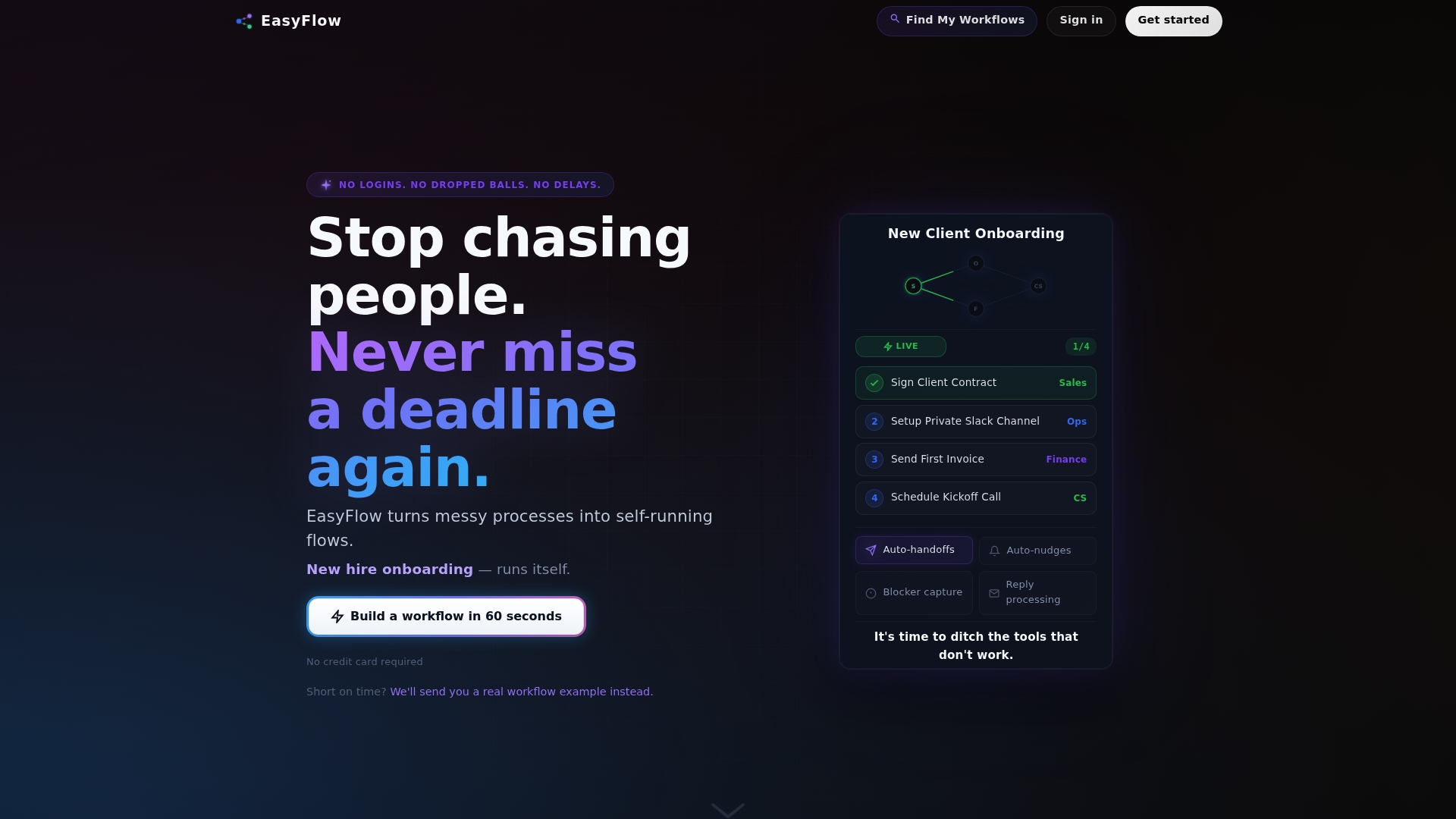
EasyFlow automates the workflows that typically burden client-facing teams, from sending day-one welcome sequences to triggering milestone check-ins at the right moment. Unlike task trackers that just list what needs to happen, EasyFlow actually executes the process. External clients can complete onboarding steps via magic links without creating accounts, which removes a major friction point from day one. Teams using EasyFlow report fewer follow-ups, faster time-to-value, and cleaner handoffs between internal stakeholders. If improving client onboarding is a priority for your team in 2026, start with EasyFlow and see how automated workflows change the experience from the first touchpoint.
FAQ
Why does client onboarding affect retention so strongly?
Onboarding is when clients form their first real impression of your organization’s competence and care. Clients who feel oriented and confident in week one renew at nearly double the rate of those who feel confused or rushed.
What is the most important metric in client onboarding?
Time-to-value is the single strongest predictor of early adoption and retention. The faster a client reaches their first meaningful outcome, the more likely they are to renew and expand.
How many touchpoints should a client onboarding program include?
A 5-touchpoint cadence in the first 30 days, at days 1, 3, 7, 14, and 30, is the recommended structure. Each touchpoint should have a specific purpose tied to client progress, not internal status updates.
What causes most client onboarding programs to fail?
Information overload, delayed system access, and inconsistent communication are the three most common failure points. Each one creates client doubt that compounds over time and raises churn risk before the first renewal.
How can teams use automation in client onboarding without losing the personal feel?
Automation handles timing and consistency, while human energy focuses on judgment and empathy. Tools that trigger the right message at the right milestone make clients feel attended to, not processed.