
White-Glove Onboarding Process Components That Work

White-glove onboarding is a premium, hands-on approach to bringing new clients or employees into your organization. It combines proactive communication, personalized engagement, human expertise, and workflow automation into a process that feels effortless for the recipient and repeatable for your team. The core white-glove onboarding process components are: a dedicated point of contact, proactive communication, scalable personalization, phased delivery, human-in-the-loop oversight, workflow automation, CRM and HR system integration, and defined success metrics.
The key components at a glance:
- Dedicated relationship manager who owns the client experience from signing through full adoption
- Proactive communication with automated check-ins, milestone updates, and reminders
- Scalable personalization through co-branded templates and client segmentation
- Phased onboarding delivery to prevent information overload
- Human-in-the-loop oversight for complex decisions and escalations
- Workflow automation to execute tasks, handoffs, and tracking without manual effort
- CRM and HR integration for a single source of truth across teams
- Documented SOPs to keep every client experience consistent
- Training and change management for the teams running the process
- KPIs and feedback loops to measure and improve outcomes
EasyFlow fits into this framework as the automation layer that actually executes these steps, rather than just tracking them.
Table of Contents
- 1. Why proactive communication defines the white-glove experience
- 2. How to deliver scalable personalization without excessive manual work
- 3. Blending human expertise with automation in onboarding workflows
- 4. How EasyFlow optimizes white-glove onboarding for operations teams
- 5. Which KPIs actually tell you if white-glove onboarding is working
- 6. Step-by-step workflow design for white-glove onboarding
- EasyFlow cuts onboarding friction where it hurts most
- Key Takeaways
- FAQ
1. Why proactive communication defines the white-glove experience
Proactive communication anticipates client needs before they have to ask. That distinction separates white-glove onboarding from standard support. When a client receives a progress update before they wonder where things stand, trust builds faster and churn risk drops.
The practical mechanics matter here:
- Automated reminders for key milestones (kickoff calls, document deadlines, training sessions)
- Scheduled check-in cadences built into the workflow, not left to individual judgment
- Internal notifications that alert the next team member when a handoff is ready
- A centralized CRM record so every touchpoint is visible to anyone on the team
IRIS Payroll’s model illustrates this well. Their team assigns a dedicated relationship manager reachable by phone, text, or email, avoiding the impersonal ticket queue that drives churn in software transitions. The client always knows who to call and what comes next.
2. How to deliver scalable personalization without excessive manual work
The common misconception is that personalization requires writing everything from scratch for every client. It does not. Co-branded templates and segment-specific onboarding plans reduce manual workload while preserving the premium feel that clients notice.
Practical approaches:
- Build onboarding templates for each client persona (enterprise vs. SMB, admin vs. end user)
- Add the client’s logo and your logo to every onboarding asset so it reads as purpose-built
- Use relative due dates that auto-populate based on the onboarding start date and task sequence
- Segment clients by complexity, industry, or revenue tier to assign the right template automatically
Phased delivery is the other lever. Unlocking tasks and content as clients complete prior steps prevents the overwhelm that kills engagement in week two. A client who sees 40 tasks on day one often does nothing. A client who sees three tasks, completes them, and unlocks the next phase keeps moving.
Pro Tip: Build your onboarding templates around the client’s job-to-be-done, not your internal process steps. A client who sees their own goals reflected in the timeline trusts the process faster.
3. Blending human expertise with automation in onboarding workflows
The human-in-the-loop model assigns AI agents to routine tasks and reserves human judgment for decisions that actually require it. In practice, that means AI handles data collection, status checks, document extraction, and task routing, while a human expert steps in for complex cases, sensitive escalations, or relationship-critical moments.

Backbase’s agentic onboarding research in commercial banking shows what this looks like at scale: AI agents run KYC checks, entity verification, and sanctions screening in parallel, then assemble a complete case file before a compliance specialist ever touches it. Banks implementing this approach have reported up to 60% reductions in KYC review time and 50% fewer manual errors.
Three design principles make this work:
- A unified client data layer so every agent and human sees the same real-time record
- Clearly defined escalation paths so complex cases route to the right specialist automatically
- Transparency at every step so clients know where they are and what happens next
For operations teams outside banking, the same logic applies. Automate the routine; protect the human moments that build the relationship. You can explore how AI enhances data collection in onboarding without sacrificing the high-touch experience.
4. How EasyFlow optimizes white-glove onboarding for operations teams
EasyFlow’s core advantage is that it executes processes rather than just tracking them. External collaborators complete tasks via magic links without creating accounts, which removes the friction that stalls most onboarding workflows at the first handoff.
Key automation features for white-glove onboarding:
| Feature | What it does in onboarding |
|---|---|
| Magic link task execution | External clients complete steps without account setup |
| Automated handoffs | Next team member is notified and assigned automatically |
| Centralized progress tracking | Every stakeholder sees real-time status in one view |
| Customizable workflow templates | Reuse and adapt onboarding flows by client segment |
| Automated follow-up reminders | Eliminates manual “just checking in” emails |
Documented SOPs underpin every reliable white-glove process. EasyFlow turns those SOPs into live workflows, so the process runs the same way every time regardless of which team member is handling the account. For operations teams managing multiple concurrent onboardings, that consistency is the difference between a repeatable system and a heroic individual effort.
Training and change management matter here too. Integrating workflow automation requires aligning the tool with your existing CRM and HR systems, defining who owns each step, and running the team through the new process before it goes live with clients. Teams that skip this phase often find the automation running in parallel with the old manual habits rather than replacing them. The 2026 onboarding best practices guide covers this alignment in detail.
For a complete client onboarding process reference, including how to structure each phase from kickoff to handoff, that guide is worth bookmarking.
5. Which KPIs actually tell you if white-glove onboarding is working
Tracking the right metrics separates teams that improve from teams that assume. The KPIs that matter for premium onboarding are:
- Time-to-value (TTV): How long from signing to the client achieving their first meaningful outcome
- Task completion rate: What percentage of onboarding steps clients complete on schedule
- Client engagement rate: Are clients opening communications, attending calls, and submitting documents on time
- Handoff smoothness: How often clients have to repeat information when moving between team members
- Feedback scores: Post-onboarding survey results and direct qualitative input
- Churn rate at 90 days: The clearest lagging indicator of whether onboarding actually worked
Industry practice recommends tracking proactive communication effectiveness and handoff rates as leading indicators, since they predict satisfaction before a client has a chance to churn. Set a baseline in your first quarter of measurement, then review monthly.
6. Step-by-step workflow design for white-glove onboarding
A well-designed onboarding workflow has four phases, each with clear ownership and defined exit criteria.
Phase 1: Pre-kickoff setup. Assign the dedicated onboarding contact, send a welcome email within 24 hours of signing, create the client record in your CRM, and schedule the kickoff call within the first week. Waiting longer lets momentum fade.
Phase 2: Kickoff and discovery. Review the client’s goals, walk through the onboarding timeline, collect or confirm receipt of required documents, introduce the full team, and set communication expectations explicitly. This call sets the tone for everything that follows.
Phase 3: Active onboarding. Complete all setup and configuration without waiting for the client to do it themselves. Deliver personalized training focused on their specific use case. Follow up on missing items before the client has to think about them. Document every decision and configuration for handoff continuity. You can track progress automatically rather than relying on manual status updates.
Phase 4: Handoff and close. Conduct a review meeting, formally introduce the long-term account manager if different from the onboarding contact, send a summary document recapping everything completed, and ask for feedback. A short survey at this stage gives you the data to improve the next onboarding cycle.
EasyFlow cuts onboarding friction where it hurts most
Operations teams running white-glove onboarding at scale face one consistent problem: the process depends on people remembering to do things. EasyFlow removes that dependency by automating the execution layer entirely.
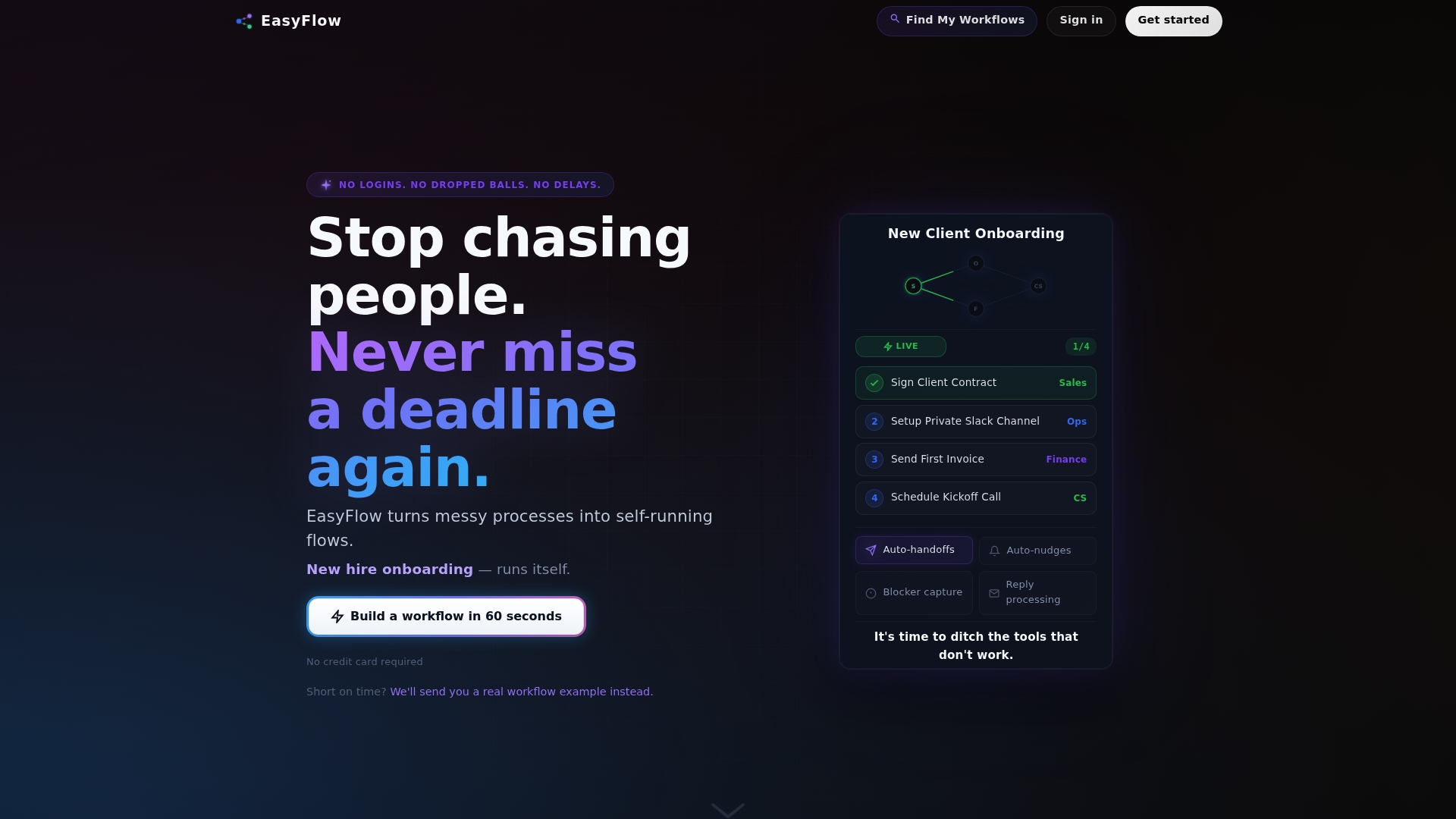
Clients receive task requests via magic links and complete steps without logging into anything. Your team gets automatic notifications when handoffs are ready. Nothing falls through because someone forgot to follow up. For teams managing complex, multi-stakeholder onboardings, that reliability is what makes the premium experience repeatable rather than accidental.
Start automating your onboarding workflows and see how EasyFlow runs the process so your team can focus on the client relationship.
Key Takeaways
A white-glove onboarding process requires proactive communication, scalable personalization, human-in-the-loop oversight, and workflow automation working together to deliver a consistent, premium client experience.
| Point | Details |
|---|---|
| Proactive communication | Automated check-ins and milestone updates build trust before clients have to ask. |
| Scalable personalization | Co-branded templates and client segmentation deliver a premium feel without manual rework. |
| Human-in-the-loop design | AI handles routine tasks; human experts step in for complex decisions and escalations. |
| KPIs that matter | Track time-to-value, task completion rate, and 90-day churn as your core onboarding metrics. |
| EasyFlow execution | EasyFlow automates handoffs and task execution via magic links, removing the manual follow-up burden. |
FAQ
What are the core white-glove onboarding process components?
The core components are a dedicated point of contact, proactive communication, scalable personalization, phased delivery, human-in-the-loop oversight, workflow automation, CRM integration, documented SOPs, and defined KPIs.
How does automation support white-glove onboarding without losing the personal touch?
Automation handles routine steps like reminders, task routing, and status updates, freeing your team to focus on the relationship-critical moments that require human judgment.
What KPIs should operations teams track for onboarding success?
Time-to-value, task completion rate, client engagement rate, handoff smoothness, and 90-day churn rate are the most reliable indicators of white-glove onboarding performance.
How does EasyFlow reduce friction in onboarding workflows?
EasyFlow lets external clients complete tasks via magic links without creating accounts, and automatically notifies the next team member when a handoff is ready, eliminating manual follow-up.
Can white-glove onboarding scale without adding headcount?
Yes. Co-branded templates, client segmentation, phased delivery, and workflow automation tools like EasyFlow allow teams to deliver a premium onboarding experience across more clients without proportional staff increases.