
Customer Onboarding Best Practices 2026: A Leader’s Guide

Customer onboarding best practices are the structured steps a business uses to deliver real product value to new clients as fast as possible. In 2026, the standard has shifted: clients expect a first win within minutes, not days. The industry now tracks time-to-first-value (TTFV), feature adoption rates, and customer health scores as the core signals of onboarding success. Most churn happens within the first 90 days, which means the quality of your onboarding process directly determines whether a client stays or leaves. Proactive, personalized approaches are no longer optional. They are the baseline.
1. Deliver first value within 5–15 minutes
The fastest way to reduce early churn is to give clients an immediate win. Most churn happens within 90 days, and the clients who stay are almost always the ones who experienced a clear benefit early. That first moment of clarity, often called the “aha moment,” anchors a client’s confidence in your product.
Keep your onboarding checklist to 5 to 7 steps maximum. A shorter checklist forces you to prioritize what actually matters and prevents clients from feeling buried before they have seen any results. Every step beyond the essential ones is a risk.

2. Personalize onboarding by segment
Generic onboarding fails because a 10-person startup and a 500-person enterprise have completely different needs, workflows, and success criteria. Segmenting by size, industry, and use case lets you tailor the experience so each client feels the process was built for them.
Collect role and objective data immediately after contract signing. An intake survey sent at that moment captures context while the client is still engaged and motivated. Failing to capture context early produces generic experiences that feel impersonal and reduce engagement from day one.
Pro Tip: Build three to five onboarding tracks based on your most common client segments. Assign new clients to a track automatically using intake survey responses, and let the workflow do the rest.
3. Use progressive feature disclosure
Showing clients every feature on day one is one of the most common and damaging mistakes in onboarding. Over-explaining features increases friction and pushes clients toward confusion rather than confidence. The goal is to reveal advanced capabilities only when a client has demonstrated readiness for them.
Progressive disclosure means the interface or onboarding flow surfaces the next relevant feature only after the client has completed a prior step. This mirrors how skilled trainers teach: one concept at a time, in context, with immediate application. Clients move faster and retain more.
4. Allow clients to skip non-essential steps
Forcing every client through every step of a fixed onboarding flow treats all clients as identical. Allowing users to skip non-essential steps respects their existing knowledge and reduces the time it takes to reach meaningful use. A client who already understands your core workflow should not sit through a tutorial designed for beginners.
Build skip logic into your onboarding flows. Flag skipped steps for follow-up rather than blocking progress. This keeps momentum high while preserving the option to revisit foundational content later.
5. Schedule proactive check-ins at key intervals
Reactive support, where you wait for a client to report a problem, is an outdated model. Proactive customer success teams schedule check-ins at days 3, 7, 14, and 30 to surface issues before they become churn signals. These touchpoints also give you the opportunity to share usage milestones, which reinforces the client’s sense of progress.
Day 3 is typically a usage check. Day 7 is a feature adoption review. Day 14 is a goal alignment conversation. Day 30 is a formal success review tied to the client’s original objectives. Each interval serves a distinct purpose, and automating the scheduling removes the risk of a touchpoint falling through the cracks.
6. Measure TTFV, adoption rates, and health scores weekly
Tracking the right metrics weekly is what separates teams that improve from teams that guess. Time-to-value, feature adoption, activation rates, and customer health scores are more predictive of long-term retention than completion rates alone. A client who checked every box but never used the core feature is a churn risk, regardless of what the checklist says.
Review these metrics every week, not monthly. Weekly reviews let you catch a struggling cohort in time to intervene. Monthly reviews often reveal problems only after the damage is done. Automated progress tracking makes this cadence practical without adding headcount.
7. Collect feedback with microsurveys
A single end-of-onboarding survey captures sentiment too late to act on it. Microsurveys, short one-to-two question prompts sent at specific moments in the flow, give you real-time data on where clients are struggling. Teams that use microsurveys and cohort testing keep their onboarding strategies current as client expectations evolve.
Send a microsurvey after the first completed step, after the day 7 check-in, and after the day 30 review. Three data points per client across a cohort of 20 gives you 60 signals to work with. That volume is enough to identify patterns and make confident changes to your flow.
8. Treat onboarding as a revenue function
Onboarding directly impacts customer expansion and lifetime value, not just initial satisfaction. Teams that treat it as a compliance checklist miss the opportunity to plant seeds for upsells, referrals, and contract renewals. The clients who expand their accounts are almost always the ones who had a strong onboarding experience.
Connect your onboarding team’s goals to revenue metrics. Measure expansion revenue from clients who completed onboarding versus those who did not. That comparison makes the business case for investing in onboarding quality, and it gives project managers a clear mandate to prioritize the work.
How AI and automation improve onboarding effectiveness
AI-driven personalization adapts onboarding content in real time based on how a client actually behaves inside your product. Treating onboarding as a dynamic, AI-informed journey rather than a static checklist reduces churn and improves satisfaction. The system watches what a client clicks, skips, or revisits, then adjusts the next prompt accordingly.
Automation handles the scheduling work that human teams consistently drop. Touchpoints at days 3, 7, 14, and 30 get sent without anyone remembering to send them. CRM and support tool integrations mean client data flows into the onboarding workflow automatically, so the team starts each interaction with full context.
Onboarding automation examples show how dynamic flows outperform static checklists across industries. The key difference is that a dynamic flow responds to client behavior, while a static checklist simply records completion. One drives outcomes. The other records activity.
Pro Tip: Send your intake survey within one hour of contract signing. Response rates drop sharply after 24 hours, and the data you collect in that first hour shapes every personalized touchpoint that follows.
What onboarding metrics actually predict retention
Behavior-based metrics like feature adoption and health scores predict retention far better than checklist completion rates. A client who finishes every onboarding step but never uses the core feature is already at risk.
The four metrics every business leader should track are TTFV, feature adoption rate, activation rate, and customer health score. Each one measures a different dimension of onboarding quality.
| Metric | What it measures | Why it matters |
|---|---|---|
| Time-to-first-value (TTFV) | Minutes or days until the client’s first meaningful win | Shorter TTFV correlates with lower early churn |
| Feature adoption rate | Percentage of clients using key features | Low adoption signals a gap between onboarding and actual use |
| Activation rate | Percentage of clients reaching defined success milestones | Tracks progression through the onboarding stages |
| Customer health score | Composite score of usage, engagement, and support activity | Early warning system for clients at risk of churning |
Review all four metrics weekly. A single week of declining health scores across a cohort is enough to trigger a proactive outreach campaign before clients start canceling.
Common onboarding pitfalls that damage client experience
The most frequent mistakes in client onboarding share a common root: the process was designed for the company’s convenience, not the client’s success. Fixing these pitfalls does not require a full redesign. It requires a shift in perspective.
- Overwhelming clients with long checklists. A checklist with 15 steps signals that you have not prioritized what matters. Cut it to 5–7 steps and move the rest to a secondary resource library.
- Treating onboarding as a one-time event. Onboarding must be a continuous process, updated regularly based on feedback and cohort data. A flow that worked well a year ago may now feel outdated.
- Delaying the first win. Every hour a client spends in setup without experiencing a benefit is an hour they spend questioning their decision. Speed to value is not a nice-to-have. It is the primary driver of early retention.
- Using a single onboarding flow for all clients. A client onboarding checklist built for one segment will frustrate every other segment. Segment your flows and tailor the content.
- Explaining features instead of outcomes. Clients do not care how a feature works. They care what it does for them. Frame every onboarding step around a specific result the client will achieve.
- Waiting for clients to ask for help. Proactive outreach at defined intervals prevents problems from compounding. Reactive support arrives after trust has already eroded.
Key Takeaways
The most effective client onboarding in 2026 combines rapid first value, behavior-based personalization, and weekly metric reviews to reduce churn and drive expansion revenue.
| Point | Details |
|---|---|
| Speed to first value | Deliver a client win within 5–15 minutes to anchor early retention. |
| Segment and personalize | Use intake surveys and behavioral data to tailor flows by client size, industry, and use case. |
| Proactive check-ins | Schedule touchpoints at days 3, 7, 14, and 30 to catch problems before they become churn. |
| Behavior-based metrics | Track TTFV, feature adoption, activation rates, and health scores weekly, not monthly. |
| Onboarding as revenue | Connect onboarding outcomes to expansion revenue to justify investment and prioritize the work. |
Why I think most companies still get onboarding wrong
Most onboarding programs I have seen are built around what the company needs to communicate, not what the client needs to experience. The checklist exists to protect the vendor, not to accelerate the client’s success. That inversion is the root cause of most early churn.
The shift to AI-driven, behavior-responsive flows is real, but it is not happening fast enough. Teams that have adopted dynamic onboarding, where the next step responds to what the client actually did rather than what they were supposed to do, report meaningfully better retention. The technology is available. The hesitation is cultural.
Microsurveys and cohort testing are the tools I advocate most strongly for teams that want to improve without overhauling everything at once. You do not need to rebuild your entire onboarding flow. You need a feedback loop that tells you which specific step is losing clients, and then you fix that step. Iterate one cohort at a time.
The companies that treat client onboarding as a revenue driver rather than an operational obligation are the ones growing their net revenue retention year over year. That framing changes everything: the budget, the team’s mandate, and the metrics that leadership reviews. Onboarding is not a cost center. It is where expansion revenue begins.
— Harsh
EasyFlow automates the onboarding workflows that slow your team down
Manual onboarding handoffs create delays, missed touchpoints, and inconsistent client experiences. EasyFlow executes your onboarding workflows automatically, routing tasks, sending check-ins, and tracking progress without requiring clients or collaborators to create accounts. External participants complete their steps via magic links, which removes the single biggest source of onboarding friction for new clients.
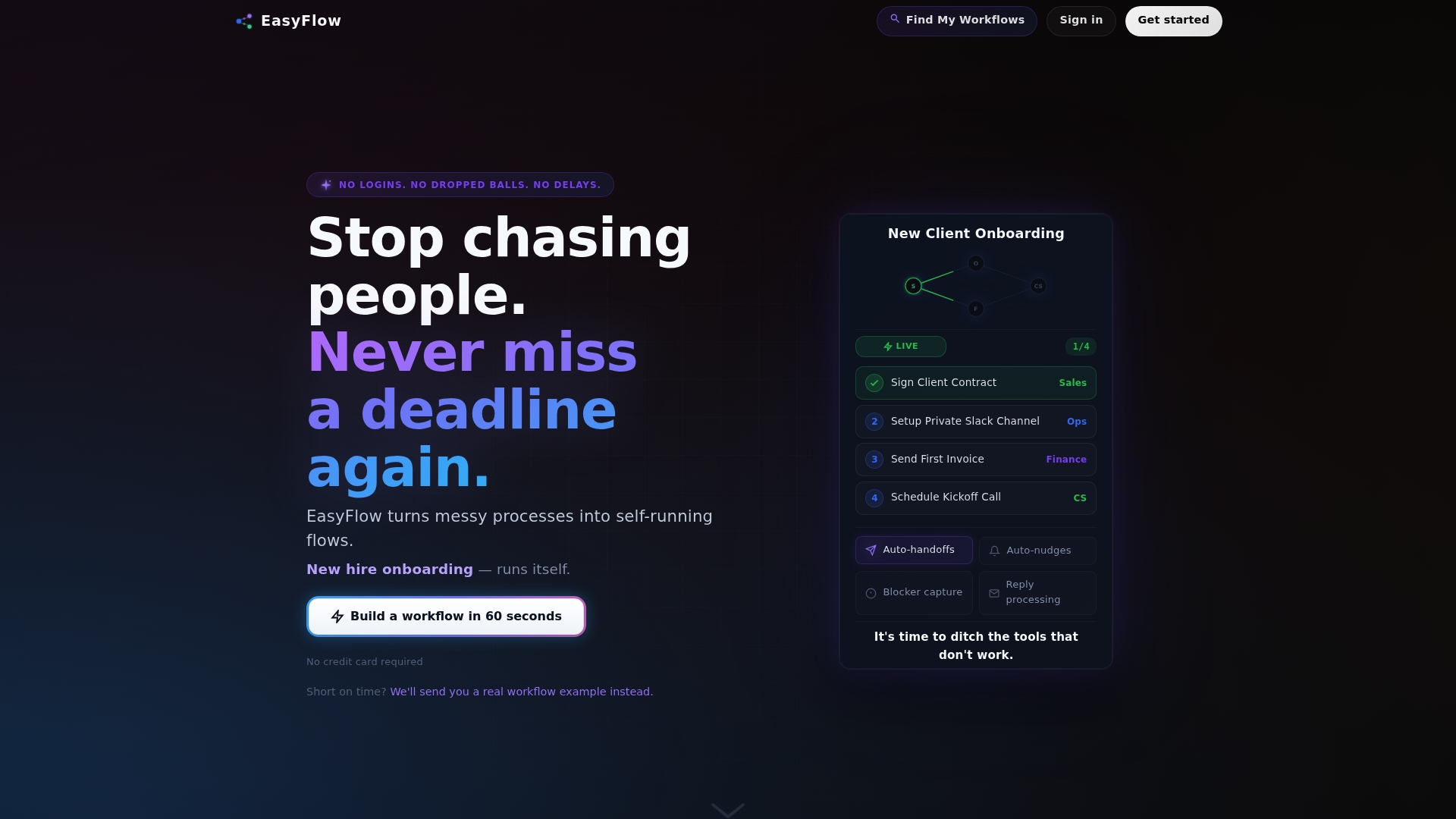
Business leaders and project managers use EasyFlow’s workflow automation to run repeatable onboarding processes at scale without adding headcount. The platform handles the scheduling, sequencing, and follow-up that teams consistently drop under pressure. If your current onboarding process depends on someone remembering to send an email, EasyFlow fixes that.
FAQ
What is the most important customer onboarding best practice in 2026?
Delivering a client’s first meaningful win within 5–15 minutes of onboarding is the single most impactful practice. Most churn happens within the first 90 days, and early value delivery is the strongest predictor of retention.
How many steps should an onboarding checklist have?
Onboarding checklists should contain 5 to 7 steps. Longer checklists overwhelm clients and delay the moment they experience real product value.
Which metrics best predict long-term client retention?
Time-to-first-value, feature adoption rate, activation rate, and customer health score are the four most predictive metrics. Reviewing them weekly gives teams enough lead time to intervene before a client churns.
How does AI improve the client onboarding experience?
AI adapts onboarding content in real time based on client behavior, surfacing the most relevant next step rather than following a fixed sequence. This reduces friction and accelerates the path to meaningful product use.
When should an intake survey be sent to a new client?
Send the intake survey within one hour of contract signing. Response rates drop significantly after 24 hours, and the data collected shapes every personalized touchpoint that follows.