
What Is a Repeatable Onboarding Process for Teams

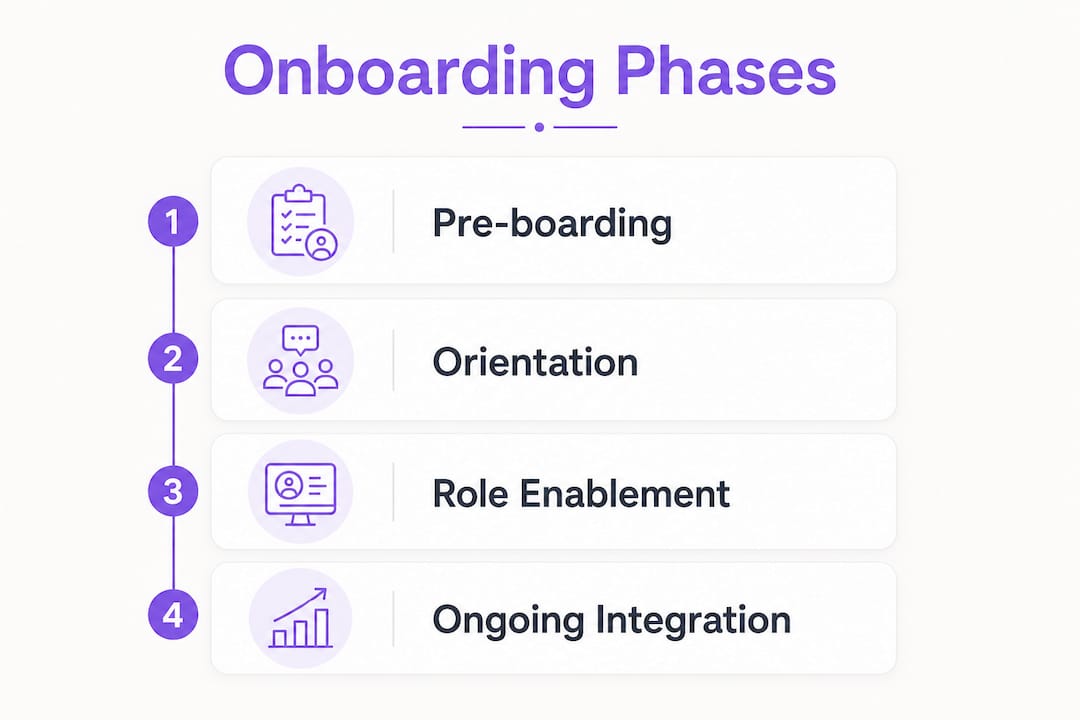
A repeatable onboarding process is a standardized system that guides every new hire or client through the same structured sequence of steps, ensuring consistent outcomes regardless of who runs it. The industry term for this is a scalable onboarding program, and it sits at the intersection of process design, role clarity, and workflow automation. A well-designed onboarding program drives up to 82% better employee retention and 70% faster time to productivity. Those numbers represent the difference between a team that scales confidently and one that constantly re-trains from scratch. The gold standard framework is the 90-day onboarding model, which divides the process into pre-boarding, orientation, role enablement, and ongoing integration phases.
What is a repeatable onboarding process built from?
A repeatable onboarding process relies on four standardized phases, each with defined outputs and owners. Without this structure, onboarding quality depends entirely on whoever happens to be running it that week.
Pre-boarding
Pre-boarding covers everything before day one: paperwork, system access, equipment setup, and welcome communications. High-performing programs complete all administrative tasks during pre-boarding, reserving day one for culture, introductions, and engagement. This separation matters because cognitive load on day one is already high. Dumping forms on a new hire alongside first-day introductions kills the connection you are trying to build.
Orientation and role enablement
Orientation runs through the first two weeks and covers company culture, team structure, and core tools. Role enablement spans days 30–60 and focuses on job-specific skills, workflows, and performance expectations. Standardized SOPs, competency matrices, and milestone checklists replace ad-hoc verbal training during this phase. Every hire receives the same base knowledge, which removes the “lottery” effect where outcomes depend on which manager ran the session.

Ongoing integration
The final phase runs through day 90 and shifts focus to performance, feedback, and cultural fit. RACI matrices clarify who owns each task, so nothing falls through the cracks when multiple stakeholders are involved. A scalable onboarding process standardizes the essentials, automates low-value admin, personalizes learning paths, and supports 30-60-90 day goals for consistent quality at scale.
Pro Tip: Build a single master onboarding checklist that covers all four phases, then create role-specific versions by adding or removing items. This gives you one source of truth without rebuilding from scratch for every new position.
The tools that hold this structure together include an HRIS for data and compliance, a learning management system (LMS) for training delivery, and a workflow automation platform for task triggers and handoffs. Teams that rely on email threads and spreadsheets to manage these phases consistently miss steps and create uneven experiences.
| Component | Purpose |
|---|---|
| SOPs | Standardize task execution so any team member can run the process |
| Competency matrix | Defines what “ready” looks like for each role at 30, 60, and 90 days |
| Milestone checklist | Tracks completion and surfaces gaps before they become problems |
| RACI matrix | Assigns clear ownership across HR, managers, and IT |
| Workflow automation | Triggers tasks, sends reminders, and routes approvals without manual follow-up |
How does a repeatable onboarding process improve retention and productivity?
Structured onboarding produces measurable results because it removes the two biggest causes of early attrition: confusion and disconnection. New hires who do not understand their role or feel isolated leave within the first 90 days at a disproportionately high rate.
“A well-designed onboarding program drives up to 82% better employee retention and 70% faster time to productivity. Repeatability is what makes those results consistent rather than accidental.”
The psychological mechanism is straightforward. When a new hire receives a clear learning path, defined milestones, and regular check-ins, they experience psychological safety. They know what is expected, they can measure their own progress, and they feel supported. That feeling directly reduces the anxiety that drives early resignations.
On the productivity side, role clarity accelerates performance. A competency matrix tells a new hire exactly what skills they need to demonstrate by day 60. That specificity cuts the time they spend guessing and increases the time they spend doing. Teams that use structured learning paths see new hires reach full productivity faster because the path is visible from day one.
The same logic applies to client onboarding. A client who goes through a consistent, well-sequenced onboarding process reaches their first value milestone faster. That speed directly affects retention and renewal rates. Reducing onboarding friction for clients produces the same compounding benefit as it does for employees: faster value, stronger loyalty, lower churn.
How to create an effective repeatable onboarding process
Building a repeatable onboarding strategy requires discipline in sequencing. Most teams make the mistake of jumping to automation before they have validated the underlying process manually.
-
Map the current process by hand. Interview managers, recent hires, and HR to document every step that currently happens, formally or informally. Do not skip this step. You cannot automate a process you do not fully understand.
-
Define roles, competencies, and milestones. For each role, write down what “successful” looks like at 30, 60, and 90 days. Attach specific, observable behaviors to each milestone so evaluation is objective.
-
Build your SOPs and checklists. Convert your process map into written SOPs. Create a master checklist and then role-specific variants. Keep language simple and steps atomic: one action per line.
-
Pilot the process manually. Run the onboarding process manually first to validate workflows before automating. This catches logical errors and missing steps that would otherwise get baked into your automation and require costly rework.
-
Collect feedback and iterate. After each pilot cohort, gather structured feedback from new hires and managers. Ask specific questions: Which steps felt unclear? Where did you wait for information? What was missing?
-
Automate the repetitive tasks. Once the manual process runs cleanly, automate task triggers, reminders, and approvals. Automating repetitive tasks while preserving human-led interactions like coaching and complex conversations is the correct balance. Do not automate the moments that require judgment or empathy.
-
Set a measurement cadence. Define the metrics you will track: ramp time, 90-day retention, manager satisfaction scores, and time-to-first-milestone. Review these on a quarterly basis.
Pro Tip: Assign a single owner to each onboarding phase. Shared ownership without a named accountable person means no one owns it. One name per phase eliminates the “I thought you handled that” problem.
The onboarding checklist essentials that work best are short, sequenced, and tied to a specific date or trigger. A checklist with 80 items and no due dates is a document. A checklist with 20 items, each triggered by a specific event, is a process.
What common pitfalls should managers avoid in onboarding?
Most onboarding failures share the same root causes. Recognizing them early saves significant time and rework.
-
Over-documenting before validating. Teams that spend weeks writing detailed SOPs before running a single pilot end up documenting a process that does not work. Write just enough to run the process, then refine based on what actually happens.
-
Treating onboarding as a one-time event. Onboarding ends at day 90 on paper, but the integration period extends well beyond that. Managers who disengage after the first month lose new hires to confusion and isolation in months two and three.
-
Ignoring measurement. Quarterly data reviews covering ramp time, performance metrics, and retention rates are the mechanism for continuous improvement. Without data, you are guessing which parts of the process work.
-
Skipping role-specific customization. A single generic onboarding program fails engineers, salespeople, and customer success managers equally. The core structure stays the same, but the role-specific content must reflect actual job requirements.
-
Automating too early. Validating workflows manually before automating prevents errors from becoming permanent features of your system. Automation amplifies whatever is already in the process, good or bad.
Pro Tip: Schedule a 90-day retrospective with every new hire before they exit the onboarding period. Ask three questions: What helped most? What was confusing? What was missing? Those answers are your next iteration.
Tracking onboarding progress automatically gives managers visibility without requiring manual status checks. When you can see where each person is in the process at a glance, you catch delays before they become problems.
Key Takeaways
A repeatable onboarding process is the single most reliable way to improve new hire retention, accelerate productivity, and scale your team without degrading the quality of each person’s experience.
| Point | Details |
|---|---|
| Start with the 90-day framework | Divide onboarding into pre-boarding, orientation, role enablement, and integration phases. |
| Validate before automating | Run the process manually first to catch errors before they get built into automation. |
| Use SOPs and competency matrices | Replace verbal training with written standards so every hire gets the same base knowledge. |
| Measure quarterly | Track ramp time, retention, and performance scores to iterate and improve the process. |
| Automate tasks, not relationships | Reserve human interaction for coaching, feedback, and complex conversations. |
Why I think most onboarding programs fail before they start
The most common mistake I see is managers treating onboarding as an HR deliverable rather than a business process. They hand it off, assume it is handled, and then wonder why new hires are disengaged by month two.
The programs that actually work share one trait: a named owner who treats the process like a product. They run retrospectives. They track metrics. They update the checklist when something breaks. They do not wait for annual reviews to fix what is obviously not working.
The automation question trips up a lot of teams too. There is a real temptation to buy a platform and automate everything immediately. The teams that do this end up automating a broken process at scale. The smarter path is to run it manually three times, fix what breaks, and then automate the parts that are genuinely repetitive. Human-led onboarding in early stages supports revenue and brand loyalty far better than a fully automated system that no one has validated.
The other thing I would push back on is the idea that repeatability means rigidity. The best onboarding programs I have seen are standardized at the structural level and flexible at the content level. The phases, milestones, and checkpoints stay the same. The specific training materials, examples, and conversations adapt to the role and the person. That combination is what produces both consistency and genuine connection.
— Harsh
How EasyFlow fits into your onboarding workflow
Building a repeatable onboarding program is straightforward once you have the structure. Executing it consistently across every new hire or client, without dropping tasks or chasing people for updates, is where most teams struggle.
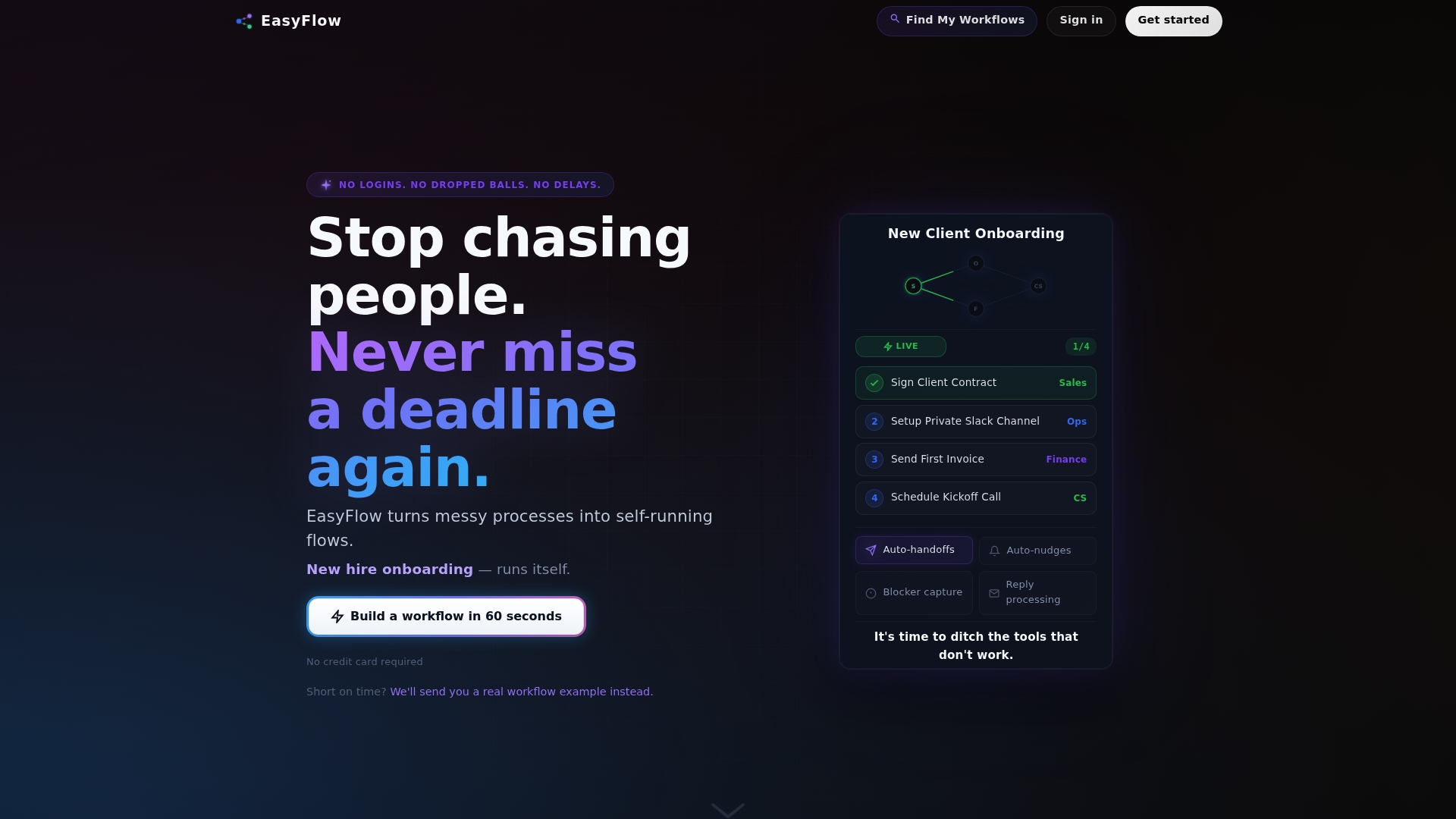
EasyFlow automates the workflow layer of onboarding: task triggers, handoffs, reminders, and approvals run automatically based on the rules you set. External collaborators complete their steps via magic links without needing to create accounts, which removes a common friction point in client onboarding. You get full visibility into where each person is in the process without manual status checks. Teams that want to run onboarding without extra staff use EasyFlow to handle the repetitive coordination while keeping human attention on the moments that matter. Start building your onboarding workflow and see how the process runs from day one.
FAQ
What is a repeatable onboarding process in simple terms?
A repeatable onboarding process is a documented, standardized system that guides every new hire or client through the same sequence of steps, producing consistent outcomes regardless of who runs it.
How long does it take to build a repeatable onboarding program?
A well-designed onboarding program takes 8–12 hours to build initially. That investment pays back through measurably higher retention and faster productivity ramp-up.
What is the 90-day onboarding framework?
The 90-day framework divides onboarding into four phases: pre-boarding, orientation, role enablement (days 30–60), and ongoing integration through day 90. It is the standard structure for scalable onboarding programs.
When should you automate your onboarding process?
Automate only after you have run the process manually and confirmed it works. Automating an unvalidated process bakes errors into your system and creates costly rework.
How do you measure onboarding effectiveness?
Track ramp time, 90-day retention rates, and manager satisfaction scores. Review these metrics quarterly to identify which parts of the process need adjustment.