
Customer Success Workflows: A Practical Guide for CS Teams

A customer success workflow is a repeatable, data-driven sequence of triggers, tasks, owners, and automated actions that guides customers from onboarding through expansion — consistently, at scale. If your team is still running CS from spreadsheets, Slack threads, or memory, you already feel the cost: missed renewals, inconsistent onboarding, and CSMs spending half their day on follow-ups instead of customers.
Three things change when you formalize a customer success workflow:
- Faster time-to-value: Customers hit their first milestone sooner because every step is pre-mapped and triggered automatically.
- Reduced handoff friction: Sales-to-CS, CS-to-support, and CS-to-renewal transitions happen on cue, not when someone remembers.
- Consistent outcomes at scale: A new CSM running the same workflow as your best CSM produces the same result.
Start here: pick one high-impact workflow (onboarding is the usual first choice), map it end-to-end, and pilot it with a small customer cohort before rolling it out.
Table of Contents
- How do you design and build a customer success workflow?
- How do you automate CS playbooks for onboarding, risk, and renewals?
- Which tools run customer success workflows?
- How do you measure whether a CS workflow is working?
- Copy-paste workflow template and two mini examples
- What mistakes kill CS workflows, and what actually works?
- How do you launch and govern a CS workflow at scale?
- Does workflow-execution automation actually change CS operations?
- Key Takeaways
- The part most CS teams get wrong
- EasyFlow runs the execution layer your CS workflows need
- Useful sources
- FAQ
How do you design and build a customer success workflow?
The most common mistake is starting with the tool. Start with the customer moment instead. Vitally’s process guide recommends a stepwise approach that prioritizes stakeholder alignment and modular playbooks before any automation is configured.
- Map the customer journey. Lay out the full sequence from trigger to outcome. Dialpad’s practical guide recommends mapping the journey before assigning ownership, so you see the full picture before dividing responsibility.
- Build the playbooks — Write entry and exit criteria for each stage. Entry: what condition must be true to start? Exit: what must be true to move on? Keep playbooks modular so they can be reused across segments.
Sample 30/60/90-day onboarding timeline
| Phase | Days | Key Milestones |
|---|---|---|
| Kickoff | 1–7 | Contract signed, kickoff call held, admin access granted |
| Setup | 8–21 | Core configuration complete, first user trained |
| Activation | — | Customer completes first core use case, usage threshold met |
| Value confirmation | — | First business outcome documented, health score reviewed |
| Expansion readiness | — | Adoption score stable, expansion conversation initiated |
Pre-launch validation checklist:
- All triggers tested in a sandbox environment
- SLA timers confirmed and notifications firing correctly
- Data sources connected and health score computing accurately
- Each task has a named owner and a fallback escalation path
- Stakeholders from CS, Product, and Sales have reviewed and signed off
How do you automate CS playbooks for onboarding, risk, and renewals?
Automation in CS is not about replacing CSMs. It is about making sure the right action happens at the right time without anyone having to remember to do it. Gainsight’s essential guide frames CS as a revenue-generating function where unified data and automated playbooks are the infrastructure for scale.
Four ready-to-adapt playbook templates
1. Onboarding playbook
- Trigger: Contract signed
- Goal: Customer achieves first core use case within 30 days
- Steps: Send welcome sequence → schedule kickoff → assign setup tasks → confirm activation → document first outcome
- Owner: Onboarding CSM
- Timeline: 30 days
- Success metric: Customer logs in 3+ times in week one; core feature activated by day 21
2. Risk mitigation playbook
- Trigger: Health score drops below threshold OR usage falls 40% week-over-week
- Goal: Restore engagement and identify root cause within 14 days
- Steps: CSM review of account data → outreach call within 48 hours → root cause documented → remediation plan sent → follow-up check at day 14
- Owner: Account CSM, escalation to CS Manager if unresolved at day 7
- Timeline: 14 days
- Success metric: Health score returns to green; customer confirms remediation plan accepted
3. Renewal playbook
- Trigger: 90 days before renewal date
- Goal: Renewal confirmed or risk flagged 60 days before expiry
- Steps: Pull account health summary → schedule executive business review → present ROI documentation → send renewal proposal → confirm or escalate
- Owner: CSM + Account Executive
- Timeline: 30 days (within the 90-day window)
- Success metric: Renewal decision documented by day 30 of playbook
4. Expansion playbook
- Trigger: Adoption score exceeds threshold AND customer has been live 60+ days
- Goal: Expansion conversation initiated and opportunity logged in CRM
- Steps: CSM identifies expansion signal → prepares use case → schedules conversation → logs opportunity → hands off to Account Executive
- Owner: CSM initiates; Account Executive owns close
- Timeline: 21 days
- Success metric: Expansion opportunity created in CRM
Risk playbook decision logic (if/then branch)
- Health score drops below threshold → Is this the first drop in 30 days?
- Yes: Automated check-in email sent; CSM task created for day 3 follow-up
- No (recurring drop): Immediate CSM task created with 24-hour SLA; CS Manager notified; upsell sequence paused
Which tools run customer success workflows?
The right tool depends on what you need the workflow to do, not just track. Gartner Peer Insights reviews of CSM platforms show the market moving toward AI-enabled solutions that surface next-best actions and support prescriptive automation, rather than static dashboards.
CSM platforms
- Gainsight: — The enterprise standard for CS operations. Offers health scoring, playbook automation, timeline tracking, and AI-assisted next-best-action recommendations. Best for large CS teams with complex segmentation needs.
- Totango: — Built around a “SuccessBLOCS” modular approach, letting teams activate pre-built workflow modules for specific lifecycle stages. Strong real-time data aggregation and early-warning health alerts.
- Vitally: — Designed for B2B SaaS CS teams that want a clean interface and fast setup. Combines health scoring, playbooks, and project tracking in one workspace. Popular with mid-market teams.
- Custify: — Focused on SaaS companies with high-touch CS models. Provides automated playbooks, health scores, and a built-in task management layer. Pricing is accessible for smaller teams.
- monday.com: — Not a dedicated CSM platform, but widely used by CS teams for workflow tracking, project management, and cross-functional handoffs. Works well when CS workflows involve multiple departments.
Pro Tip: If your CS workflows involve external stakeholders — customers completing setup tasks, partners submitting data, or vendors confirming steps — a dedicated execution engine handles that better than a CSM platform alone. CSM platforms track internal CS activity; execution engines can assign and complete tasks outside your organization without requiring external users to create accounts.
Integration data table
| System Type | Data Exchanged | Workflow Use |
|---|---|---|
| CRM (e.g., Salesforce, HubSpot) | Contract dates, ARR, contact records, deal stage | Trigger onboarding on close; feed renewal dates |
| Product analytics (e.g., Mixpanel, Amplitude) | Feature usage, login frequency, activation events | Health score inputs; trigger risk or expansion plays |
| Support (e.g., Zendesk, Intercom) | Ticket volume, resolution time, CSAT | Health score modifier; trigger escalation workflows |
| Billing (e.g., Stripe, Chargebee) | Payment status, plan tier, renewal date | Trigger renewal playbook; flag churn risk on failed payment |
| Voice of customer (e.g., Medallia, Delighted) | NPS, CSAT, survey responses | Trigger detractor follow-up; feed health model |
How do you measure whether a CS workflow is working?
Measurement splits into two layers: primary KPIs that tell you whether CS is delivering business outcomes, and operational KPIs that tell you whether the workflow itself is functioning.
Primary KPIs:
- Net Revenue Retention (NRR): The percentage of recurring revenue retained from existing customers after accounting for churn, downgrades, and expansion. The headline metric for CS as a revenue function.
- Time-to-Value (TTV): How long it takes a new customer to reach their first meaningful outcome. Shorter TTV correlates with higher retention.
- Expansion Rate: Revenue growth from existing customers through upsells and cross-sells.
Operational KPIs:
- Playbook completion rate: Completed steps ÷ assigned steps × 100. A rate below 80% usually signals ownership gaps or SLA problems.
- SLA compliance rate: Tasks completed within SLA ÷ total tasks × 100. Watch this weekly.
- Touch cadence adherence: Scheduled customer touchpoints completed ÷ scheduled touchpoints. Gaps here often precede churn.
- Health score distribution: Percentage of accounts in green, yellow, and red. Track the trend, not just the snapshot.
You can track onboarding progress automatically to keep these metrics current without manual reporting.
Reporting cadence:
- Weekly: Operational KPIs (SLA compliance, playbook completion, health score changes). Reviewed by CS team leads.
- Monthly: Performance KPIs (TTV, NRR trend, expansion rate). Reviewed by CS leadership.
- Quarterly: Business review (full NRR, churn analysis, workflow effectiveness, iteration priorities). Reviewed with executive stakeholders.
Copy-paste workflow template and two mini examples
Mini example 1: 30-day onboarding workflow
| Step | Task | Owner | SLA | Action on Completion |
|---|---|---|---|---|
| 1 | Send welcome email + resource kit | Automated | Day 1 | Trigger kickoff scheduling task |
| 2 | Schedule kickoff call | Onboarding CSM | Day 3 | Send calendar invite; log in CRM |
| 3 | Complete core product setup | Customer + CSM | Day 10 | Confirm via product event; advance stage |
| 4 | First training session held | Onboarding CSM | Day 14 | Log completion; send follow-up resources |
| 5 | Activation milestone confirmed | System (product event) | Day 21 | Trigger value confirmation task |
| 6 | Document first business outcome | CSM | Day 30 | Update health score; initiate expansion check |
For a detailed client onboarding checklist, you can adapt these steps to your specific product and customer segment.
Mini example 2: At-risk remediation workflow
| Step | Task | Owner | SLA | Action on Completion |
|---|---|---|---|---|
| 1 | Health score alert fires | Automated | Immediate | Create CSM review task |
| 2 | CSM reviews account data | CSM | 24 hours | Document findings; decide outreach approach |
| 3 | Outreach call or email sent | CSM | 48 hours | Log outcome; if no response, escalate |
| 4 | Root cause identified | CSM + Customer | Day 7 | Create remediation plan |
| 5 | Remediation plan sent | CSM | Day 8 | Customer confirms receipt |
| 6 | Follow-up check | CSM | Day 14 | Reassess health score; close or extend |
Go-live checklist
- Triggers tested and confirmed firing in the correct conditions
- All tasks have named owners and fallback escalation paths
- SLA notifications tested and confirmed reaching the right people
- Health score data sources verified and computing correctly
- Playbook content reviewed by CS lead and at least one CSM
- Pilot cohort selected (5–10 accounts, representative mix)
- Success metrics defined and baseline recorded before launch
What mistakes kill CS workflows, and what actually works?
Top 8 best practices
- Start with one high-impact workflow (onboarding or at-risk) and prove the model before expanding.
- Align CS, Sales, Product, and Finance on workflow design before building anything.
- Build modular playbooks with clear entry and exit criteria so they can be reused across segments.
- Monitor adoption: if CSMs are manually overriding workflow steps regularly, the workflow needs revision, not the CSMs.
- Iterate on a fixed cadence (monthly review minimum) rather than waiting for something to break.
- Use workflow automation to reduce handoff friction between CS and adjacent teams.
- Keep playbook steps short and executable. If a step requires a paragraph of explanation, break it into two steps.
- Document what top-performing CSMs do manually, then automate those patterns incrementally.
Red flags that a workflow is failing:
- CSMs are manually overriding or skipping automated steps more than 20% of the time
- Playbook completion rate is declining month-over-month
- Customers are reaching out about missed touchpoints
- Health score alerts are firing but no tasks are being created or completed
How do you launch and govern a CS workflow at scale?
Getting a workflow live is one thing. Keeping it effective as your team and customer base grow is another. Governance is what separates a workflow that lasts from one that quietly gets abandoned.
Responsibilities matrix (RACI)
| Task | CS Lead | CSM | RevOps / Ops | Product | Sales |
|---|---|---|---|---|---|
| Workflow design | A | R | C | C | C |
| Playbook content | A | R | I | C | I |
| Data / integrations setup | I | I | R | C | I |
| Pilot execution | A | R | C | I | I |
| Metrics reporting | A | R | R | I | I |
| Quarterly review | A | C | R | C | C |
R = Responsible, A = Accountable, C = Consulted, I = Informed
Pre-launch checklist (governance version):
- Workflow owner named and briefed
- All data sources connected and validated
- Stakeholder sign-off from CS, Sales, and RevOps
- Escalation paths documented for every SLA breach
- Success thresholds defined for pilot evaluation
- Rollback plan documented if pilot fails
Does workflow-execution automation actually change CS operations?
The short answer: yes, but only when the tool can execute, not just track. Most CSM platforms are excellent at surfacing information. Fewer can actually complete tasks, send notifications, and coordinate steps across people who are not on your internal team.
The operational difference shows up in a few specific places:
- Teams that automate task creation and notifications report fewer missed follow-ups and faster milestone completion, because the system creates the task rather than relying on a CSM to remember.
- Consistent automated touchpoints mean every customer in a segment gets the same experience, regardless of which CSM owns the account.
- When external collaborators (customers, partners, vendors) need to complete steps, tracking-only tools create friction. The customer has to log into a portal, create an account, or respond to a generic email. Execution engines can send a magic link that lets the external party complete their task directly, without any account creation.
Execution-capable workflow engines do something tracking tools cannot: they assign, trigger, and complete tasks across internal and external participants automatically. When a customer needs to submit a form, confirm a milestone, or approve a document, an execution engine sends them a direct link to do exactly that — no portal login, no account setup, no friction. That capability is what closes the gap between a workflow that looks complete on a dashboard and one that actually moves customers forward.
EasyFlow is built specifically for this execution layer. It automates handoffs, sends reminders, and lets external collaborators complete tasks via magic links without creating accounts. For CS teams running onboarding or implementation workflows that involve customer-side steps, that distinction matters.
When does a dedicated execution engine make sense? Three signals:
- Your CS workflows involve external participants (customers, partners) who need to complete tasks.
- You have frequent cross-team handoffs (CS to Support, CS to Sales, CS to Implementation) that currently require manual coordination.
- You are scaling past the point where a CSM can personally track every open task across their book of business.
Key Takeaways
A customer success workflow is only as effective as its triggers, owners, and execution layer — teams that automate task handoffs and close the feedback loop consistently outperform those that rely on manual follow-up.
| Point | Details |
|---|---|
| Definition first | A CS workflow is a repeatable sequence of triggers, tasks, owners, and automated actions mapped to lifecycle stages. |
| Pilot before scaling | Run any new workflow with 5–10 accounts first; target 80%+ completion rate before full rollout. |
| Health scores drive automation | Real-time health signals (usage, support, NPS) are the most reliable triggers for risk and expansion playbooks. |
| Measure operationally | Track playbook completion rate (completed steps ÷ assigned steps) and SLA compliance weekly, not just NRR monthly. |
| EasyFlow for execution | EasyFlow executes workflows across internal and external participants via magic links, removing account-creation friction for customer-side tasks. |
The part most CS teams get wrong
Most CS teams build workflows that look complete on paper and fall apart in practice. The gap is almost never strategy. It is execution: who actually does the task, when, and how the system ensures it happens.
The conventional wisdom says to start with your tech stack. Pick the right CSM platform, configure the health scores, build the playbooks. That advice is not wrong, but it puts the tool before the behavior. The teams that build durable workflows start by watching what their best CSMs do manually, writing it down precisely, and then asking: which of these steps could a system handle without losing the human judgment that makes it work?
The answer is usually more than you expect. Scheduling follow-ups, sending resource links, creating tasks when a health score drops, routing a renewal to the right account executive — none of that requires a CSM’s judgment. It requires reliability. Automation provides reliability. CSMs provide judgment. The mistake is asking CSMs to provide both.
One practical thing you can do this week: pull your last five churned accounts and map the last 30 days of activity before they churned. Look for the step that didn’t happen, or happened too late. That step is your first workflow priority.

EasyFlow runs the execution layer your CS workflows need
Most CS platforms tell you what should happen. EasyFlow makes it happen. For CS teams running onboarding, implementation, or risk workflows that involve customer-side tasks, the bottleneck is almost always the same: waiting for someone outside your team to complete a step, confirm a milestone, or submit information.
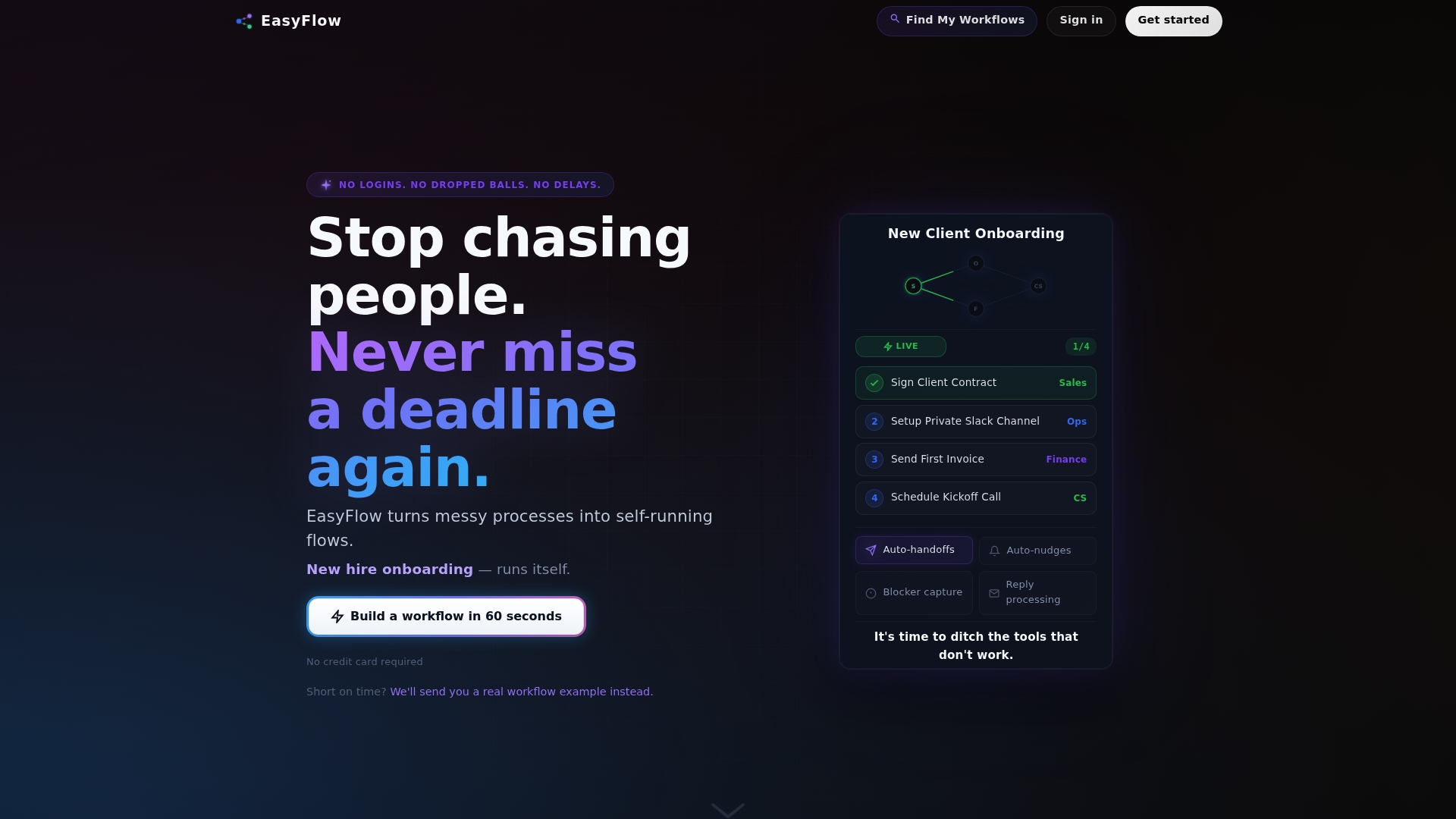
EasyFlow removes that bottleneck by sending external collaborators a direct magic link to complete their task, with no account creation required. Your customers, partners, or vendors act immediately instead of getting stuck at a login screen. Internally, EasyFlow automates task handoffs, sends reminders when steps stall, and uses AI to generate workflow drafts from a plain-language description of your process. Pre-built templates for onboarding and implementation get you live in hours, not weeks.
CS teams using EasyFlow report fewer manual follow-ups, faster milestone completion, and consistent customer experiences across their full book of business. Start a free trial at EasyFlow and run your first workflow in under a day.
Useful sources
- The Essential Guide to Customer Success: The Complete Guide for 2026
- How to Build a Customer Success Process | Vitally
- Your Customer Success Workflow: A Guide to Understanding and Optimizing It
- Customer Success Process: A Practical Guide | Dialpad
- Best Customer Success Management Platforms Reviews 2026 | Gartner Peer Insights
- Customer Success Management: Complete Guide (CSMIS)
- EasyFlow — Free Workflow Management Software for Teams
FAQ
What is a customer success workflow?
A customer success workflow is a repeatable sequence of triggers, tasks, owners, and automated actions that guides customers through lifecycle stages — from onboarding to expansion — consistently and at scale.
What are the five pillars of customer success?
Definitions vary across frameworks, but a widely used version covers: onboarding, adoption, retention, expansion, and advocacy. Each pillar maps to at least one operational workflow with defined triggers, owners, and success metrics.
What are the five steps of a workflow?
A standard workflow follows five steps: trigger (what starts it), task assignment (who does what), execution (completing the task), handoff (passing to the next owner or stage), and measurement (confirming the outcome against a success metric).
What are the four pillars of customer success?
A common four-pillar model covers: proactive engagement, health monitoring, playbook execution, and renewal or expansion management. These pillars align directly with the core components of any CS workflow.
What KPIs should you track for CS workflow effectiveness?
Track primary KPIs (Net Revenue Retention, Time-to-Value, expansion rate) and operational KPIs (playbook completion rate, SLA compliance, touch cadence adherence). Review operational metrics weekly and primary metrics monthly.