
Client Implementation Workflow Types: A 2026 Guide

Client implementation workflow types are structured sequences that govern how teams onboard clients, execute deliverables, and manage approvals across every phase of service delivery. The five core types are sequential, parallel, conditional, case, and rules-driven workflows. Each serves a distinct purpose, and choosing the wrong one for a given project creates delays, missed handoffs, and frustrated clients. Standard implementation process steps include defining objectives, assigning roles, building milestones, and obtaining formal sign-off. Getting those steps into the right workflow structure is what separates teams that scale from teams that scramble.
1. What are the main client implementation workflow types?
The five primary workflow types used in client implementation are sequential, parallel, conditional, case, and rules-driven. Each maps to a different level of project complexity and team structure. Project managers who understand all five can match the right structure to the right engagement instead of forcing every client into a one-size-fits-all process. That matching decision directly affects how fast your team delivers and how clearly clients see progress.

2. Sequential workflows and when to use them
A sequential workflow moves tasks in a strict linear order. Task B cannot start until Task A is complete. Sequential design gives teams clear progress tracking but removes flexibility when conditions change mid-project.
Sequential workflows work best for:
- Simple client onboarding with a defined checklist
- Milestone-based approvals where each sign-off gates the next phase
- Small projects with a single team and a clearly scoped deliverable
- Compliance-heavy processes where audit trails require a fixed order
The main limitation is rigidity. If a client delays one step, every downstream task stalls. That bottleneck effect makes sequential structures a poor fit for large, multi-team implementations.
Pro Tip: Map your sequential workflow against your client’s internal approval calendar before kickoff. A two-week delay in their legal review will freeze your entire delivery chain if you have not built a buffer milestone.
3. How parallel workflows speed up client onboarding
A parallel workflow runs multiple tasks at the same time across different owners or teams. Parallel execution accelerates delivery but requires careful coordination to prevent conflicts when tasks share dependencies.
A practical example: while your technical team configures a client’s software environment, your content team produces training materials and your account manager completes contract documentation. All three tracks run simultaneously. The project only advances to the next phase when all three complete.
Parallel workflows are the right choice when:
- Multiple departments contribute to a single client deliverable
- Cycle time reduction is a priority and tasks have no hard dependencies
- You have enough team members to own separate tracks without overloading individuals
- The client expects a fast go-live and sequential execution would miss the deadline
The coordination challenge is real. Dependency management becomes critical. If the technical configuration track finishes early but the content track runs late, the go-live still waits. Teams using onboarding automation tools to run parallel tracks report fewer missed handoffs because the system flags incomplete dependencies automatically.
4. Conditional and case workflows: managing complexity in client implementation
Conditional workflows branch based on rules or client inputs. If a client selects a premium tier, the workflow routes to an extended onboarding path. If they select a standard tier, it routes to a shorter one. The logic is predefined, but the path each client takes is dynamic.
Case workflows go one step further. They handle unique client requests or exceptions that do not fit any predefined branch. A change request mid-project, an escalation outside normal SLA, or a client with a non-standard integration all require case-style handling. Dynamic rules and case management enable tailored client experiences and better handling of exceptions and change requests.
Conditional and case workflows are best suited for:
- Enterprise clients with multiple product tiers or service levels
- Implementations that include approval gates with variable SLA requirements
- Change request handling where each request needs its own resolution path
- Situations where client data collected during onboarding determines next steps
Pro Tip: Build your conditional logic around no more than three decision points per workflow. More than three branches in a single flow creates maintenance complexity that will cost you more time than the flexibility saves.
5. Rules-driven workflows and approval flows in service delivery
Rules-driven workflows operate on explicit, predefined criteria. Every task, escalation, and approval follows a documented rule. Approval workflows define request formats, approver chains, SLA response times, and escalation paths. Teams that use dedicated approval templates cut approval cycle times by up to 50%.
That 50% reduction matters because approval delays are the single most common cause of implementation overruns. When approvers know exactly what format a request must take, who reviews it, and what happens if they miss the SLA window, reviews happen faster and with fewer back-and-forth cycles.
The table below compares rules-driven approval workflows against ad hoc approval processes:
| Factor | Rules-driven approval | Ad hoc approval |
|---|---|---|
| Approver clarity | Named chain defined upfront | Determined case by case |
| SLA enforcement | Automatic escalation triggers | Manual follow-up required |
| Cycle time | Up to 50% faster | Unpredictable |
| Audit trail | Automatic and complete | Inconsistent |
| Scalability | Repeatable across all clients | Breaks under volume |
Separating your approval workflow from your general project template is a best practice worth enforcing. When approval logic lives inside a broader project template, it gets modified accidentally and loses its integrity over time.
6. Five essential client implementation workflow templates
Effective client workflows separate onboarding, kickoff, approvals, production, and change management into dedicated templates. Each template serves a distinct delivery phase and prevents scope from bleeding across process boundaries.
-
Client onboarding template. This template covers everything from initial data collection to system access provisioning. It typically runs as a sequential or conditional workflow depending on the client’s tier. Key components include a welcome sequence, account setup tasks, and a completion confirmation step. Teams that track onboarding progress automatically catch stalled tasks before they affect go-live dates.
-
Project kickoff template. The kickoff template formalizes scope, assigns named owners to every task, and establishes the communication cadence. Assigning a named owner to every task prevents the bystander effect where everyone assumes someone else is responsible. This template runs sequentially and gates the start of delivery work.
-
Approval flow template. This template handles all review and sign-off requests. It defines who approves what, in what order, and what happens when a deadline is missed. Keeping this template separate from your project template protects its logic from accidental edits.
-
Content production template. Content production runs as a parallel workflow. Copywriting, design, review, and client approval all have separate owners and can advance simultaneously up to the final consolidation point. This template works well for marketing agencies, software documentation teams, and any service that delivers content as a core output.
-
Change request template. Change requests need their own case-style workflow because each request is unique. The template captures the request details, routes it to the right approver, documents the impact assessment, and records the final decision. Without a dedicated template, change requests get handled inconsistently and create scope creep that is hard to trace. A solid project workflow template for change requests also gives clients a clear process to follow, which reduces informal requests made over email or chat.
Each of these five templates maps directly to one or more of the workflow types covered earlier. Onboarding and kickoff use sequential or conditional logic. Approvals use rules-driven logic. Content production uses parallel logic. Change requests use case logic. Matching the template to the right type is what makes the system work.
Key takeaways
The most effective client implementation approach combines all five workflow types across dedicated templates, with named task owners and explicit approval rules at every stage.
| Point | Details |
|---|---|
| Match workflow type to complexity | Use sequential for simple projects, parallel for multi-team delivery, and conditional for tiered clients. |
| Separate approval templates | Dedicated approval workflows cut cycle times by up to 50% and protect logic from accidental edits. |
| Assign named task owners | Every task needs one named owner to prevent the bystander effect and reduce slippage. |
| Use five core templates | Onboarding, kickoff, approvals, content production, and change requests each need their own template. |
| Break tasks into two-week chunks | Tasks longer than two weeks require decomposition for accurate estimation and clear ownership. |
What I have learned about client implementation workflows
The biggest mistake I see project teams make is treating workflow type as a formatting choice rather than a structural decision. They pick sequential because it looks clean on a slide, then wonder why their multi-team implementation keeps stalling.
Client journeys that span multiple teams and vendors need custom workflows that reflect actual business rules, not generic project management templates. Generic tools track tasks. They do not enforce the logic that makes those tasks execute in the right order with the right people.
The second mistake is skipping task decomposition. Tasks exceeding two weeks require decomposition into smaller packages. A task called “complete integration” assigned to a developer with a three-week window is not a task. It is a hope. Break it down, assign a named owner to each piece, and set a two-week ceiling.
My honest recommendation: start every new client engagement by mapping the complexity level first. Simple scope with one team gets a sequential workflow. Multi-team delivery with concurrent tracks gets parallel. Tiered service levels or variable client inputs get conditional logic. And every engagement gets a separate approval template, no exceptions. The teams I have seen execute client implementations most cleanly are the ones who treat their workflow templates as living infrastructure, not one-time setup documents.
— Harsh
How EasyFlow handles every client implementation workflow type
EasyFlow automates sequential, parallel, conditional, and rules-driven workflows without requiring clients or external collaborators to create accounts. External participants complete tasks through magic links, which removes the friction that typically slows down client onboarding in the first phase.
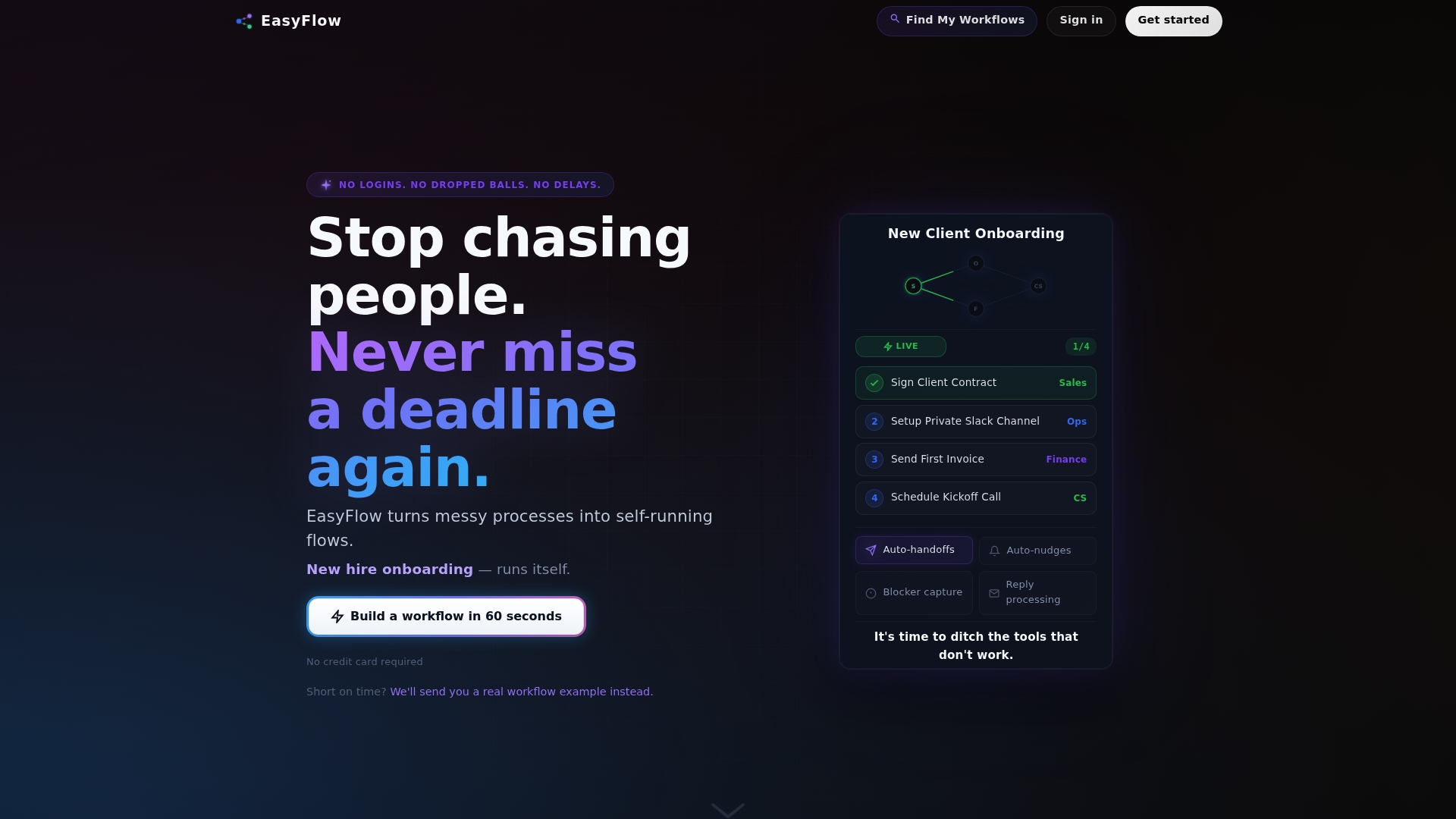
Built-in templates for onboarding, approvals, content production, and change requests give project managers a ready structure they can customize to match client complexity. EasyFlow executes the process rather than just tracking it, which means fewer manual follow-ups and faster handoffs across every delivery phase. If your team is managing client implementations across multiple workflow types, start with EasyFlow to see how automated execution changes your delivery speed.
FAQ
What are the five client implementation workflow types?
The five types are sequential, parallel, conditional, case, and rules-driven workflows. Each serves a different level of project complexity and team structure.
When should you use a parallel workflow for client onboarding?
Use a parallel workflow when multiple teams contribute to a single deliverable and cycle time reduction is a priority. Parallel execution accelerates delivery but requires careful dependency management.
How much faster are approval workflows with dedicated templates?
Teams using dedicated approval templates cut approval cycle times by up to 50%. The improvement comes from predefined approver chains, SLA rules, and automatic escalation triggers.
Why do conditional workflows outperform sequential ones for enterprise clients?
Conditional workflows branch based on client inputs or service tiers, giving each client a path that matches their actual needs. Sequential workflows force every client through the same steps regardless of complexity.
What is the best practice for task ownership in client implementation?
Assign one named owner to every task without exception. Named ownership prevents the bystander effect and reduces task slippage across all workflow types.