
Cross-Company Workflow Challenges: 2026 Solutions Guide

What are the biggest cross-company workflow challenges?
Cross-company workflow challenges come down to a handful of recurring problems: tool silos, manual data entry, communication breakdowns, unclear process ownership, and data security gaps. Each one slows execution and erodes trust between partners. The good news is that 2026 research and workflow automation tools like EasyFlow give teams a clear path forward.
Here is a quick map of the core challenges and their solutions:
- Tool silos: Teams stay in their preferred platforms, creating visibility gaps. Fix: bidirectional sync that lets each side work in its own tool.
- Manual tasks: Redundant data entry and copy-paste work consume project managers’ time. Fix: automated workflow execution.
- Communication barriers: Asynchronous preferences and layered facilitators distort messages. Fix: centralized, tool-native communication with real-time sync.
- Governance gaps: No clear process owner means disputes multiply at period-end. Fix: explicit master data ownership and governance frameworks.
- Data security: Sharing across organizational boundaries creates compliance exposure. Fix: fine-grained sync controls that share only what is explicitly configured.
- Change management: Stakeholder resistance stalls adoption. Fix: low-friction onboarding, such as magic link task completion, that requires no new accounts.
Why cross-company workflow challenges are so persistent
The friction in cross-company workflows is structural, not accidental. Every organization brings its own tools, governance rules, security policies, and data definitions to a partnership. When those systems need to cooperate, the complexity compounds fast.
Tool silos form even when two companies use the same platform, because neither wants to grant the other full account access. Confidential data lives inside those accounts, and security is a real concern. The result: information sits in separate places, and someone has to manually bridge the gap.
That someone is usually a project manager. Manual coordination overhead in cross-company projects can consume up to 20 minutes per task of administrative effort by project managers. Multiply that across dozens of tasks and you have a person whose entire day is copy-paste work instead of actual project management.

Governance breakdowns hit finance teams hardest: missing mirror entries, unclear coding, and late adjustments cascade into delayed tax filings and treasury settlement friction. A May 2026 Deloitte report found that intercompany controllership issues create downstream problems across tax, treasury, and foreign exchange operations. Unclear process ownership sits at the root of most of those breakdowns.
Communication adds another layer. Cross-company messaging travels through layers of facilitators and email chains, and by the time it arrives, the context is often stale or distorted. Cultural differences in communication style, from asynchronous-first teams to daily-meeting cultures, make compromise slow and sometimes resentful.
Why digital technology is the only realistic fix
Manual and point-to-point integration approaches simply do not scale in multi-company environments. Each new partner connection adds configuration and maintenance overhead that grows linearly, creating what practitioners call a coordination tax.
A July 2026 study in the Journal of Management Studies found that digital technology acts as a “digital boundary spanner,” bridging capability gaps between partners when one side is stronger at absorbing knowledge and the other at transmitting it. High levels of digital technology adoption can offset almost any misalignment between partners’ knowledge-sharing capabilities.
Forrester research reinforces this: integration vendors must prioritize standards, data federation, and access control to make intercompany collaboration work. The architecture matters as much as the tooling. A centralized integration layer where one party controls both sides of the connection is a liability, not an asset. What works is independent operational control: each organization configures its own sync rules, decides what data it shares, and can update its end without waiting for the other party.
Resilience matters too. An integration that silently breaks when a vendor updates its API is not infrastructure. Production-grade cross-company workflows need retry mechanisms, error queuing, and the ability to resume from the point of interruption.
Pro Tip: When evaluating integration platforms, ask specifically whether each connecting party gets its own independent scripting engine. If the answer is no, every configuration change on one side will require coordination with the other, and that coordination cost compounds with every new partner you add.
Practical strategies to improve workflow between companies
Fixing cross-company workflows requires work at three levels: process design, tooling, and people.
Start upstream. Intercompany data problems rarely originate in reconciliation. They originate in agreements, booking standards, and data requirements that were never clearly defined. Map your transaction types end-to-end before touching any tooling.
- Assign named owners to master data and process standards.
- Define shared data fields and their exact meanings across both organizations before building any integration.
- Bring tax, treasury, and compliance stakeholders into the design early so their requirements are built in, not retrofitted.
Choose tools that respect each party’s autonomy. Platforms that allow bidirectional sync with independent control per side reduce onboarding resistance significantly. When teams can stay in their preferred environments, adoption happens faster and tool-preference debates disappear.
Automate execution, not just tracking. Traditional project management tools record what needs to happen. Workflow automation tools like EasyFlow actually run the process, sending tasks to the right people at the right time without requiring every participant to log into a new platform.
Pro Tip: Stakeholder buy-in accelerates when you reduce the ask. If external collaborators can complete a task through a magic link without creating an account, the adoption barrier drops to near zero.
Measure what matters. Set KPIs for cross-company workflows specifically: task completion time, sync error rates, and the number of manual interventions per week. Without those baselines, you cannot tell whether your changes are working.
A collaborative governance model is the final piece. March 2026 HBR research found that innovations fail to scale not because of bad ideas, but because partners cannot share the driver’s seat. Governance frameworks that distribute control, rather than centralizing it with one party, are what let cross-company partnerships actually grow.
How EasyFlow addresses cross-company workflow friction
EasyFlow takes a different approach to the onboarding problem that stalls most cross-company workflows. External collaborators complete tasks through magic links, with no account creation required. That single design choice removes the most common adoption objection in partner and client workflows.
The platform has demonstrated measurable impact in onboarding and client implementation workflows, two use cases where cross-team workflow friction is highest. By automating follow-ups and task routing, EasyFlow cuts the manual coordination overhead that consumes project managers’ time. Teams report fewer status-check meetings and faster task completion cycles. EasyFlow also supports fine-grained data controls, so each party shares only what it explicitly configures, keeping compliance requirements intact across organizational boundaries.
EasyFlow cuts the overhead that slows cross-company work
Most teams dealing with cross-company workflow challenges are not looking for another tool to manage. They need a system that runs the process for them.
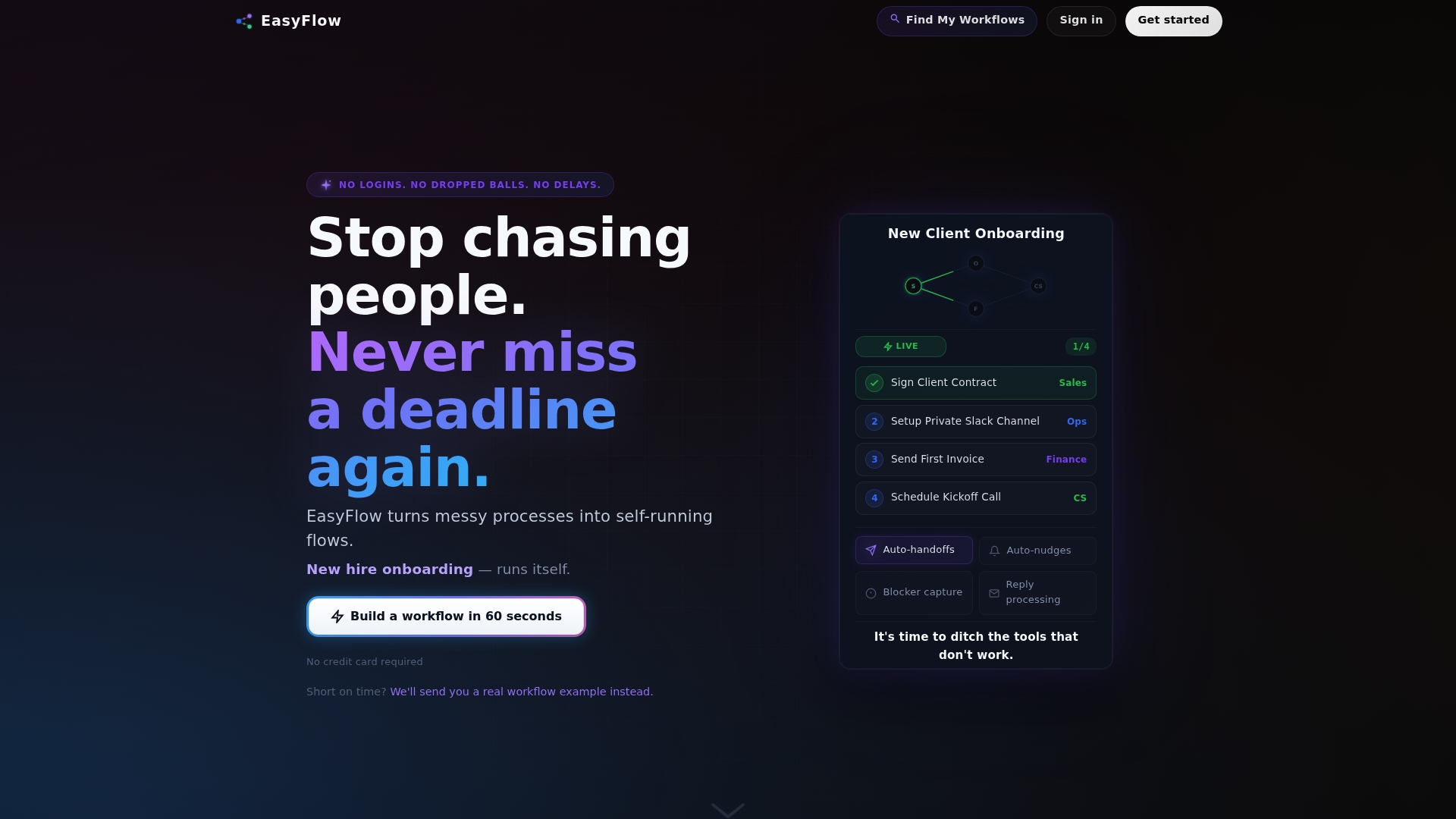
EasyFlow is built for exactly that. Where standard project management platforms require every participant to log in, create an account, and learn a new interface, EasyFlow routes tasks automatically and lets external collaborators act through a single link. No onboarding friction, no account negotiation, no follow-up emails asking if someone saw the task. For operations-heavy teams running client implementations, vendor onboarding, or partner workflows, that difference shows up immediately in execution speed. Start your first automated workflow and see how much coordination overhead you can cut in the first week.
FAQ
What causes cross-company workflow challenges?
Tool silos, manual data entry, unclear process ownership, and communication barriers are the primary causes. Each one compounds the others when organizations lack shared governance and integration infrastructure.
How does workflow automation help with inter-company collaboration issues?
Automation removes the manual coordination layer, routing tasks and syncing data between systems without human intervention. EasyFlow goes further by executing processes directly, so external collaborators never need to create accounts.
What is independent operational control in cross-company integration?
It means each organization configures its own sync rules and data-sharing logic without depending on the other party to make changes. Without it, every workflow update requires cross-company coordination, and that overhead grows with every new partner connection.
How do you measure cross-company workflow performance?
Track task completion time, manual intervention frequency, and sync error rates as baseline KPIs. Deloitte’s 2026 intercompany framework recommends KPI-driven dashboards with drill-down to individual transactions for full visibility.
Can external collaborators use EasyFlow without creating an account?
Yes. EasyFlow’s magic link feature lets external participants complete assigned tasks through a link, with no account creation required, which is the primary reason it reduces onboarding friction in cross-company workflows.
Key Takeaways
Cross-company workflow challenges are best solved by fixing process ownership upstream, choosing tools with independent operational control, and automating execution rather than just tracking tasks.
| Point | Details |
|---|---|
| Fix governance first | Assign named owners to master data and define shared data standards before building any integration. |
| Manual coordination cost | Manual coordination overhead in cross-company projects can consume up to 20 minutes per task of administrative effort by project managers. |
| Digital technology as a bridge | A July 2026 Journal of Management Studies study found digital technology offsets capability gaps between partners. |
| Independent control reduces overhead | Each party must configure its own sync rules; centralized control creates coordination tax that grows with every new partner. |
| EasyFlow reduces onboarding friction | Magic link task completion lets external collaborators act without creating accounts, cutting the most common adoption barrier. |