
Structured Onboarding and Retention: The Evidence-Based Link

A well-designed, phased onboarding program measurably increases new-hire retention, and the causal chain behind it is now well documented. When companies replace a single orientation day with a structured 90-day process, they see fewer early exits, faster time-to-productivity, and higher engagement scores. The mechanism is not mysterious: onboarding builds interpersonal connections, connections raise engagement, and engagement drives people to stay.
The cost of skipping this is not abstract, either. Replacing a new employee typically runs about 20% of their annual salary, and a large share of early departures trace back to weak engagement or culture fit rather than pay or role mismatch. Yet most organizations still fail at the basics. Gallup finds that only 12% of employees strongly agree their company does a great job onboarding new hires — a gap that costs far more than most HR budgets acknowledge.
Two things worth knowing before you read further:
- Structured onboarding is defined by phased, multi-month integration — not a single welcome event.
- SHRM and academic researchers converge on the same conclusion: onboarding’s retention effect runs through relationships and engagement, not paperwork completion.
Key Takeaways
Structured onboarding raises retention primarily by building interpersonal connections that increase engagement, and engagement is what predicts whether a new hire stays past year one.
| Point | Details |
|---|---|
| Extend beyond orientation | Run structured touchpoints through at least day 90, not just a single welcome day. |
| Require manager engagement | Block manager calendar time for week-one 1:1s; this is the strongest predictor of onboarding success. |
| Measure at three intervals | Track retention and engagement at 30, 90, and 365 days to catch problems before they become exits. |
| Prioritize connection over perks | Buddy programs and early shipped work outperform swag and welcome events for long-term retention. |
| Use ROI to justify budget | Even modest retention gains offset costs quickly, since replacing a hire runs about 20% of their annual salary. |
Table of Contents
- The Role of Structured Onboarding in Retention: What the Evidence Shows
- Core Elements of an Effective Structured Onboarding Program
- What Does the First 90 Days of Onboarding Actually Look Like?
- How Should HR Measure the Impact of Onboarding on Retention?
- Building the Playbook: From Design to Scale
- What Mistakes Undermine Onboarding’s Retention Benefits?
- Reducing Onboarding Friction Without Losing the Human Touch
- An Editorial Take on Structured Onboarding and Retention
- Sources
- FAQ
The Role of Structured Onboarding in Retention: What the Evidence Shows
Ask any experienced HR leader why some new hires quit at month three and others become five-year veterans, and the honest answer usually has nothing to do with salary. It has to do with whether that person felt connected to a team early on. Recent research backs this up with a specific causal model, not just correlation.
A 2025 study using structural equation modeling found that onboarding does not raise retention directly. Instead, it works through a sequence: onboarding practices build interpersonal connections, those connections raise engagement, and engagement is what ultimately predicts whether someone stays. The researchers describe this as a mediation chain, and the statistical effects were significant across their sample. This matters for how HR teams design programs, because it means bolting on more paperwork or compliance training will not move the needle. What moves the needle is deliberately engineering moments of human connection into the first weeks.
Harvard Business Review has covered similar ground for years, arguing that companies which treat onboarding as a relationship-building process, not an HR checklist, see measurably lower early attrition. The overlap between academic modeling and practitioner reporting here is unusually tight for an HR topic.
The direct effect of onboarding on retention is largely explained by the connections and engagement it produces. Programs that intentionally build trust with peers and managers raise engagement first, and retention follows from that engagement.
Not every onboarding tactic carries equal weight. Evidence-based design research from AIEH draws a clear line between what works and what merely feels nice:
- Strong support: structured-and-individualized tactics that combine a standard framework with role-specific customization.
- Strong support: buddy programs that run on an explicit agenda and weekly cadence, not informal “ask if you need anything.”
- Strong support: early shipped work — a small, real contribution within the first 30 days that builds self-efficacy faster than classroom training does.
- Weaker support: welcome-experience perks like swag or team dinners, which SHRM notes boost candidate satisfaction scores but show little correlation with 12-month retention when they substitute for role clarity.
Picture the mechanism as a relay, not a single handoff. HR hands the new hire a framework before Day 1. The manager takes the baton on Day 1 with a welcome and role-clarity conversation. The buddy carries it through weeks one through four with structured check-ins. By day 30, the new hire is running with real work, and engagement (the fourth leg) is what determines whether they finish the race at month twelve. Break any leg of that relay and the retention effect weakens.
Core Elements of an Effective Structured Onboarding Program
A structured onboarding program is not one document. It is a set of distinct, owned components that each address a different failure mode. Miss one and the program develops a blind spot, even if the others run smoothly.
- Pre-boarding, owned by HR: paperwork, equipment orders, and a welcome message sent before Day 1 so the first morning isn’t consumed by logistics.
- Day 1 administrative separation, owned by HR and IT: badge, systems access, and benefits enrollment handled separately from culture and team introductions, so Day 1 doesn’t feel like a DMV visit.
- Manager welcome and role-clarity conversation, owned by the hiring manager: a direct discussion of what success looks like in 30, 60, and 90 days.
- Buddy or mentor with a structured cadence, owned by a peer buddy: weekly check-ins with a real agenda, not an open-ended “let me know if you need anything.”
- 30/60/90 goals, co-owned by manager and new hire: specific, measurable milestones tied to the role, not generic company objectives.
- Early shipped work, owned by the manager: a genuine deliverable inside the first month that builds competence and visibility.
- Regular non-evaluative check-ins, owned by the manager: conversations explicitly separated from performance review, focused on adjustment and blockers.
- Feedback loops, owned by HR: a mechanism to capture what’s working at 30, 60, and 90 days and feed it back into program design.
Pro Tip: Block the hiring manager’s calendar for onboarding touchpoints before the new hire’s start date is even confirmed. Manager engagement is consistently reported as one of the single largest predictors of onboarding success, and it’s the first thing that gets skipped when a manager’s calendar fills up.
The buddy relationship deserves special attention because it’s the component most often done wrong. An unstructured “here’s someone to ask questions” pairing underperforms an agenda-driven buddy relationship with scheduled weekly topics. The difference between the two is entirely about structure, not effort.

What Does the First 90 Days of Onboarding Actually Look Like?
Structured onboarding runs on a defined timeline, and the phases matter as much as the content within them. Treating onboarding as a single orientation day is the single most common design flaw, since orientation only covers administrative and cultural basics rather than the extended integration process that actually predicts retention, according to onboarding best-practices research.
- Pre-boarding (before Day 1): send a welcome packet, confirm IT provisioning, schedule the first-week calendar, and assign the buddy.
- Day 1: complete administrative tasks (badges, benefits, systems) separately from the manager welcome and team introduction.
- Week 1: introduce the new hire to key stakeholders, assign the first shipped task, and hold the first manager 1:1.
- Day 30: review early shipped work, confirm role clarity, and collect first structured feedback.
- Day 60: assess progress against 30/60/90 goals and adjust support where gaps appear.
- Day 90: evaluate readiness, confirm engagement trajectory, and formally close the structured onboarding phase.
| Milestone | Primary owner | Example success criterion |
|---|---|---|
| Pre-boarding | HR | Equipment and access confirmed 3+ days before start |
| Day 1 | HR + IT | Administrative tasks complete before lunch |
| Week 1 | Manager + buddy | First 1:1 held, first task assigned |
| Day 30 | Manager | Early shipped work delivered, feedback collected |
| Day 60 | Manager + HR | 30/60/90 goals on track, engagement check-in run |
| Day 90 | HR + Manager | Retention risk assessed, program formally closed |
This timeline structure aligns with how EasyFlow’s own research on structured onboarding programs approaches phased integration for client and employee teams alike: separate the logistics from the relationship building, and give each phase a clear owner.
How Should HR Measure the Impact of Onboarding on Retention?
You cannot build an ROI case for onboarding investment without tracking the right numbers, and most HR teams track too few of them. The core metrics fall into two buckets: retention outcomes and leading indicators that predict retention before it happens.
- New-hire retention at 30, 90, and 365 days — the baseline outcome metric, segmented by department and hiring manager.
- Time-to-productivity — how long until a new hire hits expected output, a leading indicator that tracks role clarity.
- Engagement survey scores at 30 and 90 days — the mediating variable the MDPI research identified as the real driver of retention.
- Manager-rated readiness at day 90 — a qualitative check that catches problems dashboards miss.
- Cost-per-hire amortized over expected tenure — turns a one-time recruiting cost into an ongoing retention economics question.
A simple ROI formula looks like this: (Baseline turnover rate minus post-program turnover rate) multiplied by average cost-per-replacement, multiplied by the number of annual hires. If a 200-person company hiring 40 people a year cuts first-year turnover from 25% to 18% through structured onboarding, and each replacement costs roughly 20% of a $60,000 average salary, that’s a swing of about 2.8 fewer departures a year, saving somewhere near $34,000 annually in direct replacement costs alone, before counting lost productivity during the vacancy.
| Metric | What it tells you | Best cadence |
|---|---|---|
| 30/90/365-day retention | Whether the program prevents early exits | Quarterly cohort review |
| Time-to-productivity | Whether role clarity and shipped work are landing | Per hire, at day 30 and 60 |
| Engagement score | The mediating variable driving retention | At day 30 and 90 |
| Cost-per-hire amortized | Financial case for program investment | Annually |
Running a small pilot is the fastest way to build a credible business case. Take one department, apply the structured program to new hires for one quarter, and compare their 90-day retention and engagement scores against the prior year’s historical baseline for the same role type. A sample of even 15 to 20 hires is enough to show a directional signal that justifies wider rollout, especially when the gap between pilot and baseline is large.
Building the Playbook: From Design to Scale
Turning the research into a working program means moving through four stages without skipping any of them.
- Design: define objectives and KPIs first (which retention metric matters most for your organization), then map each core component to an owner.
- Pilot: run the program with one team or department for one quarter, tracking 30/60/90 feedback and engagement scores against a historical baseline.
- Iterate: adjust based on where the pilot’s feedback loop surfaced friction, whether that’s manager availability, buddy consistency, or unclear 30/60/90 goals.
- Scale: standardize the template across departments while preserving room for role-specific customization, since the strongest evidence favors structured-and-individualized tactics over rigid uniformity.
A sample 30/60/90 template needs four fields per milestone: the goal statement, the success criterion, the owner, and the check-in date. The manager fills in the goal and success criterion together with the new hire during the first week; HR provides the template structure and check-in cadence; the buddy contributes context on team norms that inform realistic goals.
- Minimum pilot sample size worth trusting: roughly 15 to 20 hires across a quarter.
- Feedback collection points: day 30 (early friction), day 60 (progress against goals), day 90 (retention risk and program close).
- Operational consistency check: audit whether every new hire actually received a buddy assignment and manager 1:1 in week one, since this is the step most likely to slip under hiring pressure.
EasyFlow’s guide on reducing onboarding friction for client-facing teams walks through a similar staged rollout for external-facing onboarding, which maps closely onto internal employee programs facing the same consistency problems.
What Mistakes Undermine Onboarding’s Retention Benefits?
Most onboarding programs that fail to move retention don’t fail from lack of effort. They fail from a handful of predictable design mistakes that show up across industries.
- One-day orientation only. Treating orientation as the whole program leaves 89 days of integration unaddressed. Fix: extend structured touchpoints through at least day 90.
- Tactical overload. Handing a new hire a stack of tasks without context on the “why” causes early disengagement rather than confidence. Fix: pair each task with brief context and prioritize one early shipped, meaningful contribution over a dozen disconnected chores.
- Over-indexing on swag and welcome perks. Nice gestures don’t substitute for role clarity or manager time, and the correlation with long-term retention is weak. Fix: reallocate that budget toward manager calendar time and buddy program structure.
- Weak manager engagement. A manager who skips week-one 1:1s signals to the new hire that they’re not a priority. Fix: block manager calendars for onboarding touchpoints before the start date, not after.
- No feedback loops. Programs that never ask new hires what’s working can’t improve and won’t catch problems until exit interviews. Fix: build 30/60/90 feedback checkpoints into the calendar, not as an afterthought.
- Lack of role clarity. Vague expectations erode the self-efficacy that early shipped work is supposed to build. Fix: write specific, measurable 30/60/90 goals before day one, not during week two.
Early warning signs are easy to spot if you’re watching: a manager who cancels the first 1:1, a new hire with no buddy assigned by day 3, or negative sentiment in day-30 feedback about feeling “thrown in.” Catching these signals early, and correcting them within the same quarter, is far cheaper than losing the hire at month four.
Reducing Onboarding Friction Without Losing the Human Touch
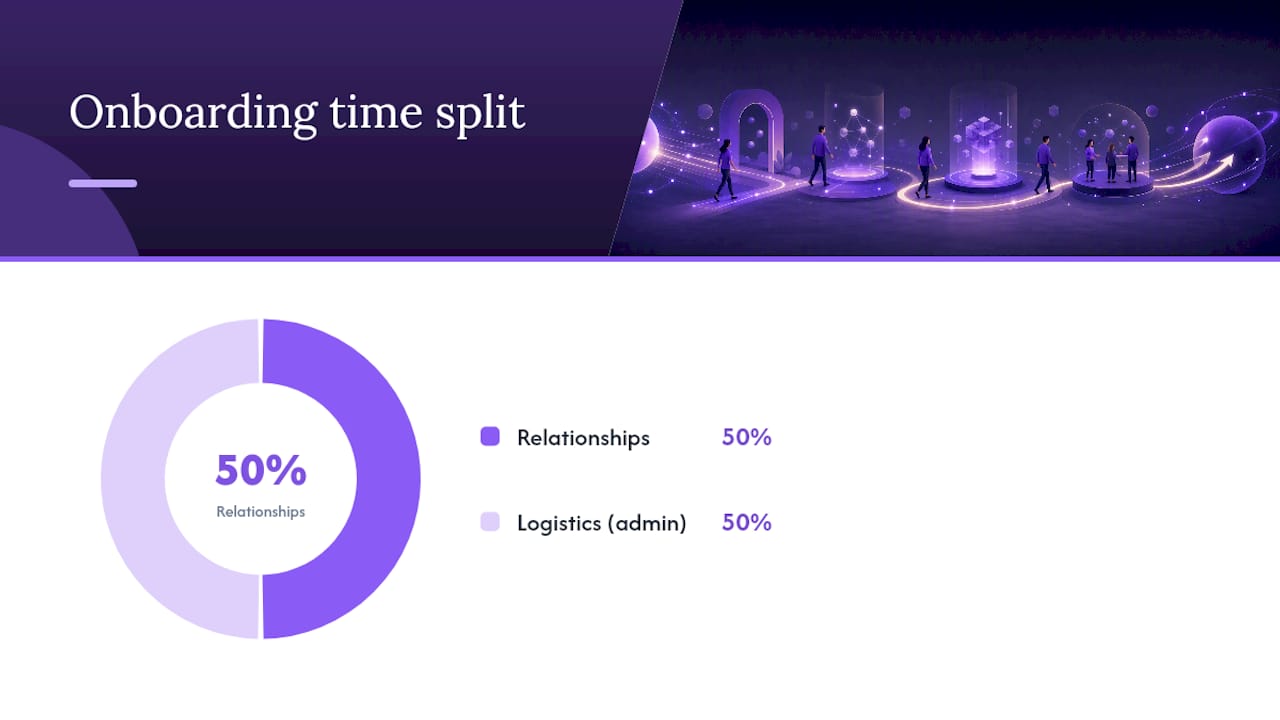
The operational reality of onboarding is that half of it is relationship-building and half of it is logistics, and most programs let the logistics eat time that should go to the relationships. IT provisioning delays, missing manager calendar blocks, forgotten checklist steps, and manual reminder emails are the friction that quietly kills structured programs before the human elements even get a chance to work.
This is where workflow automation earns its place, not by replacing manager conversations, but by clearing the administrative debris around them. Automating non-relational tasks lets HR and managers spend their limited time on socialization and coaching instead of chasing checklist items.
Practical automation use cases that support (rather than replace) structured onboarding:
- Pre-boarding automation that triggers equipment orders and system access requests the moment an offer is signed.
- Automated reminders for manager and buddy check-ins, so a scheduled 1:1 doesn’t quietly disappear when someone’s calendar gets busy.
- Self-serve new-hire portals where employees track their own 30/60/90 progress without waiting on HR to send updates.
- Magic-link external tasks for vendors, IT, or facilities partners who need to complete a single onboarding step without a full account setup, which is exactly the kind of workflow EasyFlow is built to run.
Pro Tip: Automate anything that’s purely administrative or repetitive, and never automate the moments meant to build trust. A reminder email to schedule a 1:1 is a good automation target. The 1:1 conversation itself is not, and trying to script or template it away defeats the purpose.
EasyFlow’s approach to onboarding automation adoption reflects this split: automate the handoffs (task reminders, checklist tracking, external collaborator steps) so HR teams recover the hours they’d otherwise spend chasing status updates, and redirect that time toward the manager and buddy relationships that the research shows actually drive retention.
If your team is still coordinating onboarding through spreadsheets and manual follow-up emails, EasyFlow’s workflow platform is built specifically to run these handoffs automatically, including reminders to managers and buddies, without requiring every new hire or external collaborator to create a separate account just to complete a step.
An Editorial Take on Structured Onboarding and Retention
Most companies treat onboarding as a compliance exercise dressed up in friendly language, and that’s the single biggest reason so many programs fail to move retention at all. The research is unambiguous that connection and engagement are the actual mechanism, yet HR budgets still skew toward welcome kits and orientation slide decks that address neither.
Here’s what conventional advice gets wrong: it treats “structured” as a synonym for “rigid.” The strongest evidence doesn’t favor a one-size-fits-all script. It favors structured-and-individualized programs, where the framework is consistent (buddy assigned, 30/60/90 goals set, check-ins scheduled) but the content flexes to the role and the person. Companies that build a beautiful, uniform 90-day template and then never touch it are making the same mistake as companies with no template at all, just with better production value.
The other thing worth saying plainly: manager time is the scarcest resource in onboarding, and it’s the one leaders protect the least. Every company will fund a new-hire swag budget before they’ll mandate that a manager’s calendar stay open for four 1:1s in the first month. That’s backward, given that manager engagement is one of the largest predictors of onboarding success across the practitioner research. If you have budget for one intervention, it’s not a nicer welcome packet. It’s a policy that makes manager check-ins non-optional and tracked.
If you take one thing from this, prioritize the feedback loop before you prioritize the polish. A program that collects honest 30-day feedback and adjusts will outperform a beautifully designed static program within two quarters, because it catches its own blind spots instead of repeating them for every future cohort.
Sources
- The invisible bond: sequential mediation of interpersonal connections and engagement between onboarding and retention (MDPI, 2025)
- Onboarding design: what the evidence says about effective first-90-days programs (AIEH)
- Why the onboarding experience is key for retention (Gallup)
- Strategic employee onboarding (University of Michigan research brief)
- The true cost of employee turnover (Psychometrics)
FAQ
How does onboarding affect retention?
Structured onboarding builds interpersonal connections between new hires and their peers or managers, which raises engagement, and higher engagement is what directly predicts whether someone stays past their first year, according to mediation research from 2025.
What are the 5 C’s of employee onboarding?
Definitions vary across practitioner sources, but a common framework includes compliance, clarification, culture, connection, and check-back, covering administrative setup, role clarity, cultural immersion, relationship building, and follow-up feedback.
What is structured onboarding?
Structured onboarding is a phased, multi-month integration process, typically spanning 90 days, that separates administrative tasks from cultural immersion and includes pre-boarding, a buddy program, 30/60/90 goals, and regular non-evaluative check-ins.
Does a longer onboarding process actually improve retention, or is 90 days just a convention?
Ninety days is the window practitioner sources treat as the decision point for retention, since it gives enough time for role clarity, early shipped work, and engagement to build, though the strongest programs sustain some check-ins past that point rather than stopping abruptly.
What’s the biggest mistake companies make with onboarding?
Treating a single orientation day as the entire onboarding program, which leaves administrative tasks handled but skips the extended relationship building and role-clarity work that actually drives retention.