
What Does Cross-Team Workflow Mean for Teams?

A cross-team workflow is defined as the coordinated sequence of tasks, decisions, and handoffs that span multiple teams working toward a shared business outcome. Understanding what does cross-team workflow mean is the first step to fixing the delays, miscommunications, and dropped balls that slow organizations down. The industry term for this practice is cross-functional workflow management, and it covers everything from how engineering hands off a feature to QA, to how sales passes a signed contract to the onboarding team. Cross-team workflows span multiple systems, teams, and decision layers, with success measured by how quickly processes stabilize across those dependencies. When coordination is designed deliberately, teams move faster, waste less, and deliver more predictable results.
What does cross-team workflow mean at its core?
A cross-team workflow is not just a shared project. It is a structured operating model that connects independent groups through defined ownership, visible progress, explicit handoffs, and a regular coordination rhythm.
The four components that make or break cross-team workflows are:
- Ownership: Every task or decision has one named person or team responsible. Shared ownership without clear assignment creates gaps.
- Visibility: All teams see the same current state. A single source of truth eliminates the “I thought you had that” problem.
- Handoffs: Each transfer of work is treated as a formal deliverable, not a passive status update. Handoffs require formal sign-offs to prevent work from slipping through the cracks.
- Rhythm: Teams meet on a designed cadence for alignment and decisions, not just when something breaks.
Coordination is the primary work in cross-team projects, not a side task. Most organizations treat it as secondary, which is exactly why cross-team projects fail more often than single-team ones.
Pro Tip: Map your four coordination layers (ownership, visibility, handoffs, rhythm) before you pick any tool. Tools are downstream outputs. The operating model comes first.
How do cross-team workflows differ from single-team workflows?
Single-team workflows operate within a shared context. Everyone uses the same tools, speaks the same vocabulary, and reports to the same manager. Cross-team workflows do not have that luxury.
The core differences create predictable failure points:
- Diverse systems and priorities: Marketing runs in a CRM. Engineering runs in a sprint board. Finance runs in a spreadsheet. Each team’s “done” means something different.
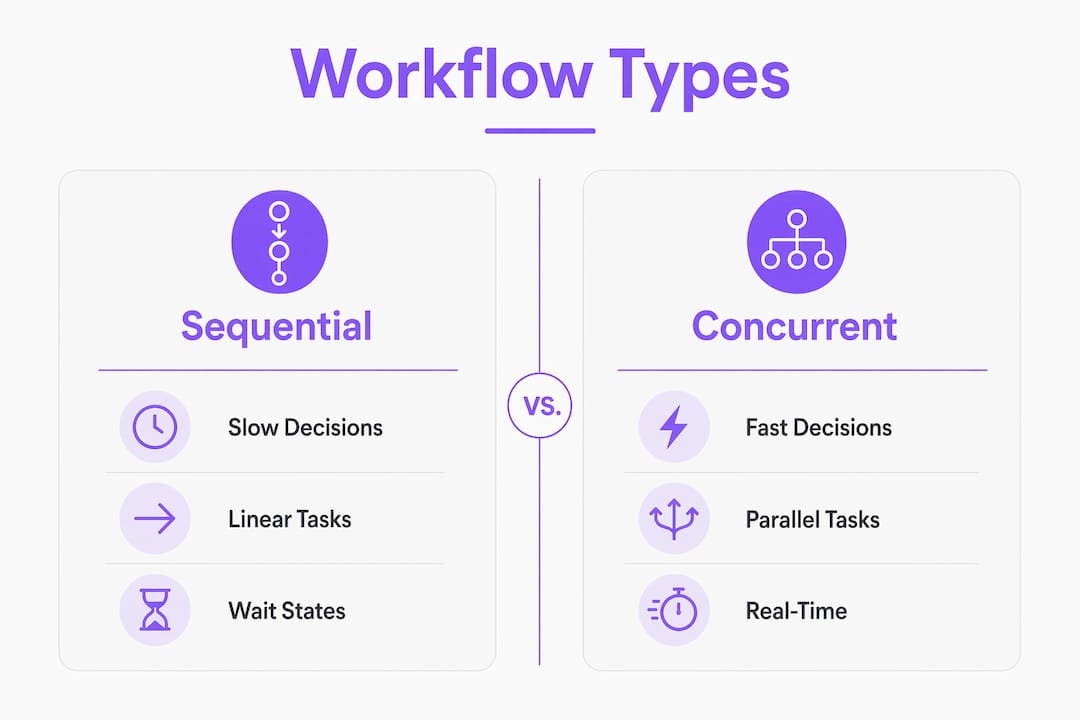
- Sequential vs. concurrent work: Many organizations default to sequential handoffs, where Team B waits for Team A to finish. Concurrent collaboration in shared spaces compresses decision cycles and cuts review rounds.
- The handoff trap: Work stalls at the boundary between teams. Replacing passive status reporting with explicit handoff tracking is the single most effective fix for this failure point.
- Unclear ownership: When two teams both think the other is responsible, nothing moves. Frameworks like RACI assign accountability before work begins.
- Inconsistent definitions: “Ready for review” means different things to different teams. Alignment workshops that build shared vocabulary prevent this confusion.
Cross-team workflows fail not because teams lack effort, but because the coordination architecture was never designed. You cannot fix a broken process by adding a new tool on top of it. Shared governance and clear ownership must come before any technology integration.
Tool adoption alone cannot fix flawed workflow design. No workflow tool can fix a broken process architecture. The governance model must exist first.
What practical strategies improve cross-team workflows?
The most effective approach to improving cross-functional teamwork combines process design with targeted automation. Neither works without the other.

Build shared vocabulary first. Run a one-time alignment workshop where all teams agree on definitions for key terms: “done,” “blocked,” “approved,” and “handed off.” Write these into a shared glossary that lives in your single source of truth. This one step eliminates a surprising volume of rework.
Establish a single source of truth. Unified platforms or effective integrations prevent tool proliferation and keep all teams looking at the same data. When each team maintains its own status tracker, discrepancies multiply. One shared system removes that problem entirely.
Design explicit handoff tracking. Treat every handoff as a mini-project with a defined input, a defined output, and a named recipient. Build validation steps so the receiving team confirms receipt before the sending team marks the work complete.
Adopt the ALIGN framework for recurring coordination. ALIGN stands for: Assess blockers, List dependencies, Identify owners, Get commitments, and Note next steps. Running this framework in weekly cross-team syncs keeps alignment current without adding extra meetings.
Track blocker resolution time as your primary health metric. The most actionable metric for workflow health is how fast one team clears another team’s blockers. It reflects real coordination efficiency, not just output volume.
Here is how two common workflow approaches compare on key dimensions:
| Dimension | Sequential workflow | Concurrent workflow |
|---|---|---|
| Decision speed | Slow; each team waits for the prior step | Fast; teams work in parallel and align in real time |
| Handoff risk | High; delays accumulate at each boundary | Lower; shared visibility reduces boundary friction |
| Rework rate | Higher; errors surface late | Lower; issues caught earlier across teams |
| Meeting load | Lower per phase, higher for catch-up | Designed cadence replaces reactive meetings |
Pro Tip: Use reusable workflow templates to standardize recurring cross-team processes. Templates lock in the ownership, handoff, and validation steps so teams do not redesign the same process from scratch each time.
Automation tools built for cross-team coordination go one step further. They execute the process rather than just tracking it, sending automatic handoff notifications, collecting sign-offs, and escalating blockers without requiring manual follow-up.
What benefits do organizations see from mature cross-team workflows?
The business case for investing in cross-functional workflow management is direct. Inefficient cross-team collaboration costs approximately $16,491 per manager per year, scaling to an estimated $874,000 annually for a 1,000-employee organization. That figure covers time lost to redundant meetings, rework, and miscommunication. Fixing the underlying workflow design recovers a significant portion of that cost.
Beyond cost, mature workflows deliver four measurable benefits:
Faster decision cycles. Cross-functional collaboration reduces handoffs and shortens decision cycles without adding extra meetings. Teams that work concurrently rather than sequentially reach decisions in fewer rounds.
Greater organizational agility. When ownership is clear and handoffs are tracked, teams can respond to changes without losing their place in the process. The workflow absorbs the change rather than collapsing under it.
Better project outcomes. Aligned objectives, shared visibility, and explicit accountability produce fewer surprises at launch. Teams that use RACI frameworks for accountability report cleaner project completions with less end-stage rework.
Higher employee satisfaction. Unclear processes frustrate good people. When team members know exactly what they own, what comes next, and who to escalate to, they spend less energy on coordination anxiety and more on actual work. That clarity shows up in retention and morale.
The workflow automation role in team alignment is especially visible here. Automated handoff notifications and escalation paths remove the burden of manual follow-up from individual contributors, freeing them to focus on the work itself.
Key Takeaways
A cross-team workflow succeeds when ownership, visibility, handoffs, and rhythm are designed deliberately before any tool is introduced.
| Point | Details |
|---|---|
| Define coordination layers first | Design ownership, visibility, handoffs, and rhythm before selecting tools or setting timelines. |
| Treat handoffs as deliverables | Require formal sign-offs at every team boundary to prevent work from stalling or disappearing. |
| Track blocker resolution time | This single metric reveals real coordination health better than output volume or meeting count. |
| Use concurrent collaboration | Parallel work in shared spaces cuts decision cycles and reduces rework compared to sequential handoffs. |
| Quantify the cost of poor coordination | Inefficient collaboration costs approximately $16,491 per manager per year, making process investment easy to justify. |
What I’ve learned from watching cross-team workflows break
Most teams I have observed do not fail because they lack effort or talent. They fail because nobody ever designed the coordination layer. The project plan exists. The tools exist. The people are capable. But the operating model, the explicit decisions about who owns what, how handoffs happen, and when teams align, was never built.
The most common mistake is treating coordination as something that will “just happen” once the right tool is in place. It does not. A new platform gives you visibility into a broken process, not a fixed one. I have seen organizations spend months implementing enterprise workflow software only to discover the same handoff gaps they had before, now just visible on a dashboard.
The teams that get this right do one thing differently. They design the coordination architecture first and treat it as seriously as they treat the product roadmap. They run alignment workshops. They write down what “done” means for every handoff. They pick one metric, usually blocker resolution time, and review it weekly.
The rhythm piece is underrated. A well-designed weekly cross-team sync, fifteen minutes, structured around the ALIGN framework, does more for workflow health than any amount of async messaging. Async is great for execution. Synchronous rhythm is what keeps dependencies from drifting.
If you manage cross-team projects, start by auditing your handoffs. Count how many are passive status updates versus explicit deliverables with named recipients. That gap is where your delays live.
— Harsh
How EasyFlow handles cross-team coordination
Cross-team workflows break at the handoff. EasyFlow is built specifically to close that gap.
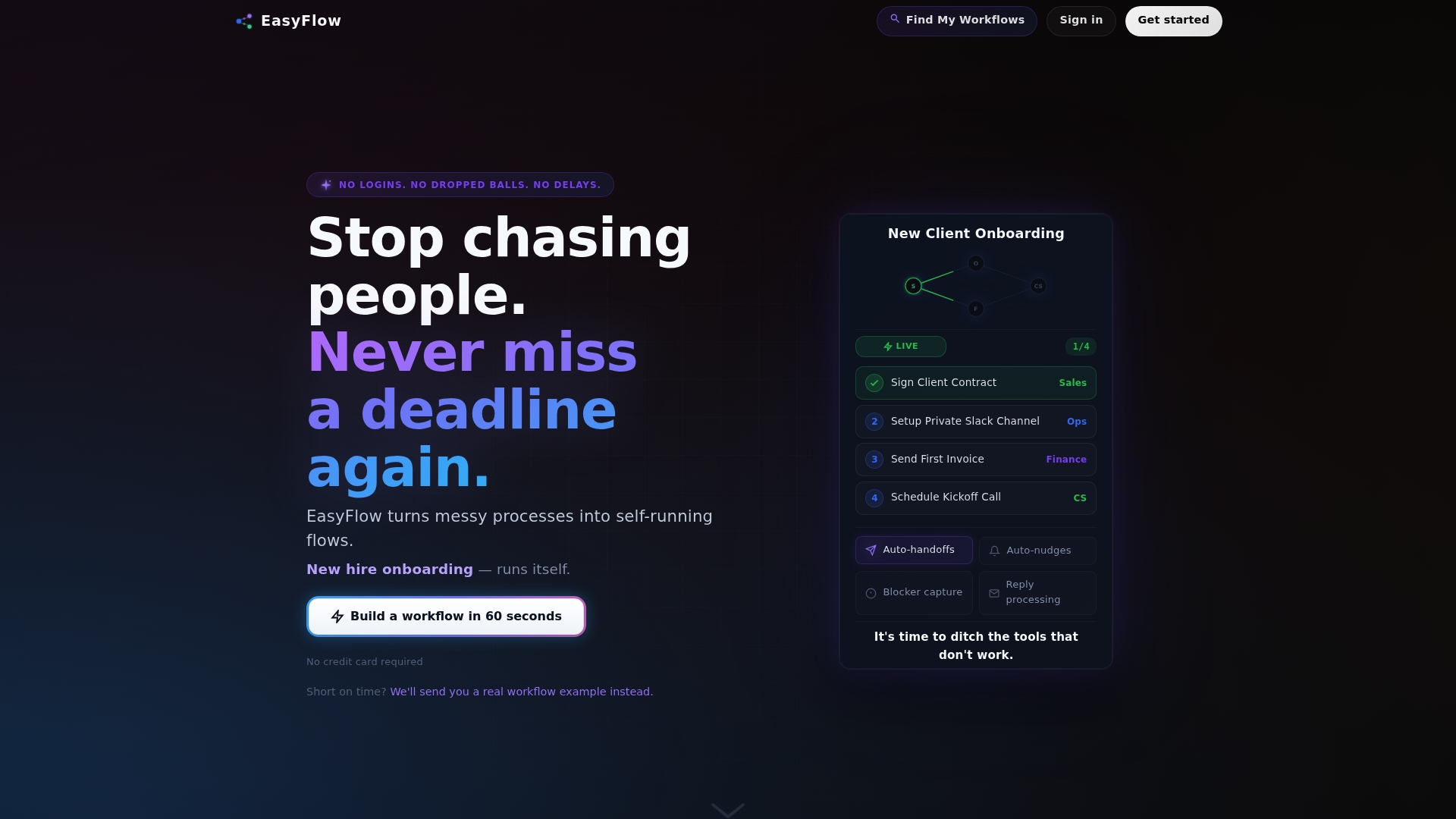
EasyFlow automates the handoff process end to end. It sends notifications, collects sign-offs, and escalates blockers without requiring manual follow-up from a project manager. External collaborators can complete tasks through magic links, so onboarding friction disappears and no one needs to create an account just to participate. For operations-heavy teams running client onboarding, new hire setup, or multi-department approvals, EasyFlow executes the process rather than just tracking it. Start with EasyFlow free to see how automated handoff tracking works in practice, or visit teameasyflow.com for a full product overview.
FAQ
What does cross-team workflow mean in simple terms?
A cross-team workflow is a structured sequence of tasks and handoffs that connects multiple teams working toward one shared goal. It defines who owns each step, how work transfers between teams, and how teams stay aligned throughout.
Why do cross-team workflows fail so often?
Most cross-team workflows fail because the coordination architecture was never designed. Teams default to passive status updates instead of explicit handoffs, and ownership gaps cause work to stall at team boundaries.
What is the most important metric for cross-team workflow health?
Blocker resolution time is the most important metric. It measures how quickly one team clears another team’s blockers, which reflects real coordination efficiency rather than just task completion rates.
How is a cross-team workflow different from a project plan?
A project plan lists tasks and deadlines. A cross-team workflow defines the operating model: who owns each piece, how handoffs are validated, and what rhythm keeps teams aligned. The workflow is the structure the project plan runs on.
Can workflow automation software fix a broken cross-team process?
No tool can fix a broken process architecture on its own. Shared governance, clear ownership, and explicit handoff design must be established first. Automation then accelerates a process that already works, removing manual follow-up and reducing coordination overhead.