
The Role of Transparency in Client Onboarding

Transparency in client onboarding is defined as clear, timely communication about fees, scope, timelines, and risks that aligns expectations before work begins. The role of transparency in client onboarding goes far beyond disclosure. It is the primary mechanism for building trust, preventing disputes, and retaining clients long after the first contract is signed. Agencies practicing radical transparency have reported client retention rates as high as 98%. That number signals something most onboarding programs underestimate: clients do not leave because of bad results. They leave because they felt uninformed.
How does transparency shape client trust during onboarding?
Trust does not form gradually over months of good work. It forms in the first few interactions, when clients decide whether your process feels honest or opaque. Transparent communication about fees, scope boundaries, and timelines manages expectations before misunderstandings can take root.
The psychological basis of this is straightforward. Transparency reduces uncertainty by making processes, decisions, and responsibilities visible to all stakeholders. When clients can see what is happening and why, they stop filling information gaps with anxiety or suspicion.
“Transparent onboarding involves clear communication about fees, scope boundaries, timelines, and risks to prevent misunderstanding and emotional disputes later. Defining what is not included is just as important as defining what is.”
Disputes rarely start with a bad outcome. They start with a client saying, “You never told me that.” Onboarding foundations built on transparency prevent exactly that scenario by creating a shared reality from day one. When both parties agree on what the engagement covers and what it does not, the emotional charge of a disagreement drops significantly.
The retention data reinforces this. Pre-boarding preparation completed before the first formal session can improve retention by up to 82%. That improvement does not come from paperwork. It comes from clients arriving at kickoff already oriented, already informed, and already trusting the process.

What are the best practices for transparent client onboarding?
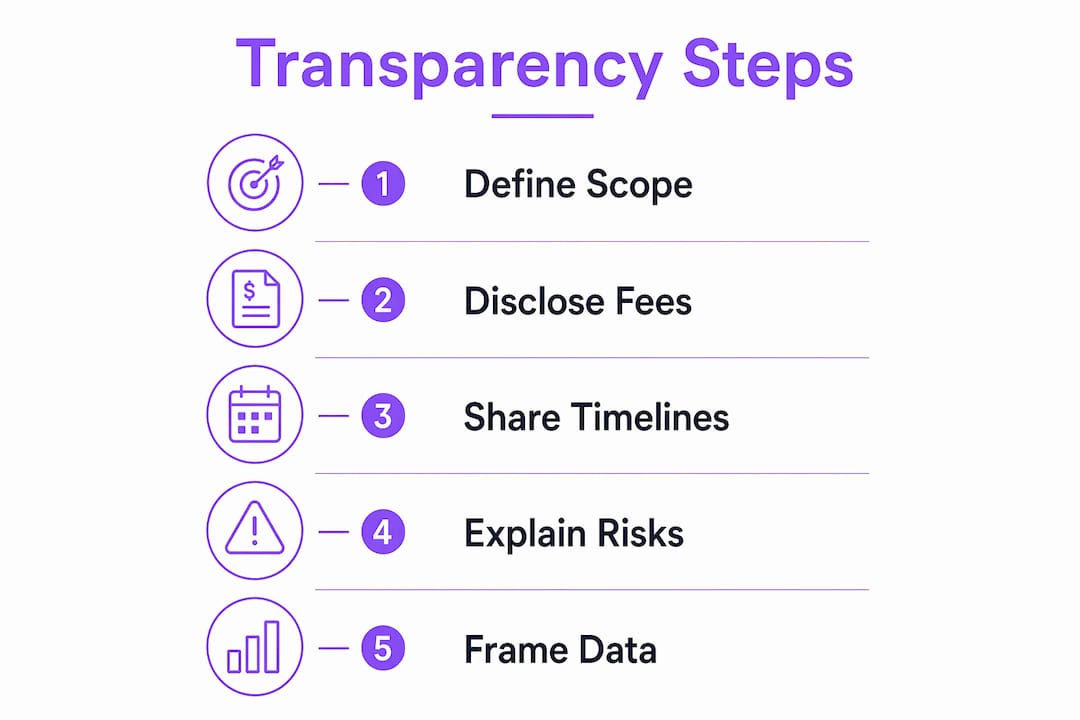
Effective transparency is not about sharing every data point you have. It is about sharing the right information, in the right format, at the right time. Four areas require explicit coverage in every onboarding program: cost, scope, timeline, and risk.
The four pillars of onboarding transparency
- Cost: State all fees upfront, including what triggers additional charges. Ambiguity around billing is the fastest way to erode trust.
- Scope: Define what the engagement includes and, critically, what it does not. Documenting negative scope prevents the “you didn’t tell me” disputes that damage relationships months later.
- Timeline: Give clients a realistic schedule with milestones they can track. Avoid padding timelines to look good. Clients respect accuracy more than optimism.
- Risk: Acknowledge what could go wrong and how you plan to address it. Clients who understand risks in advance respond to setbacks with patience, not panic.
Timing and framing matter as much as content
Sharing raw data without context often causes confusion rather than confidence. The fix is framing: present data within the context of agreed mitigation strategies so clients understand what the numbers mean for them. A project that is 10% behind schedule means nothing to a client without context. A project that is 10% behind schedule with a recovery plan already in motion means the team is on top of it.
Pro Tip: Build a one-page onboarding summary that covers all four pillars before the kickoff call. Clients who read it arrive with fewer questions and more confidence.
The timing of disclosures also matters. Share fee structures and scope documents before the contract is signed, not after. Share timeline milestones at kickoff, not buried in a project management tool the client has never logged into. Share risk assessments when the engagement begins, not when a risk materializes.
| Transparency area | When to disclose | Format |
|---|---|---|
| Fees and billing | Before contract signing | Written summary |
| Scope and exclusions | At contract signing | Signed scope document |
| Timeline and milestones | At kickoff | Visual timeline |
| Risks and assumptions | At kickoff | Risk register |
Onboarding checklists that clarify fees, responsibilities, and expectations are one of the most practical tools for delivering this structure consistently across every new client relationship.
What technology tools support transparency in onboarding?
Software does not create transparency. It makes transparency easier to deliver consistently at scale. The right tools give clients visibility into work progress without requiring them to send a single follow-up email.
Client portals with live project data are the most direct technology solution. Live dashboards showing ongoing work progress multiply client trust and reduce questions about effort and status. Clients who can see task completion in real time stop wondering whether the team is working. That shift alone reduces the volume of status-check emails most client-facing teams receive.
Workflow automation takes this further. Automated progress notifications, milestone alerts, and task handoff confirmations keep clients informed without requiring manual updates from your team. EasyFlow executes these workflows automatically, sending clients updates via magic links so they can complete their own tasks or review progress without needing to create an account. That removes one of the biggest friction points in onboarding: getting clients to engage with a new platform.
- Automated milestone alerts notify clients the moment a phase completes, removing ambiguity about where the project stands.
- Task visibility dashboards show which items are pending, in progress, or complete, giving clients a real-time view of the engagement.
- Magic link task completion lets external clients act on requests without logging into a separate system, reducing delays.
- Audit trails document every action and communication, creating a transparent record both parties can reference.
Pro Tip: Set up automated weekly summary emails through your workflow tool. Clients who receive a consistent update on the same day each week report higher satisfaction, even when the news is neutral.
Tracking client onboarding progress automatically through purpose-built tools removes the human error that comes with manual status updates. It also frees your team to focus on the work rather than the reporting.
How do you measure the impact of transparency on onboarding outcomes?
Measuring transparency requires tracking outcomes that reflect client confidence, not just process completion. The right key performance indicators connect directly to how well your onboarding communicates.
Only 29% of companies use fully structured 90-day onboarding programs. Yet extending onboarding beyond 90 days boosts productivity by 31%. That gap between adoption and impact shows most organizations stop onboarding too early, before the transparency and trust-building work has fully taken hold.
The KPIs worth tracking include:
- Dispute rate: Track how often scope or billing disagreements arise. A drop in disputes signals that your transparency practices are working.
- Client satisfaction scores: Collect structured feedback at 30, 60, and 90 days. Declining scores at any checkpoint indicate a communication gap.
- Time to first value: Measure how quickly clients reach their first meaningful outcome. Transparent timelines accelerate this by setting clear expectations.
- Follow-up email volume: Count how many status questions clients send. High volume means your proactive communication is falling short.
- Retention at 12 months: The ultimate measure of onboarding quality. Clients who felt informed and respected during onboarding stay longer.
Feedback mechanisms are as important as the metrics themselves. Post-onboarding surveys, structured 30-day check-ins, and open-ended questions about what felt unclear give you the data to improve each cycle. Client onboarding experiences in 2026 show that clients who receive structured feedback requests during onboarding report higher trust scores than those who do not.
Leadership transparency that explains the “why” behind processes and acknowledges limitations reduces disputes and builds a culture of trust that extends well beyond the onboarding period. When clients understand your reasoning, they become partners rather than auditors.
Key Takeaways
Transparency in client onboarding is the single most effective tool for building trust, reducing disputes, and improving long-term retention.
| Point | Details |
|---|---|
| Define all four pillars upfront | Cover cost, scope, timeline, and risk before the contract is signed. |
| Document negative scope | Explicitly state what is not included to prevent “you didn’t tell me” disputes. |
| Time disclosures correctly | Share fee structures before signing and risk assessments at kickoff, not after. |
| Use automation for visibility | Live dashboards and automated alerts keep clients informed without manual effort. |
| Measure trust, not just tasks | Track dispute rates, satisfaction scores, and retention to gauge transparency effectiveness. |
Why most onboarding transparency fails before it starts
The teams I have seen struggle most with transparency are not the ones hiding information. They are the ones dumping it. They send a 40-page onboarding document on day one and call it “full disclosure.” Clients sign it without reading it, and six months later the dispute arrives anyway.
Real transparency is interactive. It requires you to check whether the client understood what you shared, not just whether you shared it. Leadership that explains the “why” behind decisions and admits uncertainty builds more trust than polished presentations that leave no room for questions.
The other failure I see regularly is treating transparency as a one-time event. You disclose everything at kickoff, then go quiet for 30 days. By the time you resurface with a status update, the client has already filled the silence with doubt. Transparency is a rhythm, not a moment. Weekly updates, milestone confirmations, and proactive risk flags keep the relationship honest throughout the engagement.
The uncomfortable truth is that most onboarding friction is self-inflicted. Teams that reduce onboarding friction do so by communicating more often and more clearly, not by doing more work. The investment is in communication design, not delivery capacity.
— Harsh
EasyFlow makes onboarding transparency automatic
Transparent onboarding requires consistent communication across every client, every time. That consistency breaks down when it depends on your team remembering to send updates.
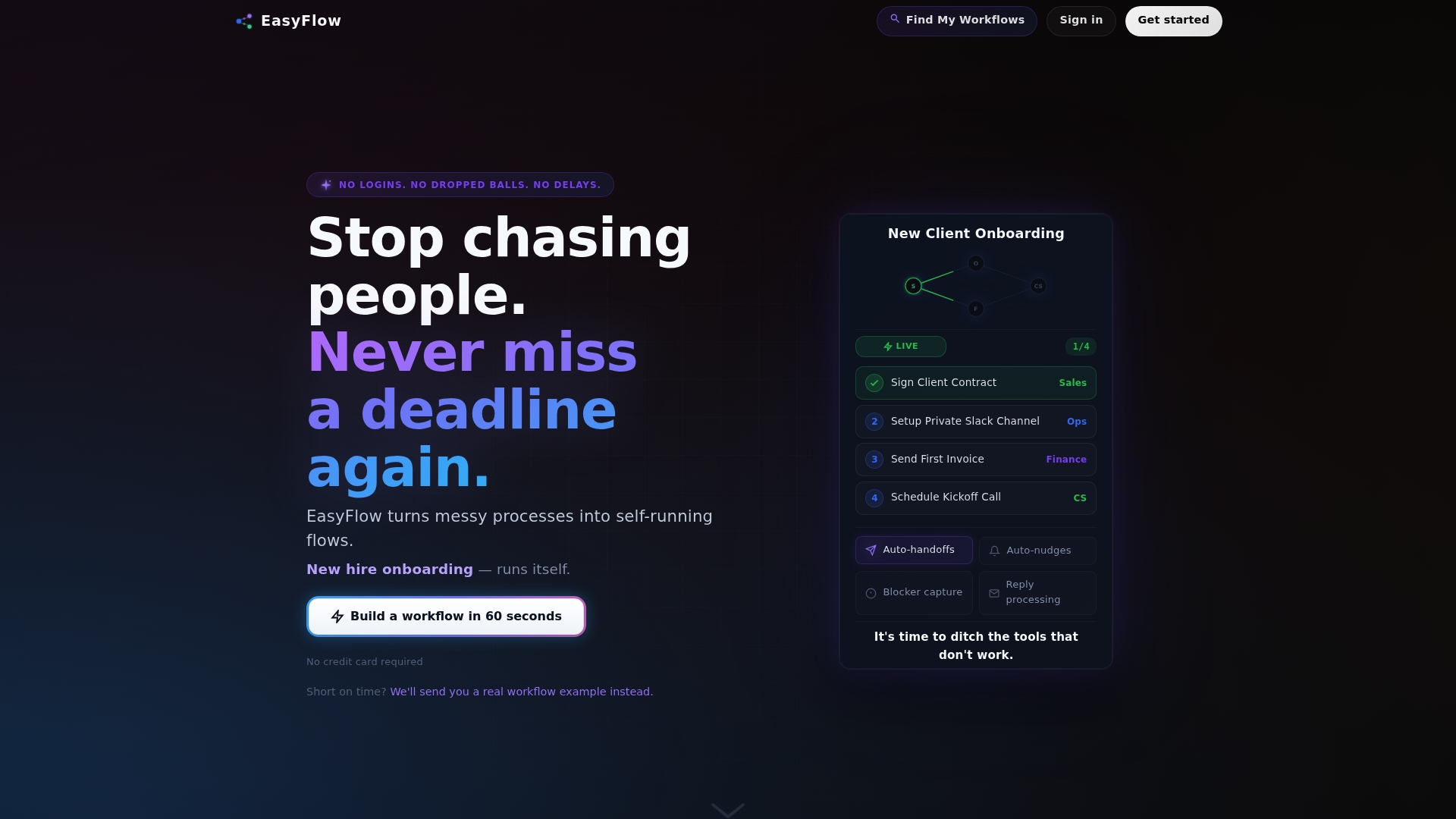
EasyFlow automates the workflows that keep clients informed without adding work to your team’s plate. Clients receive milestone alerts, task requests, and progress updates automatically. They complete their own steps via magic links without creating accounts or logging into new platforms. Your team gets a live dashboard showing exactly where every onboarding stands. Start with EasyFlow to build a transparent onboarding process that runs without manual follow-ups, or explore the full workflow automation platform to see how it fits your operations.
FAQ
What is the role of transparency in client onboarding?
Transparency in client onboarding means clearly communicating fees, scope, timelines, and risks before work begins. It builds trust, prevents disputes, and improves long-term client retention.
Why does transparency improve client retention?
Clients who feel informed during onboarding are less likely to leave. Agencies using radical transparency practices have reported retention rates as high as 98%.
What is “negative scope” and why does it matter?
Negative scope defines what your service does not include. Documenting exclusions prevents the most common onboarding disputes, which arise when clients assume a service was included but was never agreed upon.
How can technology support transparency in onboarding?
Client portals, live dashboards, and workflow automation tools give clients real-time visibility into project progress. This reduces status-check emails and builds confidence without requiring manual updates from your team.
When should onboarding transparency disclosures happen?
Fee structures and scope documents should be shared before the contract is signed. Timeline milestones and risk assessments belong at kickoff, not buried in follow-up communications.