
8 Onboarding Steps Every Client Team Needs

A structured client onboarding process is defined as a phased workflow that moves a new client from contract signing to first deliverable within a fixed, accountable timeline. The onboarding steps every client team needs are not optional niceties. They are the operational backbone that determines whether a client relationship starts with confidence or confusion. High-performing teams complete onboarding in 10 to 14 business days, with each step assigned to a single owner and tied to a measurable output. Tools like Teameasyflow make this structure visible and executable without burying your team in manual follow-ups.
1. What are the 8 essential steps in an effective client team onboarding process?
The 8-step onboarding workflow covers welcome, discovery, access, kickoff, setup, first deliverable, first review, and handoff. Each step has one owner, one output, and one deadline. This is the core structure of every client team onboarding process that actually works.

Step 1: Welcome
The account lead sends a welcome email within 24 hours of contract signing. This email includes the project timeline, primary contact details, and a link to the intake form. The goal is to signal professionalism and set expectations before the client starts wondering what happens next.
Step 2: Discovery
The account lead sends a structured intake form to collect client goals, brand assets, access credentials, and communication preferences. This step prevents the most common early failure: starting work without enough context. Discovery should be completed within two business days.
Step 3: Access
The operations lead verifies all credentials, sets up shared folders, and confirms security protocols. Skipping this step creates delays downstream when a developer or designer hits a permission wall mid-project.
Step 4: Kickoff
The project manager runs a kickoff call with a written agenda distributed 24 hours in advance. A written recap is sent within four hours of the call. This recap becomes the single source of truth for scope, timeline, and responsibilities.
Step 5: Setup
The project manager builds the project plan, assigns tasks, and configures the workflow management tool. Teameasyflow is particularly effective here because it assigns step owners and tracks SLAs without requiring clients to create accounts. External collaborators complete tasks via magic links, which removes friction immediately.
Step 6: First deliverable
The delivery lead ships the first project artifact, whether a strategy document, design mockup, or technical audit, by day eight of the onboarding window. This milestone is not just a task. Achieving a measurable milestone proves partnership value to the client’s decision-makers.
Step 7: First review
The account lead collects structured feedback within 48 hours of delivery. Feedback is documented, prioritized, and reflected in an updated project plan. This step closes the loop and signals that the team listens and adapts.
Step 8: Handoff
The account lead and project manager conduct a formal handoff review covering outcomes, open items, and next steps. A context bridge document is created to preserve client goals and communication history for any future team member who joins the account.
Pro Tip: Send the kickoff recap as a short Loom video summary alongside the written document. Clients who see a face and hear a voice retain information better and feel more connected to the team from day one.
2. Why clear ownership and defined timelines are critical in client onboarding
Assigning a single owner to each step eliminates the diffusion of responsibility that stalls most onboarding projects within the first 72 hours. When two people share ownership of a task, neither person acts with urgency. When one person owns it, the task gets done.
Defined timelines work the same way. A deadline without an owner is a wish. An owner without a deadline is a recipe for drift. The combination of both is what separates client teams that build trust quickly from those that spend the first month apologizing for delays.
“Onboarding is a test of trust and a defining moment for client relationships occurring within the first 14 days.” — Gatilab
The practical implications of this are significant for team structure:
- Limit active onboarding projects per account lead to maintain quality. Teams that cap account lead bandwidth prove reliable 14-day cycles before scaling up.
- Use a RACI matrix or equivalent to document who is Responsible, Accountable, Consulted, and Informed for each step.
- Review SLA compliance weekly during the first month to catch patterns before they become habits.
- Automate status updates so account leads spend time on relationship work, not chasing internal updates.
The single-owner model also creates a better client experience. Clients know exactly who to contact, which reduces anxiety and builds the perception of a well-run operation.
3. How phased onboarding checklists improve client team efficiency
Effective onboarding checklists contain 40 to 50 items divided across three phases: pre-kickoff, kickoff, and post-launch. Skipping any phase increases the risk of early project stall by 20 to 30 percent. That is not a small margin. It is the difference between a client who renews and one who quietly disengages.
The three phases map directly to the eight steps described above and give teams a practical way to track progress without building a custom project management system from scratch.
| Phase | Timing | Key checklist items |
|---|---|---|
| Pre-kickoff | Days 1 to 3 | Contract signed, payment confirmed, intake form sent, credentials collected, shared workspace created |
| Kickoff | Days 4 to 6 | Welcome email sent, kickoff call completed, recap distributed, communication norms agreed |
| Post-launch | Days 7 to 14 | First deliverable shipped, feedback collected, project plan updated, invoice sent, handoff document created |
The pre-kickoff phase is where most teams lose time. Contracts sit unsigned, payments are delayed, and access credentials arrive in pieces over several days. Building a checklist that triggers automatically when a contract is signed removes the human bottleneck entirely.
The post-launch phase is where most teams lose clients. Deliverables ship without a structured feedback loop, invoices arrive without context, and the handoff document is either missing or a copy-paste of the project brief. A checklist forces the team to treat post-launch as a phase, not a finish line.
Pro Tip: Build your checklist inside a workflow tool that sends automated reminders to step owners. Teameasyflow does this natively, so no one needs to manually chase a task that is two days overdue.
4. What tools and best practices enable smooth execution of onboarding steps
Workflow management software enhances visibility and automates follow-ups, which reduces manual errors and delays across the entire client team onboarding process. The right tool does not just track tasks. It executes the process by notifying owners, escalating overdue items, and giving clients a clear view of progress without requiring a status call.
The most effective practices for smooth onboarding execution include:
- Automated reminders: Set triggers at 24 hours before and 4 hours after each step deadline. This eliminates the need for a project manager to manually chase updates.
- Intake form templates: Use a standardized form for every new client. Zoomforth and Gatilab both publish intake frameworks that cover goals, assets, access, and communication preferences.
- Kickoff agenda templates: Distribute a written agenda 24 hours before every kickoff call. Include time allocations for each agenda item to keep the call under 45 minutes.
- Context bridge documents: A context bridge captures not just project specs but the client’s underlying goals and the reasoning behind key decisions. This document prevents information loss during team transitions.
- Client portals: A shared workspace where clients can view deliverables, upload assets, and track milestones reduces email volume and creates a professional first impression.
- Communication cadence: Clients expect a balance between frequent updates and autonomy. A weekly status email plus one scheduled check-in call per week is the standard that works for most client relationships.
Teameasyflow handles several of these practices natively. External collaborators complete tasks via magic links without creating accounts, which removes the friction that causes clients to disengage from portals and tools they did not choose.
Key takeaways
Structured client onboarding with single-step ownership, phased checklists, and automated workflows is the most reliable way to deliver a first deliverable within 14 business days and build lasting client trust.
| Point | Details |
|---|---|
| Single-owner accountability | Assign one person to each of the 8 steps to prevent stalls and diffusion of responsibility. |
| 14-day delivery window | High-performing teams ship the first deliverable within 10 to 14 business days from contract signing. |
| Three-phase checklists | Pre-kickoff, kickoff, and post-launch phases with 40 to 50 items reduce early project failure by 20 to 30 percent. |
| Context bridge at handoff | Document client goals and communication history to prevent information loss when team members transition. |
| Automate follow-ups | Use workflow tools to trigger reminders and status updates so account leads focus on relationship work. |
Why the first 14 days define every client relationship you will ever have
I have reviewed dozens of onboarding processes across agencies, SaaS companies, and professional services firms. The pattern is consistent. Teams that win long-term clients do not win them with better deliverables. They win them by making the first two weeks feel effortless.
The uncomfortable truth is that most client teams treat onboarding as an administrative hurdle rather than a trust-building exercise. They send a welcome email, schedule a kickoff call, and then disappear into execution mode. The client, meanwhile, is watching closely. Every delayed response, every missed deadline, every unanswered question in that first window is registered and remembered.
What I have found actually works is treating each onboarding step as a public commitment. When a client receives a kickoff recap within four hours of a call, they do not just feel informed. They feel respected. When a first deliverable arrives on day eight as promised, they do not just feel satisfied. They feel confident that they made the right choice.
The scaling question is where most teams get it wrong. They add clients faster than they add structure. One account lead managing six simultaneous onboardings without a workflow tool is not a productivity achievement. It is a churn risk. The right move is to cap onboarding load, prove the 14-day cycle consistently, and then scale with dedicated leads and automated workflows.
Personalization and automation are not opposites. A Loom video recap is personal. An automated status update is efficient. The best onboarding processes use both, and they use tools like Teameasyflow to make the automated parts invisible so the personal parts feel intentional.
Prioritize onboarding above almost everything else in your client operations. The cost of a poor start is not just one lost client. It is the referral that never happens, the case study that never gets written, and the renewal conversation that starts from a deficit instead of a surplus.
— Harsh
Run your entire onboarding workflow inside Teameasyflow
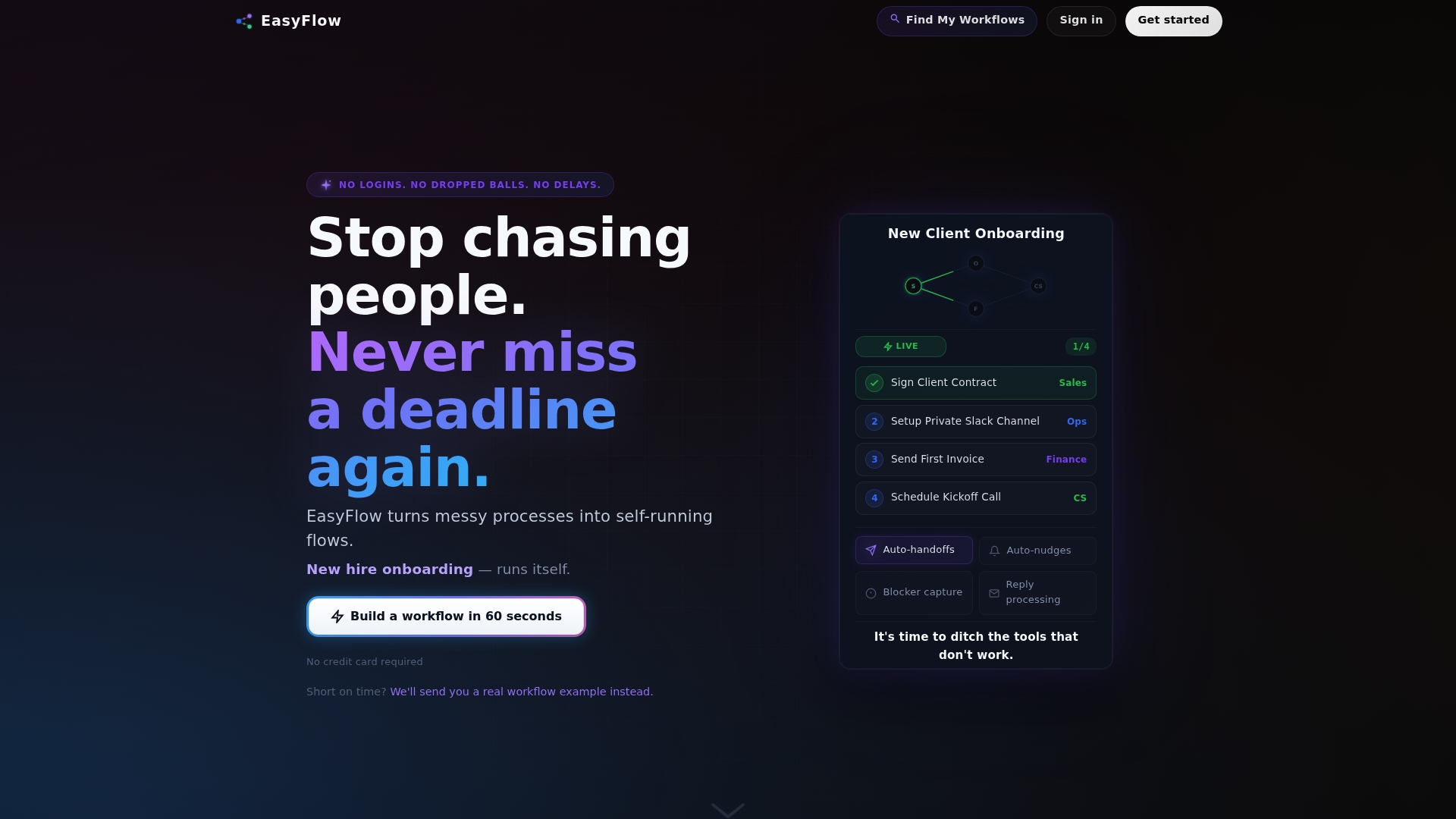
Teameasyflow is built specifically for the kind of structured, ownership-driven onboarding process described in this article. You can assign step owners, set SLA deadlines, and trigger automated reminders without asking your clients to create an account or learn a new tool. External collaborators complete tasks via magic links, which means your onboarding checklist actually gets executed rather than just tracked. The result is fewer follow-ups, faster first deliverables, and a client experience that signals professionalism from day one. Start your first workflow for free and see how quickly a structured process changes the pace of your client relationships.
FAQ
What are the essential onboarding steps for client teams?
The 8 core steps are welcome, discovery, access, kickoff, setup, first deliverable, first review, and handoff. Each step requires a single owner and a defined deadline to prevent delays.
How long should client onboarding take?
High-performing teams complete the full onboarding cycle in 10 to 14 business days from contract signing to first deliverable. Exceeding this window increases the risk of client disengagement.
Why do onboarding handoffs fail?
Handoffs fail when context bridge documents are missing. These documents capture client goals, communication history, and decision rationale, not just project specs, so new team members can continue without losing momentum.
How many items should an onboarding checklist have?
An effective client onboarding checklist contains 40 to 50 items divided across pre-kickoff, kickoff, and post-launch phases. Checklists in this range reduce early project stall risk by 20 to 30 percent.
What is the best tool for managing client onboarding steps?
Teameasyflow is designed to assign step owners, track SLAs, and automate reminders across the full onboarding workflow. Unlike task trackers, it executes the process and allows external collaborators to participate via magic links without creating accounts.