
Onboarding Time-to-Completion: HR Guide for 2026

Onboarding time-to-completion is defined as the total elapsed time from a new hire’s first day through the point where they finish all required onboarding steps and reach functional productivity in their role. This metric goes far beyond paperwork. The median time-to-productivity for knowledge-based roles sits at 65 days, while technical roles average 90 days, and complex sales roles can take 3–6 months. For HR professionals and team leaders, tracking this duration is the difference between a workforce that ramps fast and one that quietly churns in the first quarter.
What is onboarding time-to-completion, and why does it matter?
Onboarding time-to-completion is the industry’s shorthand for a metric more formally called “time-to-productivity” or “onboarding process duration.” Both phrases describe the same thing: how long it takes a new hire to move from offer acceptance through full functional readiness. The distinction matters because many HR teams measure only administrative completion, which is the signed forms and system access. That is not the same as a productive employee.
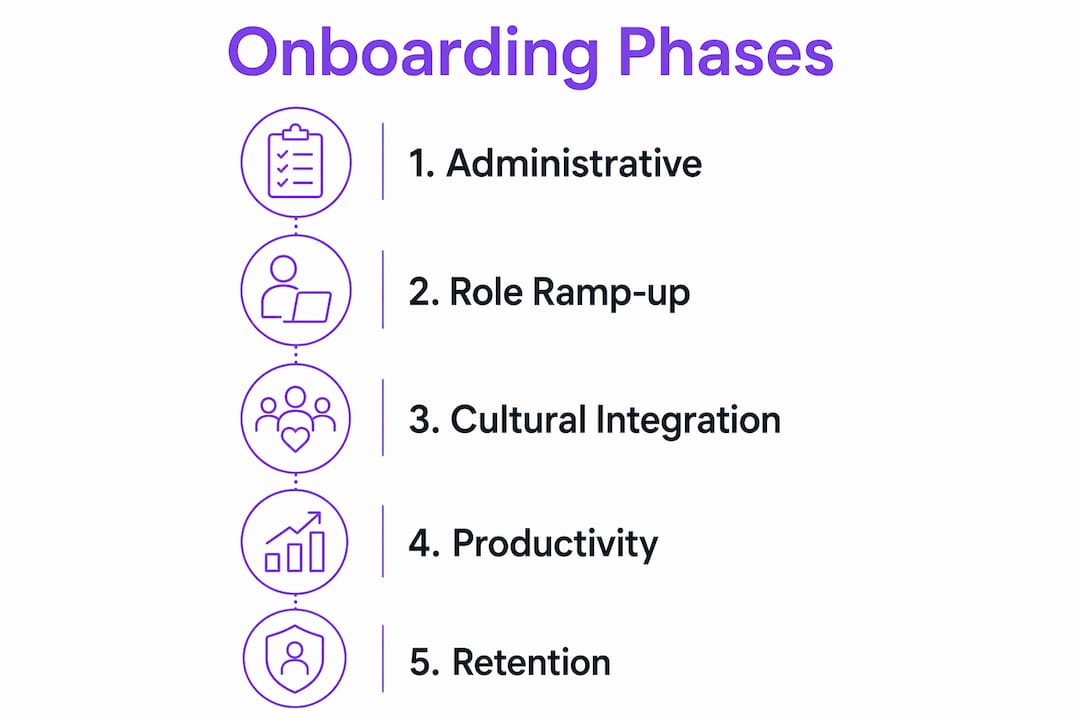
The metric has three distinct phases. Administrative completion covers the first week: contracts, tax forms, system credentials, and compliance training. Role ramp-up runs from day 1 through roughly day 90, covering job-specific skills, process knowledge, and relationship building. Cultural integration extends further, sometimes up to 12 months, and reflects how well the hire understands the organization’s norms and decision-making patterns.

Tracking all three phases separately gives HR teams a complete picture. Metrics should separately track administrative, ramp-up, and cultural integration timelines to identify exactly where delays occur. Without that granularity, you fix the wrong problem.
How long does onboarding take by role type?
The time taken for onboarding varies significantly by role complexity and seniority. Entry-level and HR/operations roles typically reach productivity in 45–60 days. Knowledge workers in generalist roles hit the 65-day median. Technical roles, including engineers and data analysts, average 90 days due to system access requirements and steeper learning curves. Sales Account Executives average 5.7 months before hitting quota consistently.
Executive onboarding sits in a category of its own. Senior leaders require 6–12 months of structured support to avoid failure. The primary reason senior hires fail is the absence of a formal 90-day integration plan. Without defined milestones, executives default to their previous company’s playbook, which rarely fits the new organization.
Here is a practical breakdown of effective onboarding timelines by role:
| Role Type | Administrative Phase | Ramp-Up Phase | Full Integration |
|---|---|---|---|
| Entry-level / HR / Ops | 1 week | 30–45 days | 45–60 days |
| Knowledge worker | 1 week | 45–60 days | 65 days |
| Technical (engineer, analyst) | 1 week | 60–75 days | 90 days |
| Sales Account Executive | 1 week | 90–120 days | 5–6 months |
| Executive / Senior leader | 1–2 weeks | 90 days | 6–12 months |
The most common misconception HR teams hold is that onboarding ends when the paperwork is done. Treating administrative form completion as the finish line correlates directly with high early attrition. The hire signed the forms. That does not mean they know how to do the job or feel connected to the team.
- Entry-level roles: Focus ramp-up on process familiarity and manager check-ins at 30 and 60 days.
- Technical roles: Prioritize system access and peer mentoring from day 1. Delays in tool access extend ramp-up by weeks.
- Sales roles: Tie completion milestones to pipeline activity, not just training modules finished.
- Executive roles: Build a formal 90-day plan with board or leadership touchpoints at 30, 60, and 90 days.
How does the hiring model affect onboarding process duration?
The hiring model you choose shapes onboarding speed before a single task is assigned. Employer of Record (EOR) arrangements compress timelines dramatically. EOR onboarding can take as little as 3 days once work authorization is verified, with a typical range of 2–10 days for straightforward cases. Direct hiring, which requires local entity setup, banking relationships, and payroll registration, can stretch to weeks or months.
This gap has real consequences for HR planning. If your organization hires across multiple countries and uses direct employment, you need to build that delay into your workforce planning calendar. Promising a new hire a start date without accounting for entity setup is a common source of offer withdrawals and candidate dropouts.
| Hiring Model | Typical Onboarding Timeline | Primary Bottleneck |
|---|---|---|
| Employer of Record (EOR) | 2–10 days to 1–6 weeks | Work authorization verification |
| Direct hiring (existing entity) | 2–4 weeks | Payroll setup, IT provisioning |
| Direct hiring (new entity) | 1–6 months | Legal entity and banking setup |
Using EORs cuts onboarding time and reduces the risk of offer withdrawals, though it does not affect visa or compliance timelines. That caveat matters for roles requiring work permits. EOR speed applies to the employment contract and payroll setup, not to immigration processing.
Pro Tip: If your team hires internationally more than twice a year, map your average entity-setup time by country. That single data point will prevent you from overpromising start dates to candidates.
What common challenges slow down onboarding completion?
Delayed IT setup is the most measurable culprit. IT delays contribute to 20% of employee turnover within the first 45 days. A new hire who cannot access their tools on day 1 spends that time disengaged, which sets a negative tone that is hard to reverse. Zero-Touch deployment and automated access provisioning eliminate this problem entirely when treated as part of pre-boarding.
The second major challenge is unclear ownership. When no single person is accountable for each onboarding task, steps fall through the gaps. IT waits for HR to confirm the start date. HR waits for the manager to submit the equipment request. The new hire waits for everyone. Tracking planned versus actual completion times surfaces these systemic failures quickly. Without that comparison, the delays stay invisible.
The four most common onboarding bottlenecks, ranked by frequency, are:
- IT and system access delays. Treat all provisioning as a pre-boarding task with a hard deadline of two business days before the start date.
- Paperwork bottlenecks. Automate document collection and e-signature workflows. Manual routing adds days with no added value.
- Poor communication between HR, IT, and the hiring manager. Assign a single onboarding coordinator who owns the full checklist, not just the HR portion.
- Undefined completion criteria. If the team cannot agree on what “done” looks like, the process never officially ends. Write completion criteria before the hire starts.
Pro Tip: Build your onboarding checklist backward from the productivity milestone, not forward from the start date. That forces you to define what “complete” actually means before the hire walks in.
The best onboarding programs prioritize comprehension checkpoints over task completion. Finishing a training module is not the same as understanding it. Short knowledge checks at the end of each module catch gaps before they become performance problems.
For HR teams looking to reduce manual follow-up, onboarding automation examples show how automated task routing and status tracking cut average completion times without adding headcount.
How does onboarding duration affect retention and productivity?
Long or poorly structured onboarding correlates directly with higher churn. Enterprises average 60–90 day onboarding periods, while small and midsize businesses typically run 14–30 days. Neither number guarantees retention. What matters is whether the process is structured and whether the hire reaches genuine productivity within the expected window.
The 90-day mark is the most critical checkpoint. Hires who feel unproductive or disconnected by day 90 are significantly more likely to begin a passive job search. Structured check-ins at 30, 60, and 90 days give managers a formal opportunity to catch disengagement before it becomes a resignation.
Hires who complete onboarding through short interactive modules show 40% higher completion rates and better knowledge retention than those who receive static PDFs. Format is not a cosmetic choice. It directly determines whether the new hire actually absorbs what they need to perform.
The practical implications for HR teams are clear:
- Replace static PDF handbooks with short video or interactive modules, capped at 10 minutes each.
- Schedule formal check-ins at 30, 60, and 90 days with a structured agenda, not an open-ended “how’s it going?”
- Track time-to-first-contribution, meaning the date the hire completes their first independent deliverable, as a leading indicator of ramp-up health.
- Extend cultural integration support beyond 90 days for technical and senior roles, where full assimilation realistically takes 6–12 months.
For teams managing complex or enterprise-facing positions, structured onboarding practices that scale across client teams provide a useful framework for maintaining consistency as headcount grows.
Key Takeaways
Onboarding time-to-completion is a three-phase metric covering administrative tasks, role ramp-up, and cultural integration, and each phase requires separate tracking to identify where delays actually occur.
| Point | Details |
|---|---|
| Three-phase definition | Track administrative, ramp-up, and cultural integration separately to find real bottlenecks. |
| Role-based timelines | Entry-level roles complete in 45–60 days; executives need 6–12 months of structured support. |
| IT setup is critical | IT delays drive 20% of early turnover; complete all provisioning before the start date. |
| EOR vs. direct hiring | EOR onboarding takes as little as 3 days; direct hiring with new entity setup can take months. |
| Format drives completion | Interactive modules produce 40% higher completion rates than static documents. |
Why I think most teams are measuring onboarding wrong
The single most common mistake I see HR teams make is declaring onboarding complete the moment the new hire finishes their paperwork. That is not onboarding completion. That is administrative processing. The actual work, getting someone to the point where they contribute independently and feel genuinely connected to the team, takes months.
The second mistake is treating onboarding as a one-time event rather than a structured process with defined phases and measurable milestones. A 30-day check-in without a structured agenda is not a milestone. It is a conversation. Milestones require criteria: “By day 30, the hire has completed product training, submitted their first deliverable, and met with all five key stakeholders.” That is measurable. “How are you settling in?” is not.
What actually works is building a ramp plan before the hire starts, assigning clear ownership for every task, and comparing planned versus actual completion dates on a weekly basis. That comparison is where the real insight lives. If IT access consistently runs three days late, that is a process problem, not a one-off. Fix the process, not the symptom.
The teams that get onboarding right treat it as a product they continuously improve, not a checklist they run once and file away.
— Harsh
How EasyFlow helps HR teams hit onboarding milestones faster
HR teams that rely on manual follow-ups and shared spreadsheets to track onboarding tasks consistently miss completion deadlines. EasyFlow automates the entire onboarding workflow, from IT provisioning requests to manager check-in reminders, without requiring new hires or external collaborators to create accounts.
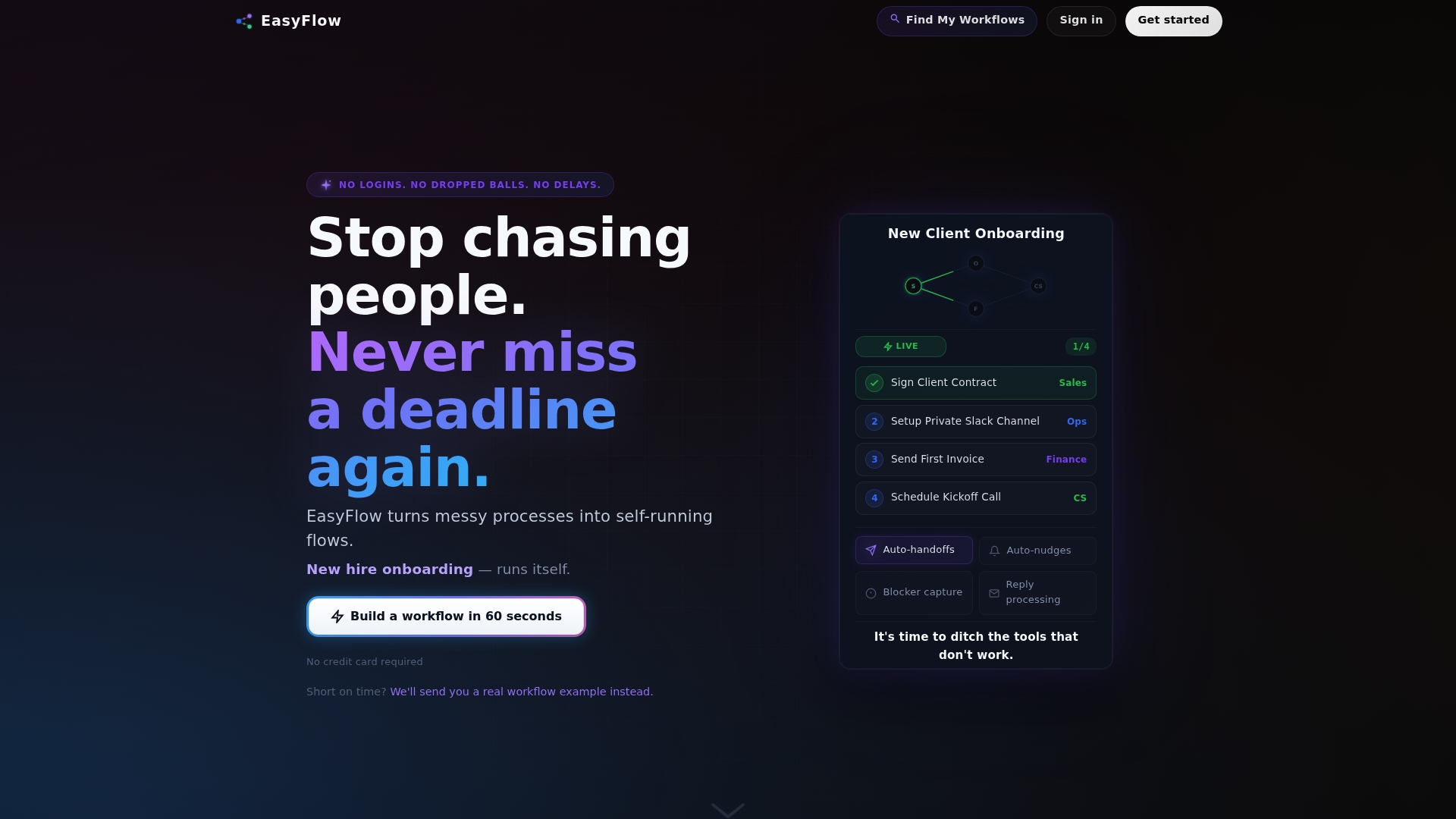
Tasks route automatically to the right person at the right time. Completion status is visible in real time, so HR leaders can spot delays before they compound. External collaborators, including IT vendors or legal teams, complete their steps via magic links with no login friction. Teams using EasyFlow report fewer follow-up emails and faster time-to-productivity for new hires. Start automating your onboarding workflows and see how much time your team reclaims in the first 30 days.
FAQ
What is onboarding time-to-completion?
Onboarding time-to-completion is the total elapsed time from a new hire’s start date through the point where they finish all required onboarding steps and reach functional productivity. It covers three phases: administrative tasks, role ramp-up, and cultural integration.
How long does onboarding typically take?
The median time-to-productivity for knowledge-based roles is 65 days. Technical roles average 90 days, sales roles can take 3–6 months, and executive onboarding requires 6–12 months of structured support.
What affects onboarding process duration the most?
Delayed IT setup, unclear task ownership, and poor communication between HR, IT, and hiring managers are the top causes of extended onboarding timelines. IT delays alone contribute to 20% of turnover within the first 45 days.
Does the hiring model change how long onboarding takes?
Yes. EOR arrangements can complete employment onboarding in as little as 3 days. Direct hiring with a new legal entity can take months due to payroll and banking setup requirements.
How do you measure onboarding completion effectively?
Track planned versus actual completion dates for each phase separately: administrative, ramp-up, and cultural integration. High on-time completion rates correlate with better retention and faster productivity.