
Onboarding Workflow Explained for HR Managers

An onboarding workflow is a connected, automated sequence of tasks that moves a new hire from offer acceptance through full role integration, typically spanning 3–12 months. Most HR managers treat onboarding as a checklist or a single orientation day. That approach fails: only 12% of employees say their employer executes onboarding well, yet companies with structured onboarding see an 82% improvement in new-hire retention. The gap between those two numbers is where onboarding workflows live. A true workflow coordinates HR, IT, finance, and the hiring manager through event-based triggers, automated reminders, and clear task ownership. The result is consistent execution regardless of who is running the process.
What is an onboarding workflow, and how does it differ from orientation?
An onboarding workflow is a system that sequences tasks, assigns owners, and fires automated reminders based on specific events, such as a signed offer letter or a completed background check. That definition separates it from two things HR managers often confuse it with: orientation and checklists.
Orientation is a one-day event for paperwork and introductions. Onboarding is a multi-month integration process that determines whether a new hire stays or leaves within the first year. Treating them as the same thing is the single most common execution mistake in HR.
A checklist is a static list of items. An onboarding workflow is a living system. The root cause of onboarding failure is designing it as a static set of activities instead of a connected, event-driven system with automated reminders and cross-department visibility. When IT does not know a new hire starts Monday, equipment is not ready. When payroll does not receive a trigger from HR, the first paycheck is delayed. A workflow closes those gaps automatically.
Here is what a true onboarding workflow does that a checklist cannot:
- Triggers tasks automatically based on events like contract signing or start date confirmation
- Assigns owners across departments so HR, IT, and the hiring manager each know their responsibilities
- Sends reminders to task owners without requiring manual follow-up from a single coordinator
- Tracks completion in real time so bottlenecks surface before they become problems
- Sequences steps so dependent tasks only unlock after prerequisites are done
Pro Tip: Map your onboarding workflow backward from the new hire’s 90-day mark. Identify every task that must be complete by day 90, then work backward to assign triggers, owners, and deadlines. This reverse-engineering approach surfaces hidden dependencies that forward-planning misses.
What are the core stages of an onboarding workflow?
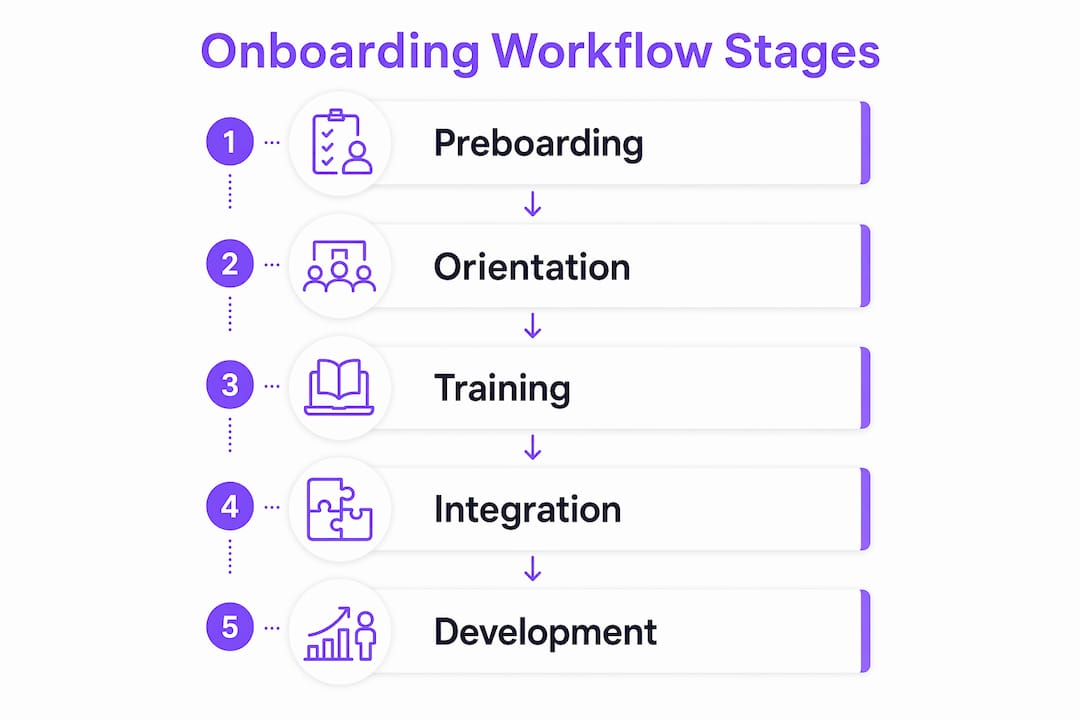
Onboarding workflows span 3–12 months, with the active management phase running 3–6 months. That timeline surprises most managers who assume onboarding ends after week one. The stages below reflect how effective organizations structure the full process.
1. Preboarding (offer acceptance to day one)
Preboarding covers everything between the signed offer and the first day. Tasks include sending welcome communications, collecting tax and banking information, shipping equipment, and granting system access. The goal is to eliminate day-one friction so the new hire arrives ready to work, not waiting for a laptop.
2. Orientation (day one to week two)
Orientation introduces the company, the team, and the role. Tasks include a company culture overview, benefits enrollment, introductions to key stakeholders, and a review of tools and systems. This phase sets first impressions. A disorganized orientation signals a disorganized company.

3. Training and mentorship (weeks two through eight)
This phase moves the new hire from observation to guided contribution. Role-specific training, shadowing sessions, and mentor assignments all belong here. The new hire should complete at least one real work task with feedback before this phase ends.
4. Integration and feedback (30, 60, and 90 days)
New hires progress from learning to contributing to owning results within the first 90 days. Structured check-ins at the 30, 60, and 90-day marks confirm that progression is on track. The 30-60-90 day feedback loop is the most under-resourced phase in most onboarding programs, yet it is where retention is won or lost.
5. Ongoing development (months four through twelve)
The final phase shifts ownership from HR to the manager and the employee. Career development conversations, skill-building plans, and performance reviews replace onboarding tasks. The workflow does not end here. It transitions into the standard performance management cycle.
| Stage | Timing | Key tasks |
|---|---|---|
| Preboarding | Offer acceptance to day one | Paperwork, equipment, system access |
| Orientation | Day one to week two | Culture overview, introductions, benefits |
| Training and mentorship | Weeks two through eight | Role training, shadowing, mentor assignment |
| Integration and feedback | Days 30, 60, and 90 | Check-ins, performance milestones, adjustments |
| Ongoing development | Months four through twelve | Career planning, skill development, reviews |
What are the real benefits of a structured onboarding workflow?
The business case for structured onboarding is direct. 80% of employees say they are more likely to stay long-term when given a structured onboarding experience. Replacing a mid-level employee costs between 50% and 200% of their annual salary. Onboarding is not an HR formality. It is a cost-control mechanism.
“Effective onboarding improves new-hire retention by 82%. The majority of companies still fail to execute it well. That gap is a direct, measurable cost sitting in most HR budgets.”
Beyond retention, structured workflows accelerate time to productivity. When tasks are sequenced and automated, a new hire completes training milestones on schedule instead of waiting for a manager to remember the next step. That acceleration compounds: a new hire who reaches full productivity in 60 days instead of 90 delivers an extra month of output per hire.
The benefits of a well-designed onboarding workflow include:
- Consistent experience across every new hire, regardless of which manager runs the process
- Reduced administrative load for HR through automated task assignment and reminders
- Faster productivity through clear milestones and role-specific training sequences
- Higher engagement because new hires feel prepared and supported from day one
- Fewer errors in compliance tasks like I-9 verification, benefits enrollment, and equipment provisioning
Workflow automation removes the single-point-of-failure problem. When onboarding depends on one coordinator’s memory, one absence breaks the entire process. Automated triggers fire regardless of who is in the office.
How do you create an effective onboarding workflow?
Building an effective onboarding workflow starts with a task audit. List every action required from offer acceptance through the 90-day mark. Assign each task an owner, a trigger event, and a deadline. That audit alone reveals gaps most HR teams did not know existed.
Event-based triggers and workflow automation prevent bottlenecks by ensuring consistent onboarding regardless of hiring manager bandwidth. A trigger is a specific event that automatically initiates the next task. Contract signed triggers IT to provision equipment. Day-one arrival triggers the manager to schedule a 30-day check-in. No manual nudge required.
Cross-department coordination is the hardest part of onboarding workflow design. HR, IT, finance, legal, and the hiring manager all own pieces of the process. Without a shared system, tasks fall through the gaps between teams. The workflow must assign ownership explicitly, not assume coordination will happen naturally.
Pro Tip: Build a single source of truth for your onboarding workflow. Every department should see the same task list, the same completion status, and the same upcoming deadlines. Siloed spreadsheets create the exact bottlenecks a workflow is designed to eliminate.
Common pitfalls to avoid when building your onboarding workflow:
- Static checklists that require manual updates and have no automated sequencing
- Single-owner designs where one HR coordinator holds all responsibility
- Missing preboarding that leaves new hires without equipment or access on day one
- No feedback loops at 30, 60, and 90 days to catch integration problems early
- Skipping the integration phase and treating onboarding as complete after week two
The 30-60-90 day check-in structure is the most practical feedback mechanism available. At 30 days, confirm the new hire understands their role. At 60 days, assess early contributions. At 90 days, evaluate whether they are operating independently. Each check-in should produce a documented action item, not just a conversation.
Monitoring the workflow after launch matters as much as building it. Track completion rates by task and by department. If IT provisioning consistently runs late, the trigger timing needs adjustment. If new hires consistently miss the 60-day check-in, the reminder cadence needs to increase. Workflows improve through iteration, not through one-time design.
For teams managing onboarding automation adoption, the shift from manual coordination to event-driven execution is the highest-leverage change available. It removes human memory from the critical path and replaces it with a system that runs on schedule every time.
Key Takeaways
A structured onboarding workflow is the single most effective tool HR managers have for improving retention, accelerating productivity, and eliminating administrative errors at scale.
| Point | Details |
|---|---|
| Onboarding vs. orientation | Orientation is one day; onboarding is a 3–12 month integration system with automated task sequencing. |
| Retention impact | Structured onboarding improves new-hire retention by 82% and makes 80% of employees more likely to stay. |
| Five core stages | Preboarding, orientation, training, integration, and ongoing development each require distinct tasks and owners. |
| Event-based triggers | Automated triggers replace manual follow-ups and ensure consistent execution regardless of manager availability. |
| Feedback loops matter | Check-ins at 30, 60, and 90 days are the most under-resourced phase and the most critical for long-term retention. |
Why most onboarding programs fail at the integration phase
Most onboarding programs die after week two. The orientation is polished, the welcome lunch happens, and then the new hire is left to figure out the rest independently. That drop-off is not a culture problem. It is a workflow design problem.
The organizations I have seen execute onboarding well share one trait: they treat the integration phase as the main event, not the afterthought. The preboarding and orientation phases are logistics. The real work of onboarding is the 60 days after orientation ends, when the new hire is trying to contribute without a safety net.
HR leaders under-resource this phase because it is less visible. No one celebrates a well-executed 60-day check-in the way they celebrate a polished first-day welcome kit. But the 60-day check-in is where you find out whether the new hire is struggling before they start quietly job-searching.
My recommendation is to build the integration phase first when designing a new onboarding workflow. Define what “successful integration” looks like at 30, 60, and 90 days. Then build the earlier phases to support those outcomes. That approach forces clarity on what onboarding is actually trying to achieve, and it surfaces the tasks that matter most versus the tasks that just feel productive.
Onboarding is not a process you run once and archive. It is a system you monitor, measure, and adjust every quarter. The teams that treat it that way retain people. The teams that treat it as a one-time project keep paying replacement costs.
— Harsh
How EasyFlow handles onboarding workflow automation
Manual onboarding coordination breaks down at scale. When your team is hiring across departments and time zones, a spreadsheet and a shared inbox are not enough.
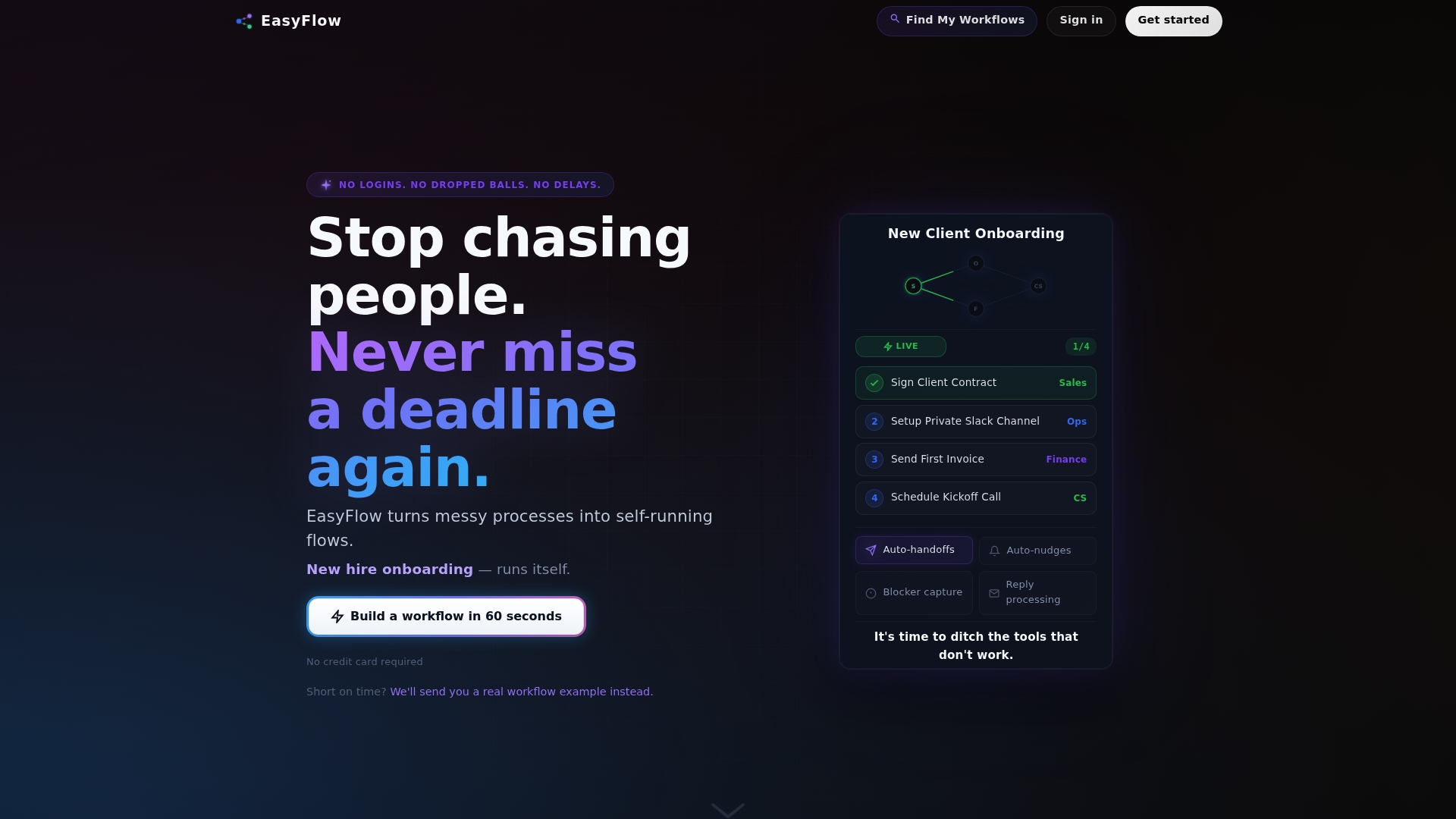
EasyFlow automates onboarding workflows by triggering tasks based on specific events, such as a signed contract or a confirmed start date. IT gets notified to provision equipment. HR receives a reminder to schedule the 30-day check-in. The hiring manager sees exactly which tasks are pending without needing to chase anyone. External collaborators can complete their steps via magic links, so no one needs to create an account just to participate. If you are ready to replace manual follow-ups with a system that runs on schedule, start with EasyFlow and see how event-driven onboarding works in practice.
FAQ
What is an onboarding workflow?
An onboarding workflow is an automated, event-driven system that sequences tasks, assigns owners, and coordinates departments to integrate a new hire from offer acceptance through full role contribution. It differs from a checklist by using triggers and reminders to execute steps automatically.
How long does an onboarding workflow last?
Onboarding workflows typically span 3–12 months, with the active management phase running 3–6 months. The process does not end after orientation or the first week.
What are the main stages of an onboarding workflow?
The five core stages are preboarding, orientation, training and mentorship, integration and feedback, and ongoing development. Each stage has distinct tasks, owners, and timelines.
Why do onboarding workflows improve retention?
Structured onboarding improves new-hire retention by 82%, and 80% of employees say they are more likely to stay long-term with a better onboarding experience. Consistent execution and clear milestones reduce the uncertainty that drives early turnover.
What is the difference between onboarding and orientation?
Orientation is a single event, typically one day, covering paperwork and introductions. Onboarding is a multi-month integration process that determines long-term retention and role performance.