
AI Task Execution for Ops Teams: Durable Step Level Control and Safeguards

AI task execution means an AI agent runs a task through to completion under a durable execution layer, not merely suggesting what a human should do next. The right approach separates orchestration (deciding what happens and when) from execution (the actual step running with retries and validation), and adds human checkpoints at the moments that matter. Tools like EasyFlow build this execution layer directly into team workflows, so steps get done instead of just assigned.
TL;DR:
- Most systems only track task status but do not actually run and verify steps, which delays workflows and increases manual follow-ups.
- Reliable execution systems split decision-making from mechanical tasks, enabling retries, idempotency, and automated state changes without manual intervention.
- Keeping I/O operations isolated to individual steps ensures workflows can be safely replayed after failures and reduces the risk of duplicate actions.
- External stakeholders can participate via magic links without creating accounts, streamlining client onboarding and approval processes.
- Monitoring task completion time, manual follow-up reduction, and retry rates during pilots reveals whether the execution system reliably automates workflows.
Table of Contents
- What Is AI Task Execution and Why Should Teams Care?
- Core Components and Architecture
- How Does AI Task Execution Actually Run?
- Implementation Patterns and Frameworks to Consider
- Where AI Task Execution Delivers the Most Value
- Risks, Controls, and Best Practices
- A Practical Checklist for Evaluating AI Task Execution
- EasyFlow’s View on Execution-First Automation
- Try EasyFlow’s Execution-First Approach
- Sources
- FAQ
What Is AI Task Execution and Why Should Teams Care?
Assistive AI drafts an email and waits for you to send it. AI task execution sends it, logs the result, and moves the workflow to the next step automatically. That distinction is the whole ballgame for operations teams.
Most task lists just track state: “done” or “not done.” Execution systems actually change state. A step runs, calls an API, waits for a response, and verifies the outcome before the workflow advances. No human has to remember to check back.
The immediate payoff shows up in three places:
- Fewer manual handoffs between people who each have to notice a task landed in their queue
- Faster cycle times because steps fire the moment their dependencies clear, not when someone checks a dashboard
- Cleaner audit trails since every execution attempt gets logged automatically
Teams that adopt this model stop treating automation as a fancy to-do list and start treating it as infrastructure.
Core Components and Architecture
Every reliable execution system splits into two layers, and confusing them is where most homegrown automation breaks down.
Orchestration decides what should happen and when. It holds the business logic: if this approval clears, trigger the next three steps. Execution is the mechanical part, actually calling the API, writing to the database, sending the notification, and reporting success or failure back up.
The control plane sits underneath both and handles the unglamorous work that makes execution trustworthy:
- Scheduling, so steps fire at the right time or in the right sequence
- Retries with backoff, so a transient failure doesn’t kill the whole run
- Idempotency guarantees, so a retried step doesn’t double-charge a customer or send a duplicate email
- Observability, so someone can see exactly where a run stalled
Steps or activities are the smallest unit of work, and they should be isolated I/O operations with cached results. According to Output.ai’s steps documentation, keeping I/O confined to individual steps is what lets a workflow replay safely after a crash without repeating side effects. That isolation is the difference between a system you can trust with a client-facing task and one you have to babysit.
How Does AI Task Execution Actually Run?
A task moves through a predictable lifecycle: it gets created, scheduled, executed step by step, verified, and then marked complete or failed. Each stage has a job, and skipping one is usually where reliability problems start.
- Create. The task enters the system with its inputs and success criteria defined.
- Schedule. The control plane decides when the step runs based on dependencies and priority.
- Execute. The step performs its I/O, whether that’s an API call, a database write, or a message send.
- Verify. The system checks the output against expected results before moving on.
- Complete or fail. Success advances the workflow; failure triggers a retry or escalates to a human.
Durable execution frameworks like Temporal and Vercel’s WDK handle step 3 and step 5 by breaking work into retryable units and replaying from the last completed step rather than starting over. That matters enormously when a run involves a dozen dependent steps and step nine fails, you don’t want to redo steps one through eight.
Human-in-the-loop checkpoints slot in at step 4 for anything with real consequences, an external email, a payment, a contract change. Research on minimum-sufficient execution argues agents should estimate the smallest reliable scope for a task before running it, expanding only if verification fails, which keeps compute and review burden proportional to actual risk.
Pro Tip: Set your retry limit before you launch, not after your first production failure. Three attempts with exponential backoff catches almost every transient error without letting a broken step hammer an API for an hour.
Implementation Patterns and Frameworks to Consider
The tooling landscape splits roughly into three camps: durable frameworks, control-plane kernels, and step-driven libraries. Which one fits depends on how much infrastructure you want to own.
Durable execution frameworks like Temporal and Vercel’s WDK handle retries and state persistence at the framework level. Pair one with a transport layer built for this purpose, AI Transport, and you get stream durability across reconnects, meaning a dropped connection mid-task doesn’t produce duplicate outputs.
Control-plane and kernel projects take a different angle:
- ExecGo separates the agent’s decision-making from execution, giving you a task DSL with DAG scheduling, retries, and observability so the agent focuses on judgment calls while the runtime handles mechanics.
- AI Stepper offers a lighter, YAML-driven approach with schema validation and built-in logging, a good fit for developer teams that want step control without adopting a full orchestration platform.
- Output.ai’s steps pattern enforces I/O isolation so workflows stay replayable.
If you’d rather not run any of this yourself, managed services are the other path. AWS Step Functions recently added a “copy agent prompt” feature specifically to help AI coding agents scaffold and deploy state machines, a sign that even cloud providers are optimizing for agent-built orchestration now. Choose managed when you want less operational overhead; choose self-hosted when you need tighter control over retry logic and data residency.
Where AI Task Execution Delivers the Most Value
The clearest wins show up wherever a task requires input from someone outside your core team, because that’s exactly where manual follow-up chains break down.
- New hire onboarding, where a dozen small steps (equipment requests, account provisioning, manager sign-off) each stall waiting on a different person
- Client onboarding and implementations, where external stakeholders need to complete forms or approve scope without becoming internal system users
- Approvals and scheduled reporting, where a step needs a yes/no from a manager before the workflow can advance
That last category of “external stakeholder” tasks is worth pausing on. Most execution platforms assume every participant has a login. EasyFlow instead lets external collaborators complete their piece through a magic link, no account creation required, which removes the single biggest source of onboarding friction in client-facing workflows. A practical rollout guide for human-in-the-loop automation covers how to structure these checkpoints without slowing the whole process down.
Risks, Controls, and Best Practices
Execution systems fail in predictable ways, and almost all of them trace back to the same root cause: non-deterministic side effects.
If a step calls an external API and doesn’t isolate that call properly, a retry can send a duplicate email or double-charge a card. According to Output.ai’s guidance on step isolation, the fix is to confine all I/O to steps, never to workflow logic, and make each side effect idempotent using deduplication keys tied to the run and activity IDs.
A short list of controls covers most of the risk:
- Isolate every external I/O call inside a step, never inline in orchestration logic
- Build idempotency keys into anything that writes data or sends communication
- Add retry limits with backoff instead of unlimited retry loops
- Require human approval before external-facing communications or high-impact database mutations
- Log every execution attempt, success or failure, for audit purposes
One underused lever worth calling out: scope estimation before execution. Running minimal verification first and only expanding scope when it fails conserves both compute budget and review time, an easy way to avoid burning resources on tasks that never needed the full treatment. Platforms like Microsoft 365 Copilot’s Cowork build in pause points at exactly these junctures so teams keep oversight without losing the speed of delegation.
A Practical Checklist for Evaluating AI Task Execution
Before piloting any execution platform, run through this list with your own workflows in mind, not the vendor’s demo.
- Does the system support durable execution with automatic replay after failure?
- Are I/O operations isolated into discrete, cacheable steps?
- Can you observe where a run stalled without digging through logs manually?
- Does it support human-in-the-loop hooks before high-impact actions?
- Can external collaborators participate without creating accounts?
- Does it integrate with the tools your team already uses daily?
Track three numbers during any pilot: time-to-complete per task, reduction in manual follow-ups, and the error or retry rate. If a vendor can’t answer how they handle idempotency on retries, that’s a real gap, not a minor detail. A guide on workflow automation’s role in team alignment walks through how to set these metrics up before your first pilot run.
EasyFlow’s View on Execution-First Automation
Most automation tools stop at reminders. We built EasyFlow to actually run the workflow, because a task that still needs a follow-up email isn’t automated, it’s tracked. Magic links let external collaborators complete their step without an account, and prebuilt templates cut the setup work most teams dread. Try it on one real workflow and see what stops needing a follow-up.
— Harsh
Try EasyFlow’s Execution-First Approach
EasyFlow is built for teams tired of chasing status updates instead of getting work done. Where a task tracker leaves a step sitting in someone’s queue until they remember to check it, EasyFlow actually executes the handoff and moves the workflow forward on its own.
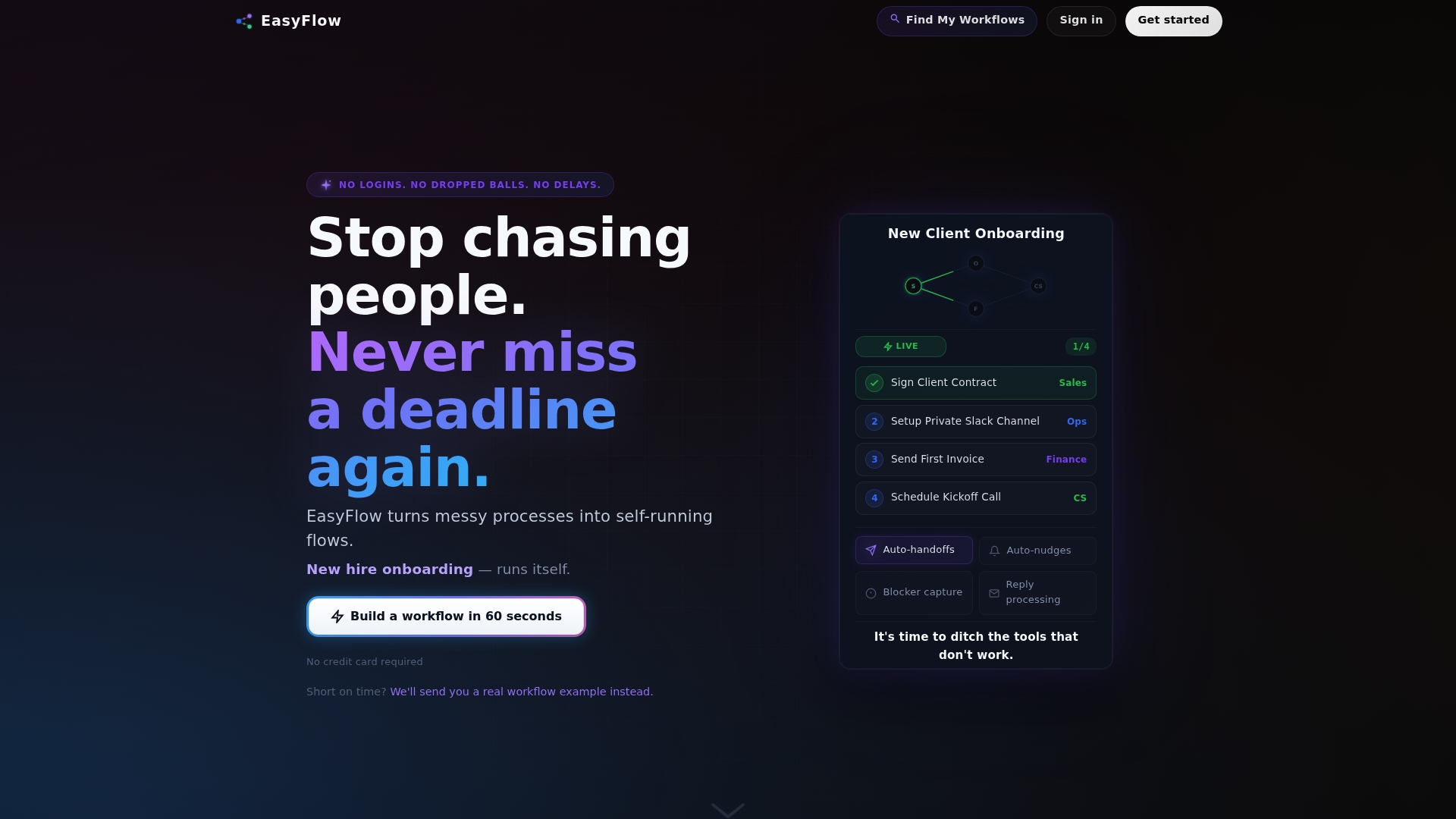
The core features line up directly with what this article covers: execution-first workflows that run steps instead of just listing them, magic links that let clients and vendors complete their part without creating an account, and prebuilt templates for onboarding, approvals, and client implementations so you’re not building a workflow from a blank page. Getting started takes three steps: sign up, pick a template close to your use case, and run it on one real workflow before rolling it out wider. You can also read how EasyFlow handles assigning tasks without manual intervention for a closer look at how the handoffs work.
Head to the EasyFlow start page to launch your first pilot, or check the free plan details if you want to test the basics before committing to anything paid.
Sources
For deeper technical grounding, Output.ai’s steps documentation covers I/O isolation, the AI Transport durable execution post details retry and reconnect semantics, and the complexity-aware execution paper formalizes scope estimation. For a practitioner view on agentic workflow productivity, see Byram Advisory Group’s analysis.
- Do AI Agents Know When a Task Is Simple? Toward Complexity-Aware Reasoning and Execution
- Introducing AI Transport v0.5.0: durable execution with Steps
- Output.ai steps documentation
- Microsoft 365 Copilot: Cowork
FAQ
What Is the Difference Between AI Task Execution and Assistive AI?
Assistive AI drafts suggestions for a human to act on; AI task execution runs the step itself, including the API call, database write, or notification, and verifies the result before moving on.
Do I Need a Framework Like Temporal to Get Started?
Not necessarily. Durable frameworks like Temporal or Vercel’s WDK matter most for complex, long-running workflows; simpler pilots can start with a step-isolation pattern like Output.ai’s steps and add durability later.
How Do Human-in-the-Loop Checkpoints Work?
The workflow pauses before a high-impact action, an external email or a major database update, and waits for explicit approval, a pattern used in platforms like Microsoft 365 Copilot’s Cowork.
Can External Collaborators Participate Without Creating Accounts?
Yes. EasyFlow lets external collaborators complete their assigned step through a magic link, which removes the account creation step that usually slows down client onboarding.
What Should I Track During a Pilot?
Watch time-to-complete per task, the reduction in manual follow-ups, and the error or retry rate; those three numbers tell you whether the execution layer is actually working.