
Frictionless Onboarding: What It Means for Ops Teams

Frictionless onboarding means designing the signup, activation, and setup process so a person or business can reach real value with the fewest possible obstacles, whether that’s clicks, forms, waiting periods, or manual back-and-forth. In practice, it looks like single sign-on with a pre-filled profile, a magic link that lets an external collaborator complete a task without creating an account, or a product tour that skips straight to the “aha” moment instead of a five-screen tutorial.
- SSO plus auto-filled account details cuts signup to a very short time
- Magic-link guest access lets a client sign a document without a password
- A straight-line product tour that hides advanced settings until they’re needed
It matters most when time-to-value determines whether someone sticks around, like a free trial or a client kickoff. The trade-off worth knowing upfront: some research on retail signups found SSO tied to weaker long-term loyalty than slower, more effortful signups, so speed alone isn’t the whole strategy.
Key Takeaways
Frictionless onboarding works when teams remove unnecessary steps first, automate the handoffs that cause delays, and measure both speed and downstream loyalty before calling any change a win.
| Point | Details |
|---|---|
| Definition first | Frictionless onboarding means removing unnecessary obstacles so users reach real value fast, not eliminating every step blindly. |
| Cut steps deliberately | Aim to remove 20 to 40% of nonessential onboarding steps, then add bumpers to catch anyone who stalls. |
| Watch the trade-off | Faster signup methods like SSO can weaken long-term loyalty, so test retention, not just conversion. |
| Measure the right KPIs | Track activation rate, time-to-first-value, early churn, and CSAT together, not conversion alone. |
| Automate the handoffs | EasyFlow removes manual follow-ups by routing tasks automatically and letting external collaborators act via magic links. |
Table of Contents
- Why Does Frictionless Onboarding Matter for Business Results?
- What Causes Friction During Onboarding?
- How Do You Design a Frictionless Onboarding Strategy?
- What Are the Best Practices for Reducing Onboarding Friction?
- Which Product Features Actually Reduce Onboarding Friction?
- How Does Workflow Automation Actually Remove Friction?
- How Do You Measure Onboarding Success?
- What Onboarding Models Should Teams Choose Between?
- What Should Teams Prioritize First When Cutting Onboarding Friction?
- How EasyFlow Removes Manual Friction From Onboarding
- Sources
- FAQ
Why Does Frictionless Onboarding Matter for Business Results?
Every extra step in an onboarding flow is a chance for someone to quit. Teams that shorten the path from signup to first value typically see three things move together: higher conversion, faster time-to-value, and lower support volume, because fewer confused users means fewer tickets.
- Higher signup-to-activation conversion
- Faster time-to-first-value (the moment a user gets something real out of the product)
- Fewer support tickets tied to setup confusion
- Better early retention, since people who reach value fast are more likely to stay
The KPIs worth watching are activation rate, time-to-first-value, early churn (30 and 90 days), and NPS or CSAT scores collected right after onboarding. Frictionless onboarding is meant to be an ongoing discipline, not a one-time redesign, which means these metrics need a standing owner.
Here’s the honest caveat: not every flow should be frictionless. When you’re onboarding a high-value client, verifying identity for compliance reasons, or building a relationship that needs trust upfront, a little friction, like a discovery call or a manual review step, can actually protect the outcome you’re optimizing for.
What Causes Friction During Onboarding?
Friction usually hides in five predictable places. Long signup forms that ask for information the product doesn’t need yet. Repeated data entry, where a client re-types the same company details across three separate forms. Vague error messages that leave a user stuck with no idea what went wrong. Unclear value, where someone signs up but never understands why they should keep going. And slow verification steps that stall momentum right when interest is highest.
- Lengthy signup forms asking for unnecessary fields
- Repeated data entry across multiple screens or documents
- Confusing or generic error messages
- Unclear or delayed demonstration of product value
- Slow identity or account verification steps
A client-facing example: an agency asking a new client to fill out the same contact information in an intake form, a contract, and a project kickoff doc, three chances to abandon over the same five data points.
Pro Tip: *Pull your funnel analytics and look for the single screen with the sharpest drop-off, not the overall completion rate.
How Do You Design a Frictionless Onboarding Strategy?
Building a frictionless onboarding process is a sequence, not a single redesign sprint. Here’s the order that actually works.
- Discover and map every touchpoint. List every screen, email, and manual step between signup and first value, including the invisible ones like a Slack message asking someone to “just send over the file.”
- Define the straight-line path. Identify the single fastest route from signup to the moment a user or client experiences real value. This is the Bowling Alley Framework: a straight-line lane to value, with guardrails to keep people from veering off.
- Remove or delay nonessential steps. The Product-Led Playbook’s data suggests teams can typically cut 20 to 40% of onboarding steps that don’t directly serve the path to value. Push profiling questions, upsell prompts, and optional settings to after activation.
- Add product bumpers. For the steps you can’t remove, use automated guides, tooltips, or conversational prompts that catch a stalled user and nudge them back onto the path instead of leaving them to figure it out alone.
- Instrument analytics before you launch anything. Define your activation event clearly. If you can’t measure whether someone reached value, you can’t tell whether your changes helped.
- Run small, reversible experiments. Change one variable at a time (a form field, a verification step, an email sequence) and watch both immediate conversion and 30 to 90 day retention.
On prioritization: treat legal, compliance, and fraud checks as must-haves that stay put. Treat profiling questions, secondary integrations, and cosmetic customization as delayable. If a step doesn’t protect the business or unlock the next step in the user’s path, it’s a candidate for removal or postponement.
Pro Tip: Every experiment needs a guardrail metric, not just a conversion goal. If removing a signup field boosts short-term signups but tanks 90-day retention, you haven’t fixed friction, you’ve just moved it downstream.
For teams starting from scratch, a realistic rollout runs four to twelve weeks: weeks one and two for mapping and instrumentation, weeks three through six for the first round of cuts and bumpers, and the remaining weeks for experiments and iteration based on what the data actually shows. Teams handling external collaborators, clients, vendors, new hires, benefit from mapping which of those handoffs could run through automated workflows instead of manual follow-up emails.
What Are the Best Practices for Reducing Onboarding Friction?
Run this as a working checklist, not a one-time audit.
- Offer at least one frictionless signup option, like signing in with an existing Google or LinkedIn account, alongside standard signup
- Use progressive disclosure: show only what’s needed for the current step, reveal advanced options later
- Personalize based on data you already have, not data you’re asking the user to hand over twice
- Write copy in plain language, one idea per screen, no jargon
- Make error messages specific (“Your card expired” beats “Something went wrong”)
- Offer self-service help, like inline tooltips or a searchable help center, before routing people to support
- Deploy product bumpers on any step where users tend to stall
A 15-minute audit: pull your funnel, find the biggest single drop-off point, read the actual copy and form fields on that screen, and ask whether every field on it is truly required right now. Most teams find their biggest win sitting on one screen, not spread across ten.
On personalization: the instinct is to ask more questions upfront to tailor the experience. Resist it. Effortless sign-up is one of three pillars in a frictionless system; collect what you need to personalize later, once trust is established.
Which Product Features Actually Reduce Onboarding Friction?
Look for these capabilities when you’re evaluating tools or building internal onboarding infrastructure:
- Single sign-on or magic links that skip account creation for external users
- Prefill and data import so users never re-enter information you already have
- Adaptive verification that adjusts scrutiny based on risk level, not a flat rule for everyone
- Interactive guides or product bumpers that catch stalled users automatically
- Workflow automation that eliminates manual handoffs between teams
When evaluating any of these, ask three questions:
- Does it integrate with the systems where your data already lives, or does it create a new silo?
- What controls do you have over the user experience? Can you customize prompts and timing, or is it fixed?
- How does it handle data privacy for the information it’s prefilling or automating?
Automation earns its keep most clearly in the handoffs between people: reminders that go out without a manager chasing anyone, and blocker detection that flags a stalled task before it becomes a missed deadline.
How Does Workflow Automation Actually Remove Friction?
Picture a client implementation that requires signatures, document uploads, and approvals from four different people across two companies. Without automation, that’s a project manager sending five follow-up emails a week and manually tracking who’s done what in a spreadsheet.
With workflow automation, each step routes to the right person automatically, and external collaborators, the client’s legal team, a vendor, a new hire’s manager, complete their part through a magic link with no account setup required. The task moves the moment it’s done; nobody waits for a status update meeting to find out.
- Fewer manual follow-ups because the system nudges people automatically
- Faster completion since tasks route the instant a prior step finishes
- Fewer silent blockers because stalled tasks get flagged instead of sitting unnoticed
Automation doesn’t just speed up one step, it removes the need for someone to manually track and chase every handoff in the chain, which is usually where onboarding actually stalls.
Start small: automate your single most repeated handoff first (a client intake form routing to a contract, for example), reuse a template for that workflow across every new client, and layer in notifications before you try to automate the whole process end to end.
How Do You Measure Onboarding Success?
Track a small set of KPIs consistently rather than a dozen vanity metrics inconsistently.
| KPI | What it tells you |
|---|---|
| Activation rate | Percentage of signups who reach your defined “first value” event |
| Time-to-first-value | How long it takes a new user or client to hit that same event |
| Completion rate | Percentage who finish the entire onboarding flow, not just the first step |
| Early churn (30/90 day) | Whether people who onboarded quickly actually stick around |
| NPS or CSAT post-onboarding | How the experience felt, not just whether it was fast |
Set targets against your own historical baseline first, then tighten the cadence, weekly reviews for a new flow, monthly once it’s stable. Instrument this with clear event definitions (what exactly counts as “activated”), a funnel chart for the full flow, and cohort tracking so you can see whether this month’s signups perform differently than last quarter’s.
What Onboarding Models Should Teams Choose Between?
Three models cover most situations. Straight-line, self-serve onboarding fits low-risk, high-volume products where speed wins. Adaptive, risk-aware onboarding fits situations involving fraud exposure or compliance, fast for verified low-risk users, step-up verification for flagged ones. White-glove, high-touch onboarding fits high-value clients where a human relationship matters more than speed.
- Signup
- Activation
- Onboarding to first value
- Expansion
Use step-up friction only where risk or contract value justifies it; default to straight-line everywhere else.
What Should Teams Prioritize First When Cutting Onboarding Friction?
Start with data, not instinct. Most teams guess where their friction lives and guess wrong. Pull the actual funnel numbers before touching a single screen.
Protect trust while you optimize speed. The SSO research is a real warning: faster isn’t automatically better once you measure past the first session. Instrument your first-value event before you change anything else, because without it you’re optimizing blind.
Small teams should fix their single worst screen first. Enterprise teams should build adaptive risk logic before chasing raw speed. Either way, don’t automate away every point of human contact. Some friction is actually relationship-building in disguise, and stripping all of it out sacrifices the loyalty you were trying to earn in the first place.
How EasyFlow Removes Manual Friction From Onboarding
Most onboarding friction isn’t a signup form problem, it’s a handoff problem. Someone finishes their part of the process, and then the whole thing stalls because nobody’s chasing the next person to act. EasyFlow fixes that specific gap: it automates task handoffs, sends reminders without a manager having to nag anyone, and flags blockers before they turn into missed deadlines.
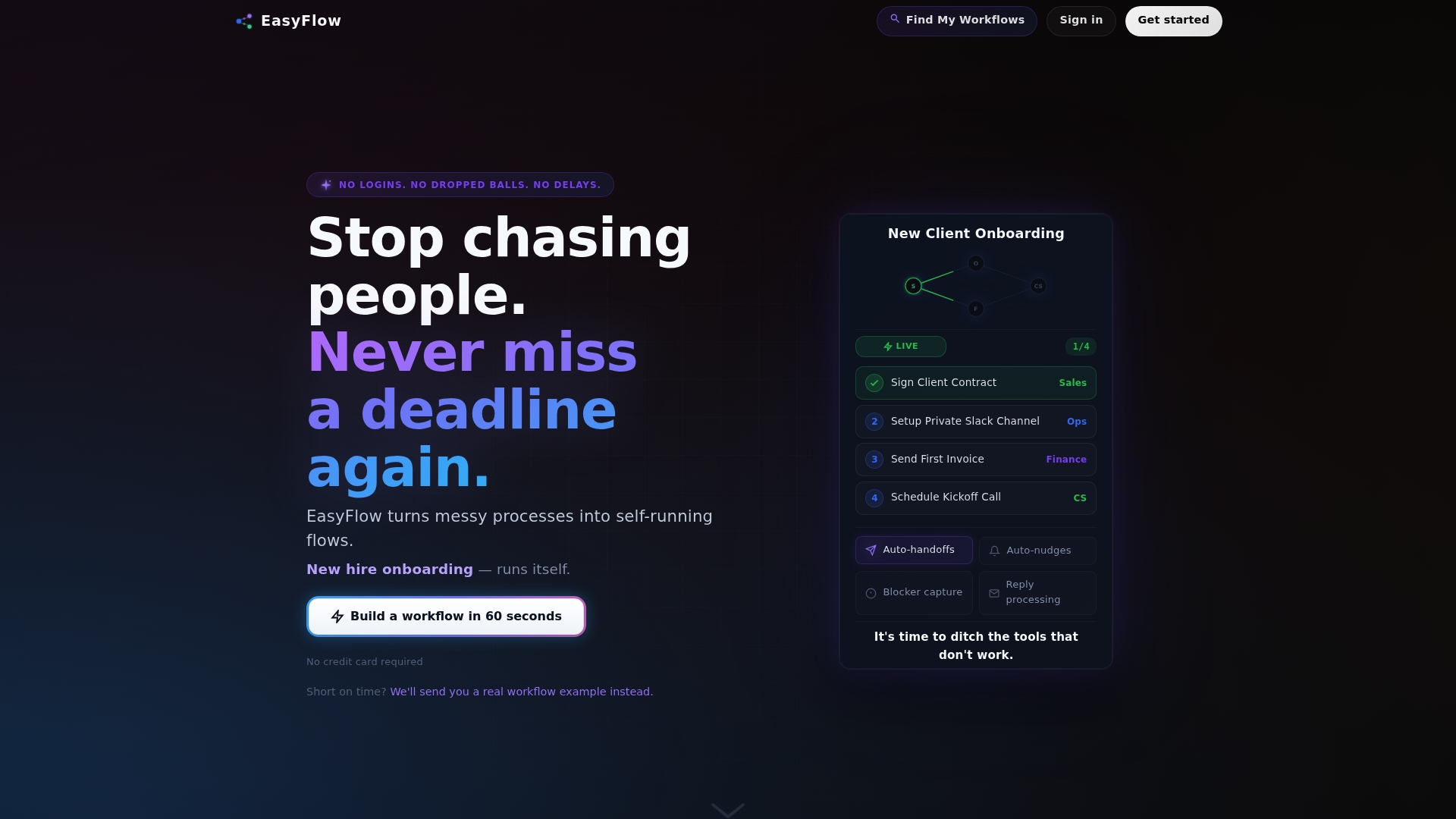
The part that matters most for external collaborators, clients, vendors, new hires, is that EasyFlow lets them complete their piece of a workflow through a magic link, no account creation, no password to reset before they can even start. Pair that with reusable templates for onboarding flows you run repeatedly, and you cut both the setup time and the follow-up emails at once. If you’re mapping your own onboarding process and want to see where automation fits, start a free trial and run your first workflow through it this week.
Sources
- Frictionless Onboarding | Product-Led Playbook (Chapter 5)
- Onboarding Without Compromises: Adaptive flows that stop fraud and drive conversion | Plaid
- Frictionless customer onboarding – what is it? | Markaaz blog
- Here’s Everything You Need To Know About Frictionless Customer Onboarding In SaaS | Inc42
FAQ
What Does Onboarding Mean in Simple Terms?
Onboarding is the process of guiding a new user, customer, or employee from their first interaction with a product or company to the point where they can use it successfully on their own.
What Are Examples of Frictionless Experiences?
Common examples include signing in with an existing Google or LinkedIn account instead of creating a new one, completing a task through a magic link with no account setup, and prefilled forms that skip re-entering data you’ve already provided.
What Are the Four Levels of Onboarding?
Definitions vary across teams, but a common version moves from passive (reading documentation) to guided (tooltips and walkthroughs) to interactive (hands-on tasks) to proactive (personalized, ongoing support based on usage).
What Are the Five Stages of the Onboarding Process?
A typical flow runs signup, activation, onboarding to first value, expansion, and ongoing engagement or retention, with each stage needing its own success metric.
How Is Frictionless Onboarding Different From Regular Onboarding?
Regular onboarding just walks a user through setup steps; frictionless onboarding deliberately audits and removes unnecessary steps, using tools like automated handoffs and magic-link access, so the same outcome takes less effort and less waiting.