
Building a Security Questionnaire Workflow That Actually Scales

The fastest, safest way to handle security questionnaires is an AI-assisted workflow where automation drafts answers from a governed knowledge library and a human always signs off before anything ships. Don’t try to automate everything at once. Pick one questionnaire format, run it end-to-end by hand into your knowledge library, and let that first pass expose where your mappings and reviewer rules break before you scale it.
TL;DR:
- Automating security questionnaires works best when starting with a single format like CAIQ and iteratively building the knowledge library through manual responses.
- Effective scope mapping is critical to avoid contradictory answers, especially when questions apply across multiple products, regions, or environments.
- AI assists in drafting responses by matching questions to a knowledge library, but humans must review high-stakes or low-confidence answers to prevent legal or contractual errors.
- Maintaining ownership, tracking expiry dates, and regularly updating evidence are essential to prevent answer drift and ensure ongoing accuracy and compliance.
- Deploying a structured workflow with automation of intake, routing, and evidence collection reduces response time and improves auditability across the questionnaire lifecycle.
Table of Contents
- What Is a Security Questionnaire Workflow?
- The Five-Stage Security Questionnaire Workflow Lifecycle
- How Does AI Automate Security Questionnaire Completion?
- Implementation Steps and a Pilot Checklist That Actually Works
- Governance, Auditability, and Preventing Answer Drift
- How EasyFlow Operationalizes Questionnaire Workflows
- Author’s Perspective: Balancing Speed With Governed Answers
- Try EasyFlow for Your Questionnaire Workflow
- Sources
- FAQ
What Is a Security Questionnaire Workflow?
A security questionnaire is a structured due diligence document a prospect, customer, or partner sends to evaluate your security posture before signing a contract. Procurement teams use them to satisfy third-party risk management requirements; security teams use them to decide whether your controls meet their bar. The security questionnaire workflow is the repeatable process your team follows to answer these documents accurately, quickly, and with evidence that holds up under audit.
Most questionnaires fall into a handful of recognizable formats. The CAIQ (Consensus Assessments Initiative Questionnaire), built on the Cloud Security Alliance’s Cloud Controls Matrix, is the closest thing the industry has to a standard. The SIG (Standardized Information Gathering questionnaire) from Shared Assessments covers a broader risk surface and comes in “Core” and “Lite” versions. Higher education and research institutions frequently use HECVAT, a purpose-built assessment for vendors serving that sector. Beyond these, you’ll field custom spreadsheets, vendor-specific portals, and ad-hoc PDFs that map loosely to SOC 2 trust service criteria without naming them directly.
Scope mapping matters more than most teams realize. A question like “Do you encrypt data at rest?” sounds simple until you have three product lines, two cloud regions, and a legacy system still running on different infrastructure. Before any answer goes out, someone needs to define:
- Which product or environment the question actually applies to
- What you’re contractually allowed to disclose versus what triggers a legal review
- Whether the answer changes based on the customer’s data classification or region
Skip this step and you’ll end up with contradictory answers across questionnaires, the kind of inconsistency that makes a reviewer on the other side start asking harder follow-up questions.
The Five-Stage Security Questionnaire Workflow Lifecycle
Teams that get this right don’t treat questionnaire response as a fire drill every time sales forwards a spreadsheet. They build a lifecycle with defined stages, and each stage has a specific job. This maps closely to how Vanta’s implementation guidance sequences questionnaire automation rollouts, and it holds up regardless of which tool you use to execute it.
- Discovery. Pull the last 10 to 20 questionnaires your team has answered and look for repeated questions. You’ll typically find substantial overlap across formats once you strip out formatting differences. Map who owns which answer domain: infrastructure, HR/access control, incident response, data handling.
- Setup. Build the knowledge library structure before you load a single answer. Every entry needs an owner, a scope tag (which product or environment it covers), an expiry date, and a link to supporting evidence. Connect the integrations you’ll actually need: document storage, ticketing, and whatever portal your biggest customers use.
- First-time value. Run one full questionnaire through the system by hand, start to finish. This is not a formality. It’s how you catch mapping errors, missing evidence, and reviewer bottlenecks before they cost you a deal.
- Deployment. Turn on automated intake so incoming questionnaires get parsed and routed without someone manually forwarding a PDF. Set reviewer SLAs (a timely response is common for standard questions, faster for deal-critical ones) and connect your export path to whatever portal format the customer requires.
- Operating. This is the stage most teams underinvest in. Feedback from reviewers needs to flow back into the knowledge library, stale evidence needs regular audits, and you need to be tracking metrics, not just closing tickets.
Pro Tip: Don’t skip stage three to save time. Teams that jump straight from setup to full automation almost always discover their scope tags are wrong only after a customer flags a contradictory answer, which costs far more time than the pilot would have.
The lifecycle only works if ownership survives the initial excitement of setup. A knowledge library with no assigned owner for the “data retention” category is a library that goes stale within two quarters, and nobody notices until a reviewer catches it in a live questionnaire.
How Does AI Automate Security Questionnaire Completion?
The automation pipeline behind a modern security questionnaire workflow breaks into distinct steps, and understanding each one tells you exactly where to trust the machine and where to insist on a human.
- Ingest: the questionnaire (spreadsheet, PDF, or portal export) gets pulled into the system.
- Parse: questions are broken into structured rows, stripped of formatting noise, and normalized so “Do you encrypt data at rest?” and “Is data encrypted while stored?” are recognized as the same question.
- Match: each parsed question gets matched against your approved knowledge library entries.
- Draft: the system generates a proposed answer, pulling in the matched evidence citation.
- Confidence scoring: each draft gets a score reflecting how closely the question matched an approved entry.
- Reviewer routing: low-confidence or high-stakes answers get routed to the right subject-matter owner; high-confidence matches move faster through review.
- Export: approved answers get formatted back into the customer’s required format, whether that’s a spreadsheet, a portal upload, or a PDF.
This is where AI earns its keep and where it needs a leash. It’s reliably good at formatting, bulk-matching repeated questions, and pulling the right evidence citation for a known answer. It should never be trusted alone on anything involving a contractual commitment, a customer-specific carve-out, or a disclosure that touches legal exposure. Industry practitioners are blunt about this: AI drafts, humans remain the final gatekeepers, full stop.
Confidence scoring is what makes this manageable at volume. A well-tuned threshold, often somewhere around 85 to 90 percent match confidence, lets high-certainty answers flow through with a light-touch review while genuinely ambiguous questions get real attention from someone who understands the nuance. Set the threshold too low and reviewers drown in low-value approvals. Set it too high and risky answers slip through unreviewed.

Implementation Steps and a Pilot Checklist That Actually Works
Getting from “we answer questionnaires manually” to “we run a governed automation pipeline” doesn’t happen in one leap. Following a sequence, rather than trying to stand everything up simultaneously, is what separates pilots that stick from ones that quietly get abandoned after a bad first month.
- Set up intake first. Decide which formats you’ll support (spreadsheet upload, direct portal connection, email forwarding) and connect the integrations your team already lives in, whether that’s a shared inbox, a Slack channel, or a ticketing system.
- Design the knowledge library before loading content. Structure it around canonical answers, not raw questionnaire text. Each entry needs a product scope tag, an evidence attachment, and an expiry rule so nobody is citing a pen test summary from two years ago.
- Configure reviewer routing and SLAs. Define who owns which category of answer and what the approval gate looks like for each. A junior analyst shouldn’t have unilateral sign-off on anything touching data residency commitments, which require appropriately experienced reviewers.
- Package evidence deliberately. Attach SOC 2 report excerpts, penetration test summaries, and architecture diagrams directly to the relevant knowledge library entries, and flag anything that requires an NDA or customer-specific disclosure gate before it goes out.
- Run the pilot and measure it. Choose one framework (CAIQ is a reasonable first target because it’s standardized), run it through the full pipeline, and track your supported-answer rate and reviewer edit rate.
Before you automate any of this, take a hard look at whether your current process is actually worth codifying. Research on process automation is consistent on this point: automating a broken process just makes the mess move faster. If your current answer for “who owns incident response disclosures” is “it depends who’s around,” fix that before you build automation on top of it.
On the integration side, connecting the knowledge library to wherever your evidence already lives matters more than most teams budget for. Guidance on automation setup points to pulling SOC 2 reports, ISO certificates, and policy documents directly from tools like Google Drive, SharePoint, or Confluence into a searchable, versioned base rather than re-uploading everything manually every quarter.
A checklist worth keeping visible during the pilot:
- Framework chosen and scoped
- Knowledge library populated with owners and expiry dates
- Reviewer roles and SLAs defined before the first question comes in
- Evidence attached with source dates, not just filenames
- Supported-answer rate and reviewer edit count tracked from day one
Governance, Auditability, and Preventing Answer Drift
Answer drift is the quiet failure mode of every questionnaire automation effort. It happens when the knowledge library stops reflecting reality, an infrastructure change goes unrecorded, a policy gets updated, and the system keeps confidently serving up the old answer because nobody flagged it as stale.
The fix is structural, not aspirational. Every canonical answer needs an assigned owner and an expiry date, full stop, no exceptions for “we’ll get to it later.” Evidence citations need source IDs and freshness dates attached, and the system should block any answer that lacks a valid citation from going out unsupported. A production-grade workflow treats parsing, matching, evidence verification, and export as separate components, each with its own owner routing, specifically so a gap in one stage doesn’t silently corrupt the next.

An audit trail isn’t optional overhead here. It’s what lets you answer the question every serious customer eventually asks: who approved this specific answer, when, and based on what evidence? Recording reviewer decisions, edits, and export timestamps turns a defensible process into a demonstrable one.
The metrics that actually tell you whether the system is working:
| Metric | What it tells you |
|---|---|
| Supported-answer rate | Percentage of answers backed by a valid, current evidence citation |
| Reviewer edit rate | How often humans change AI-drafted answers before approval |
| Stale-source catches | How many outdated evidence citations get flagged before export |
| Turnaround time | Time from questionnaire intake to completed, approved export |
Analyst guidance on automation programs points to exactly these measures, supported-answer rate and reviewer edit rate especially, as the clearest signals of whether a knowledge library is actually earning its keep or just accumulating outdated entries nobody trusts.
How EasyFlow Operationalizes Questionnaire Workflows
Most of the friction in questionnaire response doesn’t come from writing answers. It comes from chasing people: the security architect who has to confirm a control, the legal reviewer sitting on an approval, the customer contact waiting on a portal upload. EasyFlow is built around executing that handoff chain rather than just tracking it on a board somewhere.
External reviewers, a customer’s procurement contact, a partner auditor, don’t need to create an account to participate. They get a magic link, complete their piece, and the workflow moves forward automatically. That alone removes a meaningful chunk of the onboarding friction that stalls questionnaires for days at a time.
Practical capabilities that map directly onto the workflow described above:
- AI-assisted knowledge extraction to help populate your answer library from existing documents
- Evidence attachments tied directly to workflow steps, not buried in a separate shared drive
- Visual workflow diagrams (Gantt and timeline views) so you can see where a questionnaire is stuck
- Automatic reviewer assignment with blocker detection and a logged audit trail
Pro Tip: Start your pilot with the questionnaire format you get most often, not the most complex one. A high-frequency, moderate-complexity format like CAIQ gives you faster feedback on where your reviewer routing breaks down.
If you’re running this on spreadsheets and email threads today, the practical next step is integrating your existing document stores and running one questionnaire through a structured pilot before you commit to a full rollout.
Author’s Perspective: Balancing Speed With Governed Answers
Here’s what most teams get wrong: they treat questionnaire automation as a project with an end date instead of an operating discipline. It isn’t. The knowledge library degrades the moment you stop maintaining it, the same way any product degrades without a roadmap.
What actually separates teams that sustain this from teams that abandon it after two quarters is boring: clear ownership per answer category, reviewer SLAs that get enforced rather than politely ignored, and a real feedback loop where reviewer edits flow back into the library instead of disappearing into a closed ticket.
Escalate to legal or a security subject-matter expert the moment a question touches a contractual commitment or a disclosure with any ambiguity. Automation should shrink the volume of routine work reaching your specialists, not create a shortcut around them.
— Harsh
Try EasyFlow for Your Questionnaire Workflow
EasyFlow is built for the exact handoff problem that slows most questionnaire teams down: waiting on people. It executes the process, routing questions to owners, chasing evidence attachments, letting external reviewers respond through a magic link with no account setup, so nothing sits idle in someone’s inbox for three days.
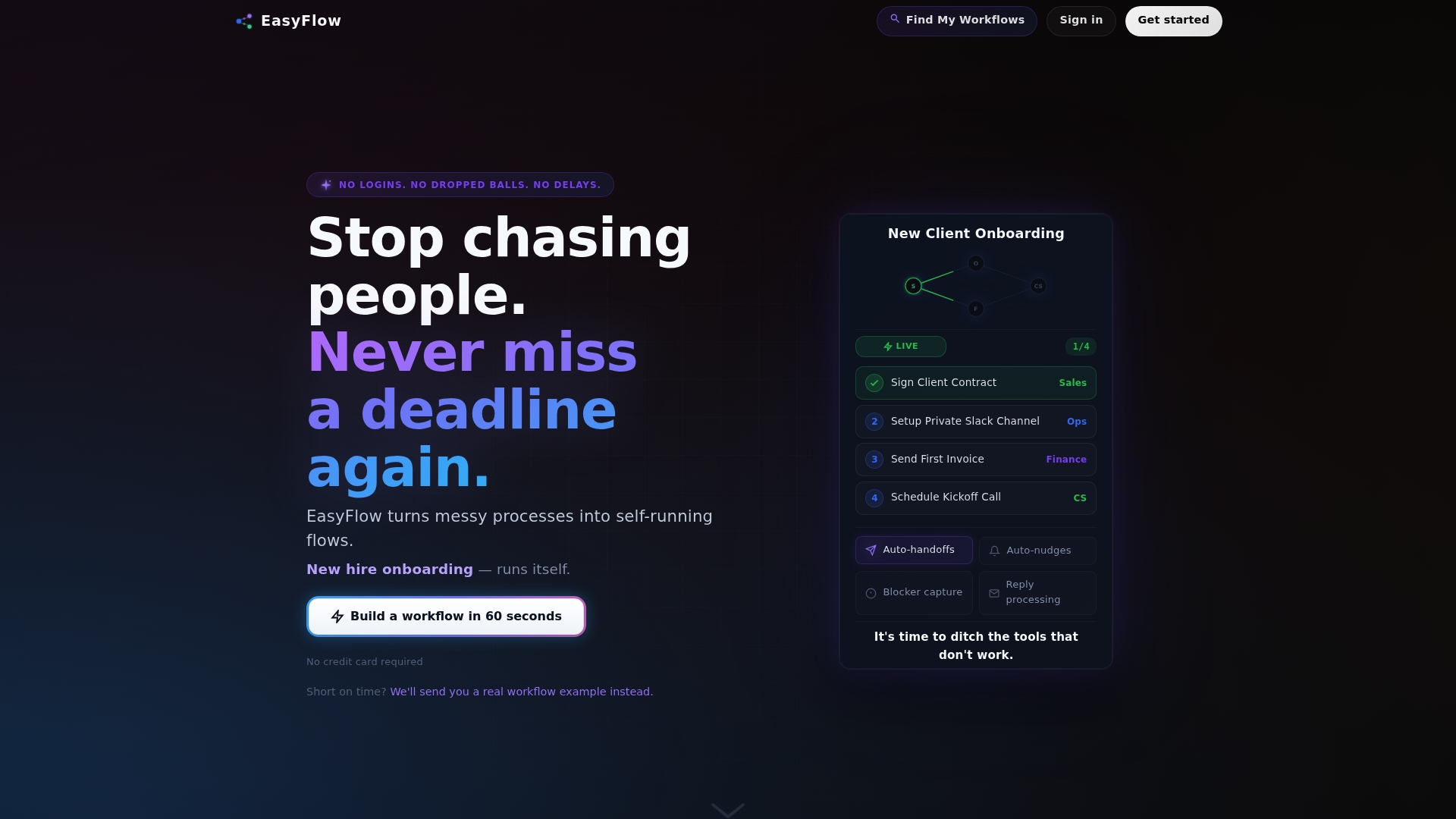
If you’ve been coordinating questionnaires through email threads and shared spreadsheets, connecting them to a workflow that automatically assigns owners, tracks blockers, and logs every approval is a meaningful jump in throughput. For a deeper look at how automated approval chains work in practice, our guide on automated approval workflows walks through common patterns.
You can start a free trial and run your next questionnaire through EasyFlow to see how much time you get back before your next renewal cycle comes up.
Sources
For teams building out an assessment plan from scratch, a few sources are worth reading directly rather than secondhand:
- NIST Special Publication 800-115: Technical Guide to Information Security Testing and Assessment
- Cloud Security Alliance blog — 5 steps of the security questionnaire process to automate today
- Vorp Labs — Security questionnaire review workflow
- Forrester — knowledge management and automation insights
FAQ
What Is a Security Questionnaire?
A security questionnaire is a structured document buyers use during procurement or third-party risk review to evaluate a vendor’s security controls, typically covering data handling, access management, incident response, and compliance certifications.
What Is the TPRM Checklist?
A third-party risk management (TPRM) checklist is the set of criteria an organization uses to vet vendors before onboarding, generally covering security posture, data handling practices, contractual protections, and ongoing monitoring requirements rather than one fixed universal list.
What Is a CBP Security Questionnaire?
A CBP security questionnaire relates to U.S. Customs and Border Protection supply chain security programs and is distinct from vendor security due diligence questionnaires; if you’ve been asked about this in a security review context, confirm which specific document your customer means before responding.
How Do You Perform a Security Assessment?
A security assessment typically follows a planning, execution, and reporting cycle: define scope, test or review controls against a framework, document findings with evidence, and report results to stakeholders, an approach NIST’s technical guide outlines in detail.
Can AI Fully Automate a Security Questionnaire Workflow?
AI can reliably handle parsing, matching, and drafting from an approved knowledge library, but contractual commitments and customer-specific disclosures still need human sign-off before export, which is why a security questionnaire workflow built entirely without governed review carries real risk.