
Examples of Automated Approval Workflows for Teams

Automated approval workflows are predefined processes that route requests to the right approvers, enforce decisions automatically, and create a complete audit trail without manual follow-up. The industry term for this practice is approval process automation, and the examples of automated approval workflows that deliver the most value share three traits: clear triggers, conditional routing logic, and integration with existing enterprise systems. Automating ticket routing and approvals can reduce first reply time by 73% and increase customer satisfaction by 9%. That result is not a coincidence. It reflects what happens when rule-driven decisions stop sitting in someone’s inbox. EasyFlow is one platform built specifically to execute these processes, routing requests and completing handoffs without requiring every participant to create an account.
1. Examples of automated approval workflows across industries
The most widely deployed automated approval workflows fall into five categories. Each one has a defined trigger, a routing condition, a set of approvers, and a final outcome that the system records automatically.
Expense claim approvals are the most common starting point for teams new to approval process automation. A request enters the system when an employee submits a claim. The workflow checks the amount against a threshold: claims under $500 are auto-approved, while claims above that figure route to the finance lead for manual review. The outcome is logged, and the employee receives a notification either way.

Document sign-off workflows handle policy updates, contracts, and publication approvals. The trigger is a document submission. The workflow routes the file to a legal reviewer, then a department head, in a fixed sequence. No approver can skip the queue. This structure is common in regulated industries where sign-off order matters for compliance.
Purchase request and procurement chains involve multiple approval levels based on spend category and amount. A $2,000 software license might require a manager’s approval, then a budget owner’s sign-off, then a final check from IT security. Each step has a deadline. If an approver does not respond within 48 hours, the system escalates automatically.
IT access and permissions requests are a strong fit for automation because the rules are binary. A user requests access to a system. The workflow checks the user’s role against an access control list. If the role matches, the request routes to the IT manager for a single approval. If it does not match, the request routes to both IT and the security team. The decision is logged for audit purposes.
Vendor onboarding approval sequences coordinate multiple departments. Procurement reviews the commercial terms. Legal checks the contract. Finance confirms the payment setup. Each department works in parallel or in sequence depending on the organization’s risk tolerance. The vendor receives a single notification when all approvals are complete, rather than a separate email from each team.
Pro Tip: Map the current manual process on paper before building any automated workflow. Identify every decision point and every person who touches the request. Automation that mirrors a broken manual process will break faster.
2. How approval workflow structures work and when to use each
The structure of an approval workflow determines its speed, compliance level, and auditability. Two primary enterprise models exist: sequential approval and first-to-respond (parallel) approval.
Sequential approval routes the request to one approver at a time, in a fixed order. The second approver only sees the request after the first approver acts. This model is the right choice for high-value or compliance-sensitive decisions, where the order of review matters and each approver needs to see the previous decision before acting.
First-to-respond approval sends the request to multiple approvers simultaneously. The first person to approve or reject moves the workflow forward. This model works well for low-risk requests where speed matters more than layered review. Parallel approvals suit low-risk requests, while sequential approvals are necessary for high-value compliance workflows.
Custom conditional routing adds a third layer. The workflow evaluates criteria such as request amount, department, or request type, then assigns the appropriate model automatically. A $200 travel reimbursement might trigger a first-to-respond flow. A $50,000 vendor contract triggers a sequential flow with four mandatory approvers.
| Model | Speed | Compliance fit | Complexity | Auditability |
|---|---|---|---|---|
| Sequential | Slower | High | Medium | Full chain recorded |
| First to respond | Faster | Low to medium | Low | Single decision recorded |
| Conditional routing | Variable | Configurable | High | Full logic path recorded |
Pro Tip: Build conditional routing on no more than two or three criteria at first. Adding five conditions to a new workflow creates debugging problems that slow down adoption.
3. Tools and techniques for building effective approval workflows
Tool choice depends on the organization’s tech stack and team skill level. A team running Microsoft 365 has a natural starting point in Power Automate, which offers pre-built approval templates and direct integration with SharePoint, Teams, and Outlook. Teams outside the Microsoft ecosystem typically evaluate low-code platforms that connect to their existing databases and communication tools.
Regardless of platform, four technical capabilities determine whether an automated approval workflow actually holds up in production:
- Dynamic approver assignment. The workflow pulls the correct approver from a directory or lookup list rather than hardcoding a name. When an employee changes roles, the workflow stays accurate without manual updates.
- Conditional logic. The system evaluates request attributes and routes accordingly. Without conditional logic, every request follows the same path regardless of risk or value.
- Timeout-based escalation. Organizations implement escalation and delegation rules to handle approver absence. If an approver does not respond within a set window, the request escalates to their manager or routes to a backup approver automatically.
- Audit logging. Every decision, timestamp, and routing change is recorded. This record is what makes automated approvals defensible in a compliance review.
Leading AI workflow tools now provide AI agents that classify incoming requests, validate documents, and handle audit logging automatically. This matters for teams processing high volumes of varied requests, where manual classification creates bottlenecks before the approval even starts.
EasyFlow handles multi-level approvals and external handoffs without requiring every participant to hold an account. External collaborators complete their part of the process through a magic link, which removes the onboarding friction that typically delays vendor and client approval chains. Teams working on client implementation workflows find this particularly useful when approvals cross organizational boundaries.
Pro Tip: Always build a notification at every state change, not just at the final decision. Approvers who can see where a request stands are far less likely to let it sit.
4. Measurable benefits and what drives them
The efficiency gains from approval process automation are real, but they come from specific design choices, not from automation alone. Automating routing and approvals reduces first reply time by 73% and lifts customer satisfaction by 9%. Those numbers reflect what happens when requests stop waiting for someone to manually read an inbox and decide who handles it next.
Automated approval systems replace informal email chains with centralized, auditable tracking of every request’s status. That shift matters beyond speed. When a compliance officer asks who approved a vendor contract and when, the answer is in the system. When a manager wants to know how many purchase requests are pending, the dashboard shows it in real time.
Team alignment improves because automated workflows reduce the follow-up burden. Requesters stop sending “just checking in” emails. Approvers stop losing requests in crowded inboxes. The role of approvals in project workflows shifts from a bottleneck to a checkpoint that the system manages.
The workflows that deliver the strongest results share one characteristic: they are well-defined before automation begins. Automation targets well-defined, rule-driven workflows to avoid multiplying confusion in complex or political processes. A workflow with clear rules runs faster and more accurately when automated. A workflow with ambiguous rules creates automated confusion at scale.
Key takeaways
Automated approval workflows deliver the strongest results when they combine clear triggers, conditional routing, and full audit logging from the start.
| Point | Details |
|---|---|
| Start with defined workflows | Automate processes with clear rules first; ambiguous workflows create problems at scale. |
| Match model to risk level | Use sequential approvals for compliance-heavy decisions and parallel approvals for low-risk requests. |
| Build in escalation rules | Timeout-based escalation prevents requests from stalling when approvers are unavailable. |
| Prioritize audit logging | Centralized tracking replaces email chains and makes every decision defensible in a review. |
| Choose tools by context | Tool selection should reflect your team’s tech stack and skill level, not vendor marketing. |
What I’ve learned from watching teams automate approvals
The most common mistake I see is teams automating the approval process before they understand it. They map the current state, find five people who “need to approve” a request, and build a five-step sequential workflow. Six months later, two of those approvers are rubber-stamping everything because nobody ever defined what they were actually reviewing.
Clarity in workflow design is not a pre-automation task. It is the automation task. If you cannot write the decision rule in one sentence, the workflow is not ready to be built. “Approve if amount is under $1,000 and requester is a full-time employee” is a rule. “Approve if it seems reasonable” is not.
The second thing I would push back on is the assumption that speed is the primary benefit. Visibility and audit trails are the key values beyond speed in automated approvals. I have seen teams cut approval time in half and still struggle with compliance reviews because they could not reconstruct who approved what and when. The audit log is not a nice-to-have. It is the reason the automation is defensible.
My practical advice: start with one workflow that has fewer than four decision points and at least one clear numeric threshold. Run it for 30 days. Review the log. You will learn more from that exercise than from any planning document.
— Harsh
How EasyFlow handles approval workflows for your team
Teams that need multi-level approvals without the overhead of managing user accounts across every stakeholder will find EasyFlow built for exactly that problem.
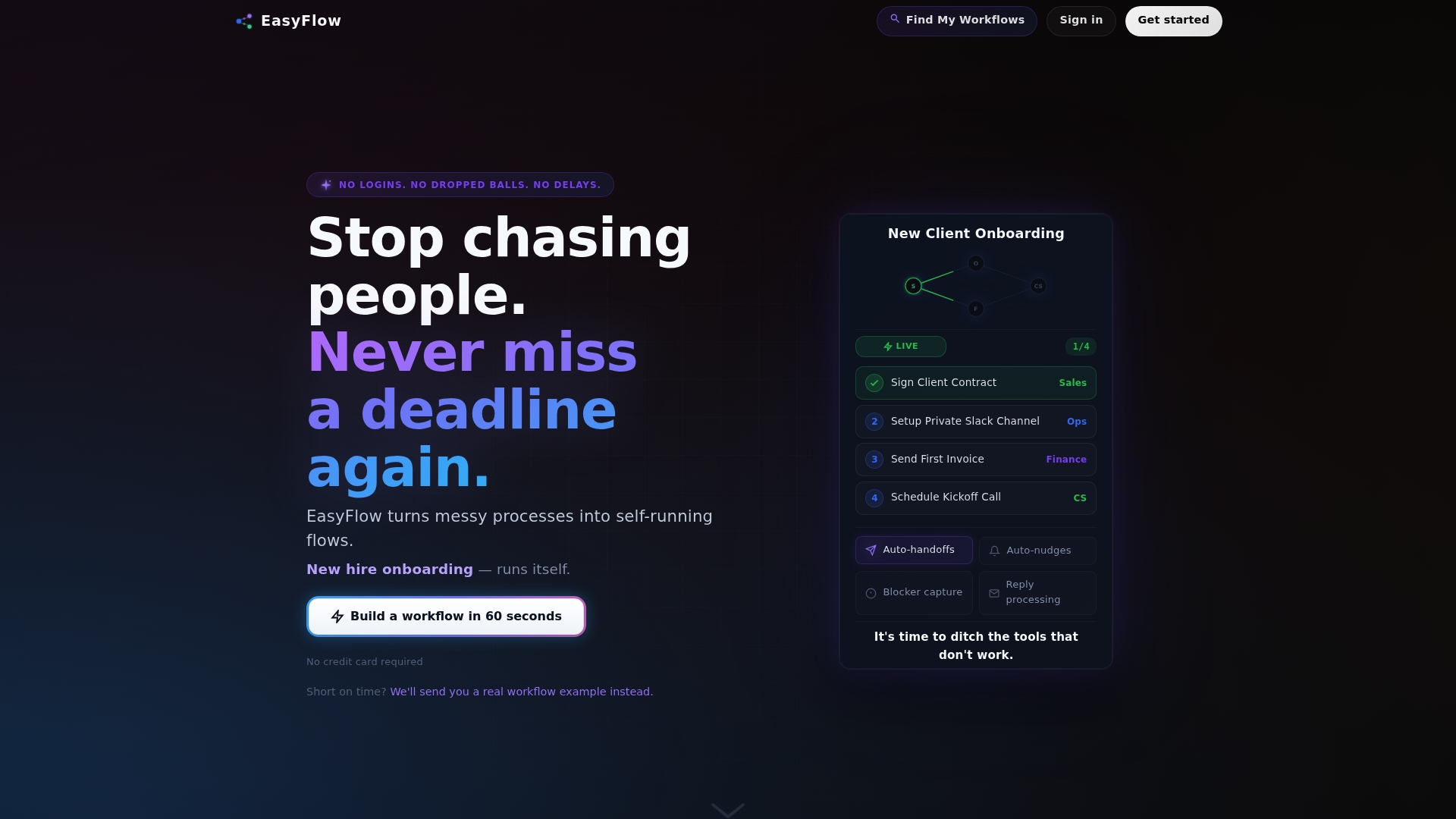
EasyFlow executes approval workflows across internal teams and external collaborators, routing requests dynamically and logging every decision automatically. Participants complete their steps through magic links, so vendors, clients, and contractors join the process without account setup. The result is faster approvals, fewer follow-ups, and a complete audit trail your compliance team can actually use. Start with EasyFlow free and build your first automated approval workflow in minutes, or visit teameasyflow.com to see how teams use it for onboarding, procurement, and client implementation approvals.
FAQ
What are the most common examples of automated approval workflows?
The most common examples include expense claim approvals, purchase request chains, IT access requests, document sign-offs, and vendor onboarding sequences. Each uses conditional routing to send requests to the right approver based on predefined rules.
What is the difference between sequential and parallel approval workflows?
Sequential approval routes requests to one approver at a time in a fixed order, which suits compliance-heavy decisions. Parallel approval sends the request to multiple approvers simultaneously, which works best for low-risk, time-sensitive requests.
How do automated approval workflows handle approver absence?
Most approval workflow software uses timeout-based escalation, which automatically routes the request to a backup approver or manager if the primary approver does not respond within a set time window.
What makes an approval workflow ready to automate?
A workflow is ready to automate when every decision point has a clear, rule-based condition that can be written in a single sentence. Workflows with ambiguous or politically driven decisions should be clarified before automation begins.
How does automation improve compliance in approval processes?
Automated systems replace informal email chains with centralized audit logs that record every decision, approver, and timestamp. That record makes every approval defensible during a compliance review without manual reconstruction.