
Reduce Contractor Onboarding Friction With Automation

The fastest way to reduce contractor onboarding friction is to stop treating it like a welcome packet and start treating it like an operational pipeline. That means standardized, automated workflows with compliance checkpoints built in from the start, not bolted on at the end.
Here is what actually moves the needle:
- Automate compliance collection upfront. Fragmented manual processes are the primary driver of onboarding delays, not compliance complexity itself. Build the checks into the workflow so they happen automatically.
- Use magic links for document submission. Contractors can upload W-9s, COIs, and licenses from a single form with no account creation required, cutting submission time dramatically.
- Switch to mobile-first communication. With 83% of non-desk workers lacking regular email access, portal-based messaging and SMS notifications are not optional for field-heavy contractor pools.
- Pace your requirements. Dumping every form and policy on day one kills completion rates. Spread requirements across the first few weeks.
- Build feedback loops in. Collect contractor input during the first two weeks and use it to fix the process, not just acknowledge it.
Table of Contents
- What actually causes contractor onboarding friction?
- How EasyFlow removes the manual work from contractor onboarding
- Keeping contractors engaged throughout onboarding
- Scaling contractor onboarding in 2026 and beyond
- Cut onboarding time with EasyFlow’s workflow automation
- Key Takeaways
- FAQ
What actually causes contractor onboarding friction?
Most teams assume onboarding delays come from compliance complexity. The real culprit is almost always structural: Many companies still rely on manual paperwork and disconnected HR systems for compliance submission. That combination creates predictable failure points.
The four root causes:
- Fragmented documentation. When W-9s go to HR, COIs go to legal, and license verifications sit in someone’s inbox, nothing moves in sync. Errors compound and re-entry wastes hours.
- Disconnected systems. Without integration between your contractor management, IT provisioning, and payment systems, every handoff is a manual step. Automated routing and notifications eliminate the access bottlenecks that delay project starts.
- Unclear ownership. When no one person owns a contractor’s onboarding gate, tasks stall. Mapping each stage to a named owner with an explicit failure state is what separates a process from a hope.
- Email dependency. Email-based onboarding fails a large share of contractors before it starts. Mobile-first portals are not a nice upgrade; for frontline contractors, they are the only channel that works.
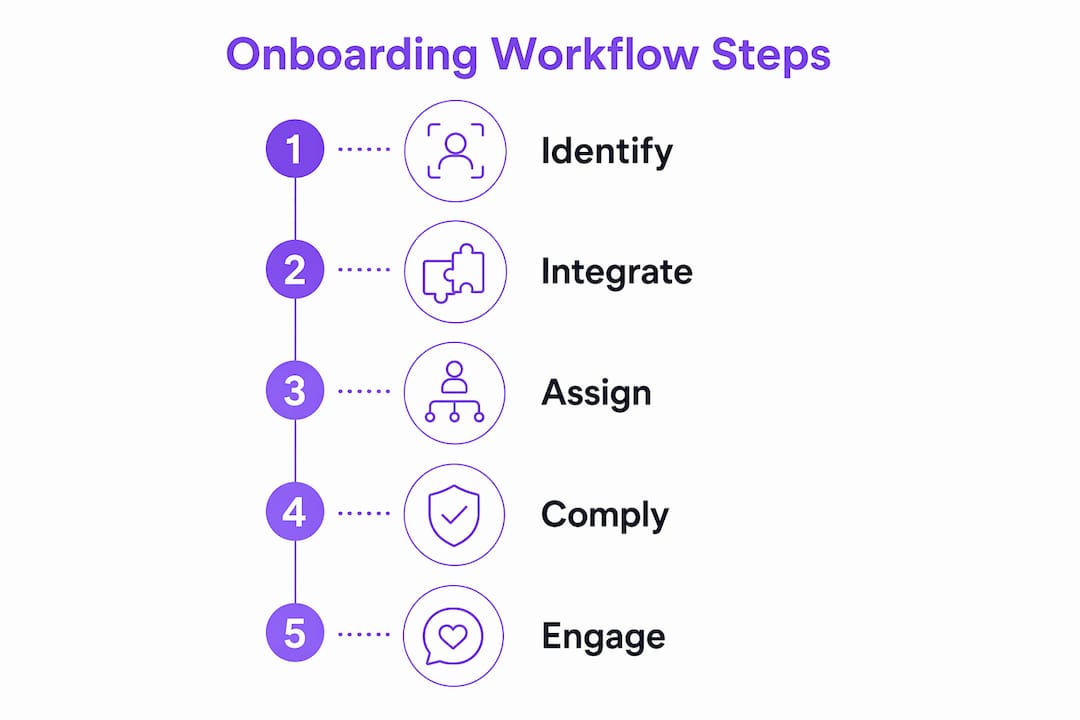
Fixing these means centralizing your workflow, integrating your systems, and assigning ownership at every gate. Pre-approved contract templates and rate cards alone can cut legal turnaround from 5–10 days to same-day execution.
Pro Tip: Map your onboarding process as a series of gates, each with a named owner and a defined failure state. Knowing exactly where drop-offs occur lets you fix the actual blocker instead of rewriting your welcome email for the fourth time.
How EasyFlow removes the manual work from contractor onboarding
EasyFlow is built around a core insight most project management tools miss: tracking tasks is not the same as executing them. Where tools like Asana or Trello show you what needs to happen, EasyFlow actually runs the process.
For contractor onboarding, that distinction matters immediately. When a new contractor enters the pipeline, EasyFlow triggers the workflow automatically: document requests go out via magic links, compliance checkpoints fire in sequence, and internal teams get notified only when their input is genuinely needed. Contractors never create an account. They click a link, upload what is required, and they are done. Magic links can reduce onboarding time dramatically in some implementations.
Compliance is integrated into the workflow, not appended to it. Every stage gate checks for required documents before the next step unlocks. That means no contractor reaches the payment rail without a completed W-9, and no one starts on-site without a verified COI. Real-time dashboards give operations managers full visibility into where each contractor stands, so follow-up chasing becomes the exception rather than the daily routine.
EasyFlow’s contractor workflow management approach applies this same logic across every handoff: HR, IT provisioning, legal review, and payment setup all run in a coordinated sequence rather than as isolated tasks someone has to manually coordinate.
Keeping contractors engaged throughout onboarding
Onboarding does not end when the paperwork clears. For most contractors, the first two weeks determine whether they stay engaged or quietly disengage. Treating onboarding as a continuous communication workflow rather than a one-time event is what separates high-completion programs from ones that stall.
A few practices that hold up in practice:
- Go mobile-first from day one. With 83% of non-desk workers lacking regular email access, portal-based messaging and SMS notifications are not optional for field-heavy contractor pools.
- Phase your requirements. Spreading onboarding tasks across several weeks rather than front-loading everything on day one measurably improves completion rates.
- Collect feedback early. Ask contractors what confused them during their first week. The answers reveal process gaps faster than any internal audit.
- Train your internal team. Automated workflows only stay effective when the people managing them understand what the system handles and when human judgment is actually needed.
Pro Tip: Require explicit confirmations at each stage gate and automate reminders for incomplete steps. A contractor who has not submitted their insurance certificate by day three should receive an automated nudge, not wait until someone notices on day ten.
Milestone check-ins at the end of week one and midway through the first project catch misalignment before it becomes a problem. Even a single structured review early in a short-term contract prevents the rework that comes from unclear expectations.

Scaling contractor onboarding in 2026 and beyond
The operations teams that scale contractor onboarding without adding headcount share one habit: they measure the right things. Form submission rates tell you almost nothing. Stage-level completion times, drop-off rates by gate, and time-to-operational-readiness tell you where the process actually breaks.
Automation combined with mobile-first workflows allows high onboarding volumes with consistent compliance and without proportional staffing increases. The key is segmentation: route low-risk contractors through an automated fast lane and reserve manual review for exceptions. That keeps your team’s attention where it adds value.
Data security cannot be an afterthought as onboarding systems grow. Every document upload, identity verification, and payment detail capture is a potential exposure point. Enterprise clients increasingly audit onboarding systems for access controls, data retention policies, and audit trails before signing contracts. Build those controls into the workflow architecture, not as a post-launch patch.
Emerging priorities for 2026 onboarding programs:
- Risk-based routing to fast-track low-risk contractors automatically
- Stage-level metrics replacing form-submission counts as the primary KPI
- Integrated IT provisioning so system access is granted the moment compliance clears
- Automated expiration alerts for COIs and licenses, triggered 30 days before lapse
- Process standardization across contractor types to eliminate one-off workflows
Teams that scale onboarding without extra staff do it through process design, not headcount. The automation handles volume; the team handles judgment calls.
Cut onboarding time with EasyFlow’s workflow automation
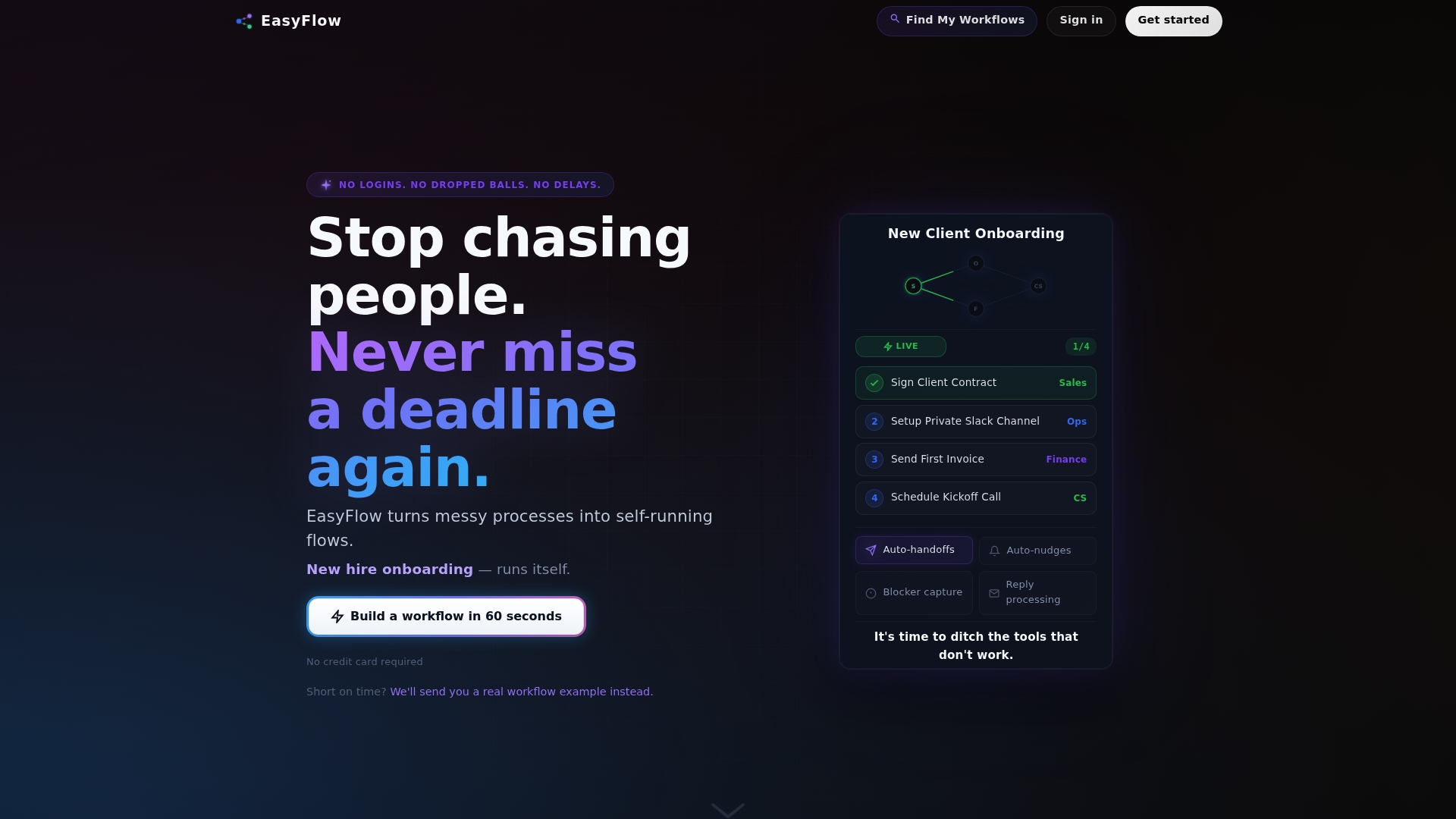
Manual contractor onboarding costs operations teams hours they do not have. EasyFlow replaces the follow-up emails, the disconnected spreadsheets, and the compliance gaps with a workflow that runs itself. Contractors complete their requirements through a single magic link with no account setup. Internal teams see real-time status across every active onboarding. Compliance gates fire automatically so nothing reaches the payment stage incomplete.
EasyFlow fits operations teams that manage external collaborators at volume and cannot afford to rebuild their process every time headcount grows. No per-seat fees for contractors who just need to submit documents. No account creation friction that kills completion rates before the process starts.
Start your first automated workflow and see how quickly a structured process replaces the manual coordination your team is currently absorbing.
Key Takeaways
Reducing contractor onboarding friction requires automated, gate-based workflows with integrated compliance, mobile-first communication, and stage-level metrics to replace manual coordination.
| Point | Details |
|---|---|
| Root cause is structural | 58% of companies still use manual paperwork and disconnected systems, not compliance complexity, as the primary friction source. |
| Magic links cut submission time | Contractors upload required documents via a single link with no account creation, reducing onboarding time to under two minutes. |
| Mobile-first is mandatory | 83% of non-desk workers lack regular email access, making portal-based messaging the only reliable channel for many contractor pools. |
| Phase requirements, not dump them | Spreading onboarding tasks across several weeks improves completion rates versus front-loading everything on day one. |
| EasyFlow automates the pipeline | EasyFlow runs compliance gates, document collection, and team notifications automatically, replacing manual coordination across HR, IT, and legal. |
FAQ
What causes the most contractor onboarding delays?
Fragmented manual compliance processes and disconnected systems are the primary drivers, not compliance complexity itself. 58% of companies still rely on manual paperwork and siloed HR systems, which creates re-entry errors and tracking gaps at every handoff.
How do magic links reduce onboarding friction?
Magic links let contractors submit documents from a single form with no account creation or portal navigation required. This approach can reduce contractor-side onboarding time to under two minutes.
Why does mobile-first communication matter for contractor onboarding?
83% of non-desk workers do not have regular company email access, so email-based onboarding fails a large share of contractor pools before it starts. Portal-based messaging and SMS reach contractors where they actually work.
How does EasyFlow help operations teams improve contractor onboarding?
EasyFlow automates the entire onboarding pipeline, from document collection via magic links to compliance gate sequencing and IT provisioning notifications, so contractors move from hired to ready without manual coordination at each step.
When should a team switch from manual to automated contractor onboarding?
Many teams find manual contractor onboarding becomes challenging once they manage more than a small number of active contractors, or when onboarding spans multiple states or contractor types. Above that threshold, manual processes create compliance exposure faster than a team can manage by hand.