
How Project Managers Track Accountability Day to Day

Project managers track accountability by naming a single owner for every deliverable, attaching measurable acceptance criteria to that owner’s work, and surfacing progress on KPIs through recurring dashboards and check-ins. That’s the whole formula. The rest is execution.
The methods that make this work aren’t exotic. A RACI matrix tied to a work breakdown structure (WBS) settles who owns what before work starts. KPIs like on-time delivery rate and overdue task count give you a number to watch instead of a feeling to guess at. Standups, weekly reviews, and documented escalation paths turn that visibility into action instead of a dashboard nobody opens.
This piece walks through each layer:
- How to assign ownership so it can’t be disputed later
- Which KPIs actually predict accountability breakdowns
- Meeting cadences that create follow-through instead of status theater
- How to measure whether your accountability practices are working
- The culture and documentation habits that keep remote teams honest
The Project Management Institute frames accountability as something you build at project kickoff, not something you enforce after things go wrong. That timing matters more than most PMs realize.
Key Takeaways
Accountability tracking works when a single named owner, measurable acceptance criteria, and KPIs on a recurring dashboard replace guesswork with visible, checkable progress.
| Point | Details |
|---|---|
| One Accountable per deliverable | Enforce the RACI rule strictly; shared accountability is the most common cause of missed deadlines. |
| Break work down before assigning owners | A detailed WBS prevents vague deliverables from hiding diffused responsibility. |
| Track leading and lagging KPIs | Watch overdue task count and issue resolution time to catch drift before on-time rate drops. |
| Make meetings decision-focused | Pre-read dashboards before weekly reviews so meeting time goes to assigning follow-ups, not status reading. |
| Automate the follow-up work | EasyFlow’s magic links and automated reminders cut the manual chasing that causes accountability to slip. |
Table of Contents
- Why Accountability Gaps Cost More Than They Look Like They Should
- How Do You Assign Ownership So It Actually Sticks?
- Which KPIs and Dashboard Views Create Real Accountability?
- How Often Should Teams Meet to Enforce Accountability?
- How Do You Measure Whether Accountability Is Improving?
- Building a Culture Where Accountability Doesn’t Feel Punitive
- Your First-Week Accountability Setup Checklist
- Where Automation Fits Into Accountability Tracking
- What I’ve Learned Watching PMs Fix Accountability
- Let EasyFlow Handle the Follow-Up So You Don’t Have To
- Sources
- FAQ
Why Accountability Gaps Cost More Than They Look Like They Should
A missed deadline rarely stays a single missed deadline. It cascades into rework, a tense sponsor call, and a team that starts double checking each other’s work instead of trusting it. The real cost of weak accountability isn’t the late task. It’s what happens in the weeks after, when trust between the PM and the sponsor takes a hit that no status report fully repairs.
Most accountability failures trace back to two patterns: diffused ownership and vague deliverables. Diffused ownership happens when three people are “kind of” responsible for the same output, so each assumes someone else is handling it. Vague deliverables happen when a task like “update the client” gets logged without specifying what update, by when, or in what format. Neither failure shows up as a red flag in most tracking tools, because on paper the task technically exists. It just has no teeth.
Statistic Callout: Harvard Business Review reports that a majority of cross-functional teams struggle with dysfunction rooted in unclear roles and a lack of psychological safety, not lack of effort or talent.
That statistic points at something PMs underestimate: accountability breakdowns are usually structural, not personal. Someone doesn’t drop the ball because they’re careless. They drop it because the ball was never clearly theirs to begin with.
The fix starts at project initiation, not mid-project cleanup. PMI’s guidance on accountability is direct about this: use the project charter and early kickoff meetings to set expectations, name deliverables, agree on deadlines, and decide how progress will actually be measured. Projects that skip this step spend the middle third of the timeline retroactively assigning blame instead of tracking progress. Get ownership clear on day one, and the rest of the system, dashboards, standups, escalation has something solid to track against.
How Do You Assign Ownership So It Actually Sticks?
Ownership only works as an accountability tool when it’s unambiguous. That means one person, one deliverable, one clear definition of “done.” Two frameworks handle this better than anything else in a PM’s toolkit: RACI and the work breakdown structure.
RACI stands for Responsible, Consulted, and Informed, plus the role that matters most for accountability: Accountable. Cornell IT’s definition is blunt about the rule that makes RACI work: there must be only one Accountable person per deliverable. The moment two people share the “Accountable” label, you’ve recreated the diffused ownership problem RACI exists to solve. Responsible can include several people doing the work. Accountable is singular, always.
The work breakdown structure does the complementary job. Where RACI assigns roles, the WBS breaks the project into discrete deliverables small enough that ownership can’t hide inside a vague phase name like “Design.” Instead of “Design phase, owned by the design team,” a proper WBS gets you to “Wireframes for checkout flow, owned by Maria, due Thursday.” That specificity is what makes tracking possible at all.
Acceptance criteria close the loop. A deliverable without acceptance criteria is a promise with no way to verify it was kept. Take a vague deliverable like “improve onboarding documentation” and convert it into something measurable: “Onboarding guide covers all five setup steps, reviewed by two new hires with zero unresolved questions, published by March 12.” Now there’s no argument about whether it’s done.
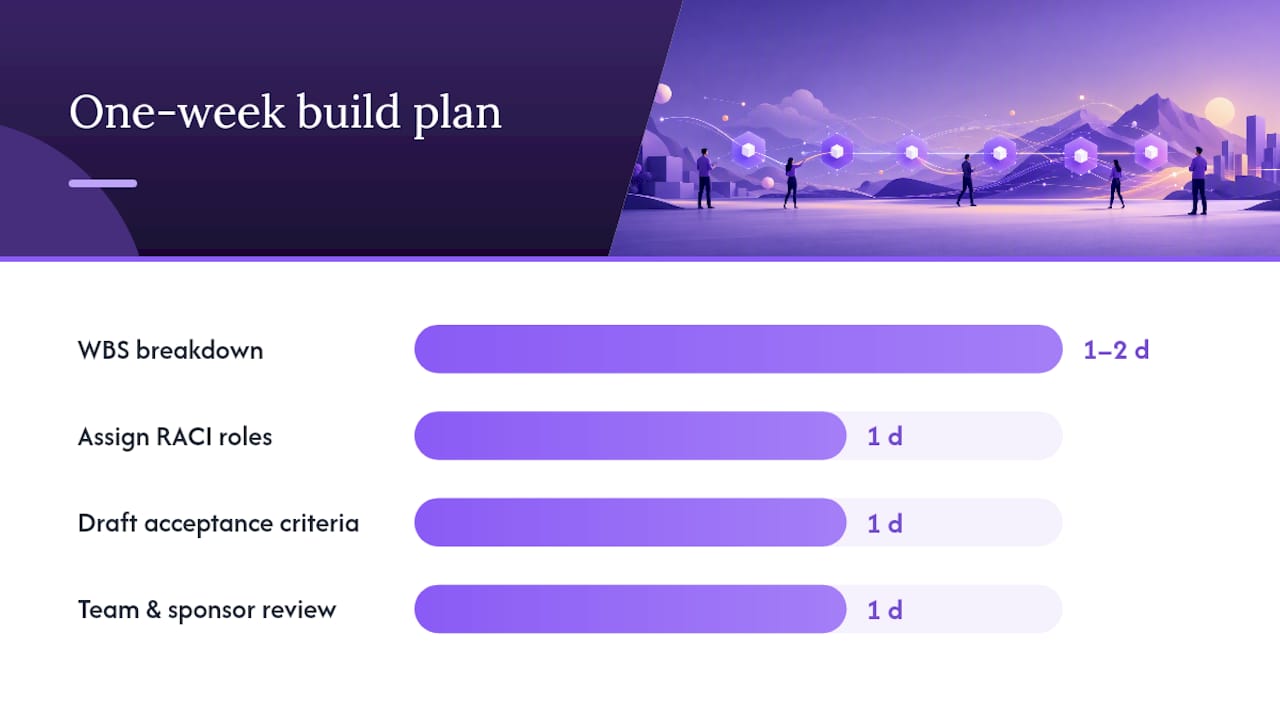
Here’s how to build this artifact in under a week:
- Day one to two: Break the project into a WBS with deliverables specific enough that each one could plausibly have exactly one owner.
- Day three: Assign RACI roles to each deliverable, enforcing the single Accountable rule even when it means an uncomfortable conversation about who that person is.
- Day four: Draft acceptance criteria for every deliverable in the critical path, phrased as a condition you can check off, not a feeling you can debate.
- Day five: Review the combined RACI and WBS with the team and the sponsor, and fix disputed ownership before work starts, not after.
Pro Tip: If two people both think they’re Accountable for the same deliverable, that’s not a scheduling problem, it’s a sign the WBS is still too broad. Split the deliverable until ownership resolves cleanly on its own.
Project Management Formula’s guidance on tracking deliverables backs this up directly: teams that fix a single accountable owner, agree on acceptance criteria, and reduce friction around updates see measurably better tracking outcomes than teams that skip straight to a tool.
Which KPIs and Dashboard Views Create Real Accountability?
Not every metric on a project dashboard drives accountability. Some just generate noise. The ones that actually work share a trait: they make a person’s performance visible to the team and the sponsor without anyone having to ask.
Five KPIs do most of the heavy lifting:
- On-time delivery rate shows what percentage of deliverables hit their acceptance date, the single clearest signal of whether ownership is functioning.
- Overdue task count flags where accountability is breaking down right now, not in last month’s retrospective.
- Issue resolution time measures how fast a flagged blocker actually gets closed, which tells you whether escalation paths work or just exist on paper.
- Budget variance connects accountability to cost, since scope creep and missed deadlines usually show up here before anywhere else.
- Stakeholder satisfaction captures whether the sponsor’s experience of the project matches what the numbers say, because a dashboard can look green while trust is quietly eroding.
Workzone’s research on accountability strategies describes dashboards as accountability engines: real-time visibility into deadlines, owners, and blockers motivates follow-through in a way that a weekly email summary never does. That’s the mechanism worth understanding. It’s not the metric itself that changes behavior. It’s knowing the metric is visible to your manager and your teammates at any moment.
Build the dashboard around three audiences. Delivery teams need the detailed view: task-level owner names, acceptance criteria links, and active blockers. PMs need a mid-level view that highlights risk indicators and overdue items across the whole project. Sponsors need a summary view, Project Management Formula recommends keeping this separate from the working tracker entirely, so sponsor reporting doesn’t turn the team’s daily tool into a performance document everyone tiptoes around.
Configuration determines whether any of this becomes a habit. Set automated reminders for approaching deadlines, schedule weekly exports so the sponsor view updates itself, and lock down permissions so people edit only their own deliverables. A dashboard that requires manual updates every week quietly dies by month two.
How Often Should Teams Meet to Enforce Accountability?
Dashboards create visibility. Meetings turn that visibility into follow-through. Three cadences cover most projects, and each one has a job the others don’t do.
- Daily standups exist to surface blockers, not solve them. Each person answers what they finished, what’s next, and what’s blocking them, in under two minutes each. Problem-solving belongs in a separate conversation immediately after; dragging it into the standup turns a ten-minute check-in into a forty-minute meeting nobody wants to attend.
- Weekly dashboard reviews should run off a pre-read, not a live walkthrough. Send the dashboard snapshot the day before so the meeting time goes toward decisions: who’s picking up the overdue item, what’s the new deadline, who’s escalating what. Every action item gets an assigned owner before the meeting ends, or it evaporates by Monday.
- Monthly or phase reviews step back to trends: is on-time delivery improving, is budget variance widening, is the same person showing up in overdue items three months running. This is also where sponsor reporting cadence gets set, and where documented escalation happens: a named issue, a named owner, a deadline for resolution, logged somewhere the sponsor can see it.
Escalation only works when it’s a process, not a last resort. Define in advance what triggers it, SwarmStack’s risk assessment playbook recommends setting explicit thresholds so a delay of a day doesn’t get treated the same as a delay that threatens the launch date, and who receives it. Without that clarity, escalation becomes a political move instead of a routine safeguard.
How Do You Measure Whether Accountability Is Improving?
You can’t tell if your accountability practices are working without a baseline. Project-management is clear on this: capture your metrics before you change anything, then track the trend, because a single snapshot tells you almost nothing about direction.
A simple measurement plan looks like this:
- Metric: On-time delivery rate. Baseline: 61%. Target: 85%. Intervention: enforce single-owner RACI on all critical-path deliverables. Review cadence: monthly.
- Metric: Overdue tasks at any given time. Baseline: 14. Target: under 5. Intervention: automated deadline reminders plus weekly dashboard review. Review cadence: weekly.
- Metric: Issue resolution time. Baseline: 6 days. Target: 2 days. Intervention: documented escalation triggers. Review cadence: monthly.
Statistic Callout: Teams that fix ownership, define acceptance criteria, and reduce update friction see measurably better tracking outcomes than teams relying on tooling alone.
Watch the difference between leading and lagging indicators. Overdue task count and stalled standup updates are leading indicators: they tell you something’s drifting before the deliverable is actually late. On-time delivery rate and budget variance are lagging: they confirm what already happened. A PM who only watches lagging indicators finds out about accountability drift a month after it started. Track both, and the leading indicators buy you the time to intervene before the trend shows up in the monthly numbers.
Building a Culture Where Accountability Doesn’t Feel Punitive
Systems break down fast in a team that’s afraid to report bad news. If flagging a delay gets you blamed instead of helped, people stop flagging delays, they just quietly hope the problem resolves itself. Harvard Business Review’s research on cross-functional teams ties this directly to psychological safety: teams without it default to unclear roles and self-protective silence, the exact conditions that make accountability tracking useless.
One practical fix: make “I’m behind” a normal sentence in a standup, not a confession. A PM who responds to a red flag with “thanks, what do you need” instead of “why is this late” gets more honest updates over time, and honest updates are the raw material accountability tracking depends on.
For remote teams, documentation has to replace the hallway conversation that used to catch small problems early. That means:
- One single source of truth for status, not a tracker plus three side conversations in chat.
- A clear rule for update frequency, daily for critical-path items, weekly for everything else.
- Lightweight acceptance evidence, a screenshot or a one-line note, attached directly to the deliverable rather than described secondhand in a meeting.
Recognition closes the loop. Calling out a deliverable that hit its acceptance criteria on time, publicly and specifically, does more for accountability culture than any dashboard color ever will.
Your First-Week Accountability Setup Checklist
Start small and finish the basics before adding more system. Here’s the sequence, timeboxed so it fits around an already busy week:
- Build the WBS and assign owners (90 minutes): break deliverables down until each one can have a single clear owner.
- Draft RACI for critical-path items only (60 minutes): don’t try to RACI the entire project in week one.
- Write acceptance criteria for the top five deliverables (60 minutes): pick the ones most likely to cause disputes later.
- Choose three KPIs (30 minutes): on-time rate, overdue count, and one more relevant to your project’s biggest risk.
- Configure a basic dashboard (90 minutes): owner names, due dates, and blocker flags visible to the whole team.
- Schedule the weekly review (15 minutes): same day, same time, pre-read sent 24 hours ahead.
For a quick early win, clear any deliverable that currently has no listed owner. Orphaned deliverables are the fastest accountability leak to fix, and closing them out in week one gives the sponsor visible proof the new system is working before the first monthly report.
Where Automation Fits Into Accountability Tracking
Manual status collection is where accountability systems quietly fall apart. A PM chasing five people for updates every Friday isn’t tracking accountability, they’re doing unpaid administrative work that a workflow tool can absorb instead.
Automating the repetitive parts closes the gaps that manual follow-up always misses:
- Automated status collection pulls updates on a schedule instead of relying on someone remembering to report in.
- Deadline reminders fire before a task goes overdue, not after, catching drift while there’s still time to fix it.
- Automatic escalation routes a stalled item to the right person without the PM having to notice it first.
- Magic links let external collaborators, a client, a contractor, a new hire, complete their step without creating an account, which removes a real source of onboarding friction and delay.
EasyFlow builds these patterns into use cases like new-hire onboarding and client implementations, where the people involved often aren’t full-time team members and shouldn’t need a login just to confirm a step is done.
Pro Tip: Test automated status collection on your lowest-stakes recurring update first, a weekly internal check-in, before rolling it out to client-facing deliverables. It’s the easiest way to catch configuration mistakes before a sponsor sees them.
What I’ve Learned Watching PMs Fix Accountability
The PMs who fix accountability fastest aren’t the ones who buy the fanciest dashboard. They’re the ones willing to have the uncomfortable conversation about who’s actually Accountable for a deliverable, in the RACI sense, before the deadline arrives, not after it’s missed.
If you’re starting from scratch, don’t try to build the whole system at once. Fix orphaned ownership on your three riskiest deliverables this week. Everything else, KPIs, dashboards, escalation rules, works better once that foundation is solid.
Let EasyFlow Handle the Follow-Up So You Don’t Have To
Most accountability breakdowns aren’t a tracking problem, they’re a follow-up problem. Someone has to chase the update, send the reminder, and nudge the client who hasn’t responded in three days. EasyFlow takes that work off your plate by executing the workflow itself: sending reminders automatically, collecting status updates on schedule, and routing approvals to the right person without you lifting a finger.

The feature that changes the math for operations-heavy teams is the magic link. External collaborators, clients, contractors, new hires, complete their assigned step through a link with no account setup required, which is exactly the kind of friction that quietly stalls onboarding and client implementations. Pair that with a pre-built weekly status update workflow and your dashboard reviews start with current data instead of a scramble to collect it.
Start a free trial and set up your first accountability workflow at Teameasyflow, or browse the platform’s full feature set at Teameasyflow before you commit.
Sources
- RACI and RASCI definitions | Cornell IT
- The buck stops here | PMI
- Project Management Accountability: 5 Strategies That Work | Workzone
- Tracking deliverables – Project Management Formula
FAQ
What Is Accountability in a Project?
Accountability in a project means one named person owns a deliverable’s outcome and can be measured against agreed acceptance criteria, distinct from the broader team that’s simply responsible for the work.
What Are the Three C’s of Accountability?
Definitions vary across frameworks, but a commonly cited version centers on clarity (of role and expectation), commitment (to the deadline and standard agreed upon), and consequence (a clear result, positive or corrective, tied to whether the deliverable was met).
What Is the 80/20 Rule for Project Managers?
Applied to accountability, the 80/20 rule suggests that roughly 20% of deliverables, usually the critical-path items, drive 80% of project risk, which is why RACI and acceptance criteria should get applied there first rather than spread evenly across every task.
How Do You Measure Accountability Improvement Over Time?
Baseline your key metrics, like on-time delivery rate and overdue task count, before making changes, then track the trend monthly rather than judging a single week’s snapshot.
What Tools Do Project Managers Use to Track Accountability?
Most PMs combine a project management platform for task-level ownership with an issue tracker for blockers; tools like EasyFlow add automated status collection and magic-link access for external collaborators who shouldn’t need a full account.